The press is rarely the first decision.
A 300-copy art book, a 20,000-label product launch and a corrugated shipping carton may carry the same brand artwork, but they should not automatically be printed in the same way. The substrate behaves differently. The order may contain one design or fifty SKUs. Some colors can be built from CMYK; others need a spot ink or white underprint. Cutting, binding, coating and application may matter as much as the printed image.
This is why a useful discussion of printing processes begins with the finished product, not with a ranking of machines.
Offset, digital, flexographic, screen and gravure printing each create an image through a different transfer method. Those differences affect setup, economical run length, substrate compatibility, color control, artwork preparation and what can happen after printing. None is universally the highest-quality or cheapest choice.

Offset, digital, flexographic, screen and gravure printing should be compared against the product specification and distribution plan.
Table of Contents
The Short Answer: Which Printing Process Fits Which Product?
| Product or requirement | Strong starting point | Why | What must still be confirmed |
|---|---|---|---|
| Hardcover books, art books and premium catalogs | Sheet-fed offset | Broad paper choice, controlled CMYK and spot colors, efficient imposed production | Quantity, format, signatures, paper, proofing and binding |
| Very short books, prototypes and multiple small versions | Production digital | No conventional plates, fast version changes and variable content | Press type, sheet size, paper certification, color target and finishing |
| Roll labels and flexible packaging | Digital or flexographic | Digital supports short multi-SKU work; flexo is strong for repeat and longer roll production | Material, adhesive, white ink, varnish, die cutting and application method |
| Corrugated cartons and shipping boxes | Flexographic, digital or offset-laminated construction | Each route serves a different graphic level, quantity and board structure | Corrugated grade, liner, ink coverage, flute visibility and finishing |
| Cloth bags, signs and selected specialty surfaces | Screen printing | Strong spot-color deposit and wide substrate range | Ink system, curing, mesh, artwork detail and wash or rub resistance |
| Very long repeat packaging runs | Gravure or flexographic | Durable image carriers and stable roll production can support high volumes | Cylinder or plate cost, forecast stability, SKU life and substrate |
| Variable names, codes or regional versions | Digital | Each impression can change without remaking conventional plates | Database accuracy, RIP workflow, barcode validation and version control |
This table is a starting point, not a universal quantity chart. A small folding carton may run efficiently on offset, while a short label program may suit digital roll production. A large book order might use digital inkjet, web offset or sheet-fed offset depending on format, geography and equipment. The final choice should come from a comparable quotation based on the same finished specification.
The ISO 12647 family reflects this process-specific reality. It maintains separate process-control standards for offset lithography, publication gravure, screen and flexographic printing rather than treating color printing as one interchangeable method. The ISO/TC 130 catalogue provides the current status of those standards.
1. Offset Lithography: The Main Commercial Route for Many Books and Catalogs
Offset lithography uses a plate for each color separation. The image transfers from the plate to a rubber blanket and then from the blanket to the paper or board. The indirect transfer is the reason for the word “offset.”
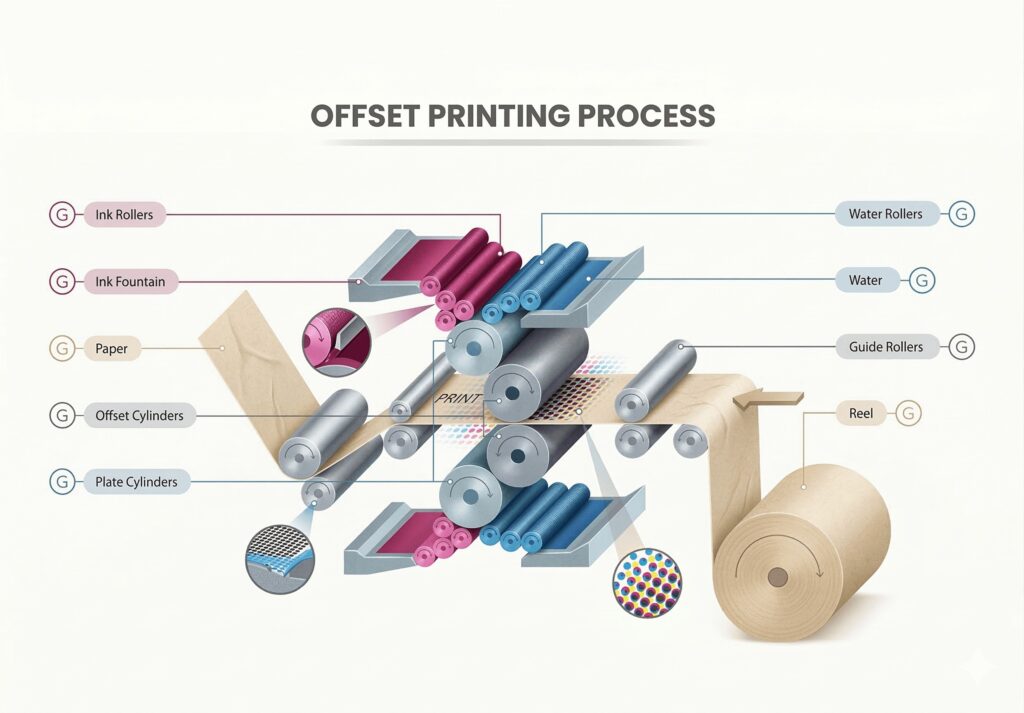
In offset lithography, the image moves from plate to blanket before reaching the printing sheet.
What the buyer is paying for
Offset has front-loaded preparation. Files are imposed, plates are produced, the press is set up and sheets are brought to the approved color condition before saleable production continues. Once that setup is absorbed, the press can produce a consistent run efficiently.
The commercial calculation is therefore not simply “offset is for more than 500 copies.” The crossover depends on:
- trim size and how pages impose on the parent sheet;
- page count and number of signatures;
- one-color, four-color or spot-color requirements;
- paper cost and makeready waste;
- whether several titles can share materials or press planning;
- coating, folding, binding and finishing operations;
- the available offset and digital equipment.
For custom hardcover book printing, offset is often a strong route when the project needs controlled full-color reproduction, spot inks, a broad paper range or enough copies to distribute press setup across the run. Image-led art book printing adds another requirement: the proof, paper and press condition must be defined together, because the same image does not look identical on coated, uncoated and tinted stocks.
Where offset is strongest
- Multi-signature books and catalogs
- Image-heavy work with controlled CMYK reproduction
- Pantone or other specified spot-color printing
- Coated and uncoated papers selected for commercial presses
- Medium and longer repeat runs with stable artwork
- Projects that continue into folding, sewing, binding or carton converting
Where buyers get caught
Offset becomes less attractive when files keep changing after plates are made, when every copy needs different content or when the order is too small to absorb setup and waste. It also does not guarantee accurate color by itself. The printer still needs an agreed output condition, calibrated workflow, appropriate paper and a physical reference when color is critical.
Heidelberg describes modern sheet-fed offset as part of an integrated prepress, press and postpress chain. That is the useful buyer perspective: the press is one operation inside a larger manufacturing route, not the complete product. See the manufacturer’s offset printing overview.
2. Digital Printing: A Family of Plateless Production Methods
“Digital printing” does not identify one machine or one image-forming technology. Commercial digital production includes electrophotographic systems using liquid ink or dry toner, as well as production inkjet systems. Their sheet sizes, color gamuts, paper requirements, surface feel and finishing compatibility are not identical.
What they share is the ability to image from digital data without producing a conventional plate for every color and version.
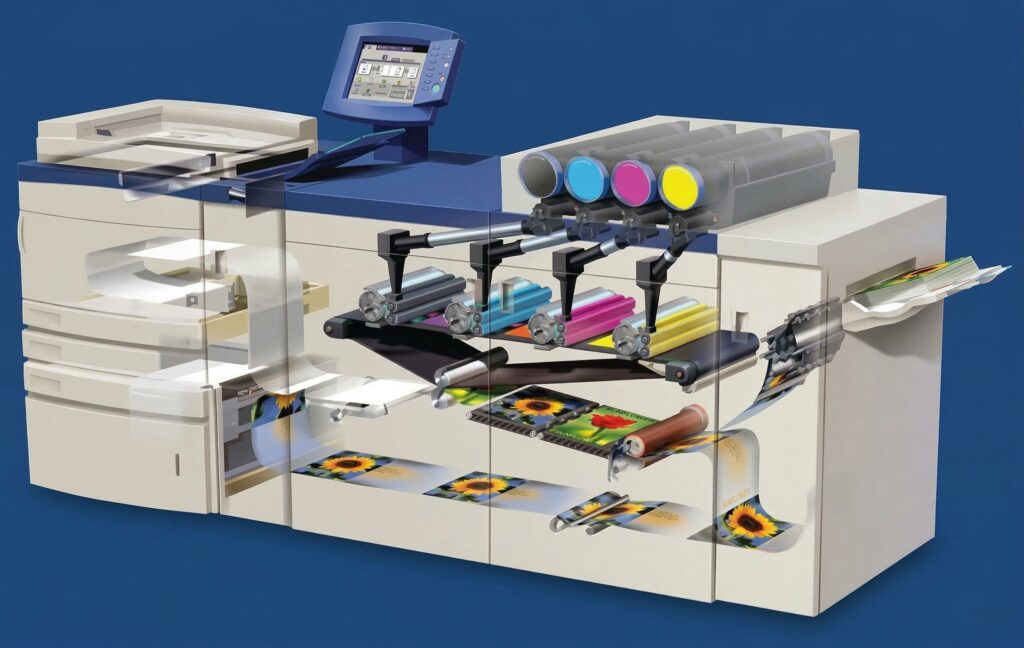
Production digital printing reduces conventional plate setup and can change text, images or codes between impressions.
Why digital changes the economic model
Digital removes some analog setup steps, making short runs, prototypes and versioned work easier to schedule. It can also support variable data, so names, serial numbers, images, QR codes or language versions change within the same production stream.
That flexibility is useful for:
- short-run paperback book printing;
- market-test editions and advance copies;
- manuals with frequent revisions;
- regional catalogs;
- personalized direct mail;
- labels with many low-volume SKUs;
- numbered or coded components.
HP’s description of its Indigo liquid electrophotographic process shows why “digital” should not be confused with an office printer. Its system forms an image electronically, transfers ElectroInk to a heated blanket and then transfers the image to the substrate. The HP Indigo technology overview also explains its extended-color and media capabilities.
Digital is not automatically the cheaper choice
A digital run may have a lower setup burden but a higher incremental image cost. Offset may start with greater setup and become more economical as quantity rises. The actual crossover moves when page count, format, paper, color coverage, binding and spoilage change.
Do not select a process from quantity alone. Ask suppliers to quote digital and offset against the same:
- finished size and page count;
- paper brand or agreed equivalent;
- color and spot-color requirement;
- binding and lamination;
- proofing scope;
- packed quantity and delivery basis.
The lower line-item print price can be misleading if one method requires a paper substitution, cannot reproduce a critical spot color, produces a different book thickness or restricts the selected finish.
3. Flexographic Printing: Built Around a Flexible Relief Plate and Anilox Control
Flexography uses a flexible raised-image plate. An engraved anilox roll meters ink to the plate, and the plate transfers the image to a moving substrate. It is commonly configured as roll-to-roll or inline production and is central to labels, flexible packaging, corrugated materials and other packaging applications.
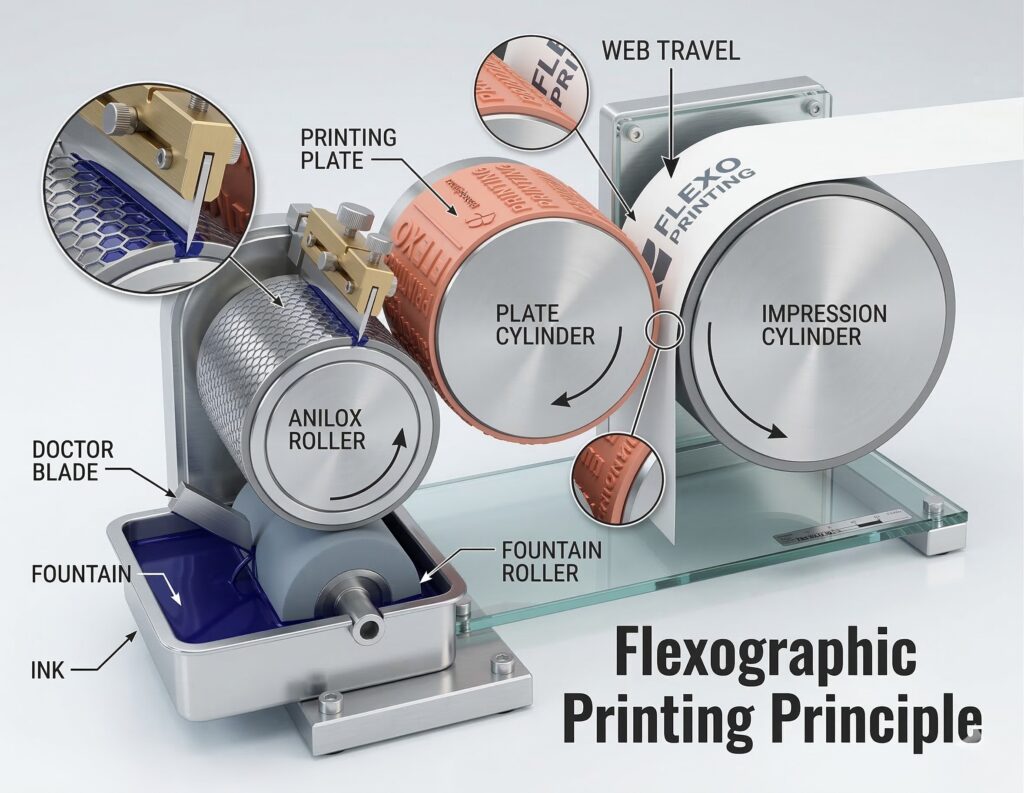
Flexography uses an anilox roll to meter ink onto a raised flexible plate before transfer to the substrate.
Why flexo suits packaging production
Packaging is not only a printed sheet. A label may need adhesive, release liner, white ink, varnish, lamination and die cutting in roll form. A flexible pouch may require reverse printing, lamination and sealing performance. A corrugated box has a visibly textured structure that changes how fine detail reproduces.
Flexographic lines can combine several operations around a repeatable web workflow. Modern flexo should not be dismissed as suitable only for simple graphics. Results depend on plate imaging, anilox selection, ink, mounting, substrate and process control. ISO 12647-6 applies to flexographic printing of labels, boxes, flexible packages and publication materials, including process and spot-color considerations. See the current ISO 12647-6 scope.
For a buyer comparing custom sticker and label printing, the practical choice is often digital versus flexo, or a hybrid route. Digital can reduce plate exposure across many short SKUs. Flexo can become stronger for repeat volumes, stable designs and inline converting. The correct crossover depends on total linear meters, number of versions, material, colors, embellishment and repeat frequency.
Corrugated printing needs a separate decision
Direct flexographic printing on corrugated board is efficient for transport cartons and brand graphics that suit the surface. It is not the same result as printing detailed artwork on coated paper and laminating that sheet to corrugated board.
For custom paper box printing, first identify the structure:
- folding carton printed on paperboard;
- rigid box wrapped with printed paper;
- direct-printed corrugated box;
- litho-laminated corrugated box;
- label applied to a stock carton.
Those are different production routes even when the finished dimensions look similar.
4. Screen Printing: High Ink Deposit and Unusual Substrates
Screen printing uses a stencil carried by mesh. A squeegee moves ink across the screen and forces it through the open image areas onto the substrate. Each color generally requires its own screen and printing pass.
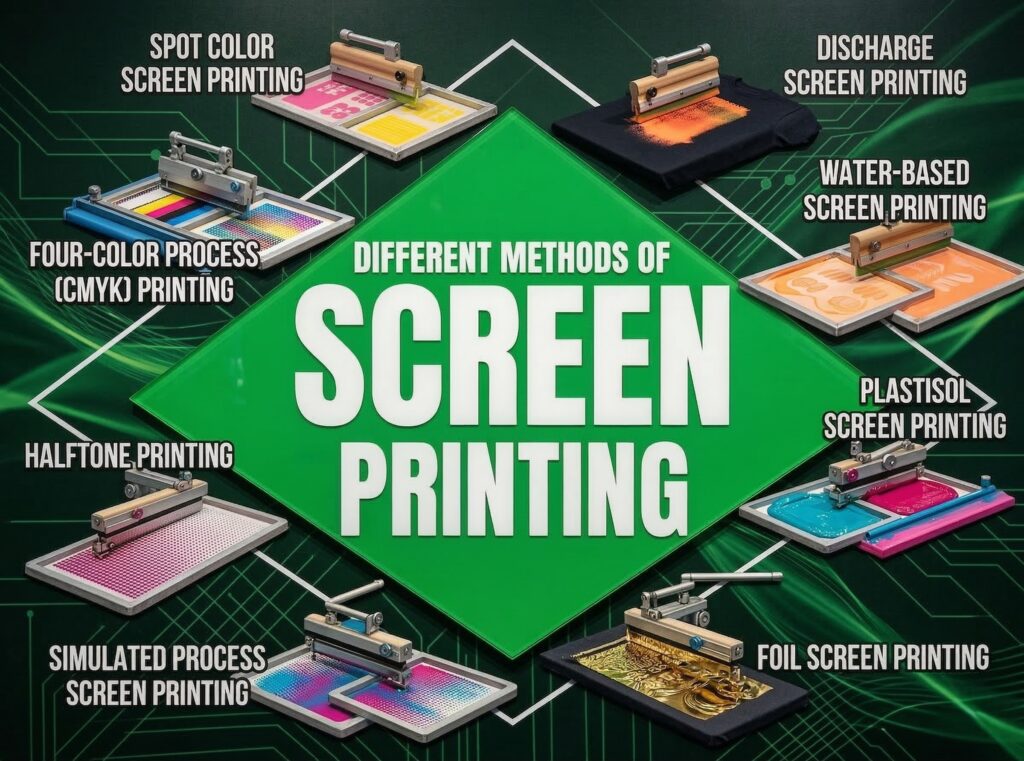
The screen, stencil, ink, squeegee and substrate must be matched as one controlled system.
The process can lay down a comparatively strong ink film and work with surfaces that are difficult to feed through conventional paper presses. This makes it useful for spot graphics and functional or decorative applications on:
- fabric and canvas bags;
- signs and display panels;
- selected plastics, glass and metal;
- dark substrates that require an opaque ink layer;
- specialty coatings and tactile effects;
- limited packaging panels or components.
FESPA’s technical explanation identifies the same core elements: a tensioned mesh and stencil, a squeegee, a suitable ink, the substrate and a stable machine base. Its screen-printing process overview also emphasizes the ink-to-substrate relationship.
When screen printing is the wrong default
Screen printing is not normally the efficient route for a full photographic book interior or a catalog containing hundreds of changing images. Every color separation and screen introduces setup, while fine process work demands tighter control than a bold one- or two-color graphic.
Use it when its distinctive ink deposit, opacity, substrate access or specialty chemistry solves a requirement. Do not choose it merely because the artwork has few colors.
5. Gravure Printing: Engraved Cylinders for Stable, Long-Run Production
Gravure is an intaglio process. The image is engraved as cells below the surface of a cylinder. The cylinder receives ink, a doctor blade removes ink from the non-image surface, and ink remaining in the cells transfers to the substrate under pressure.
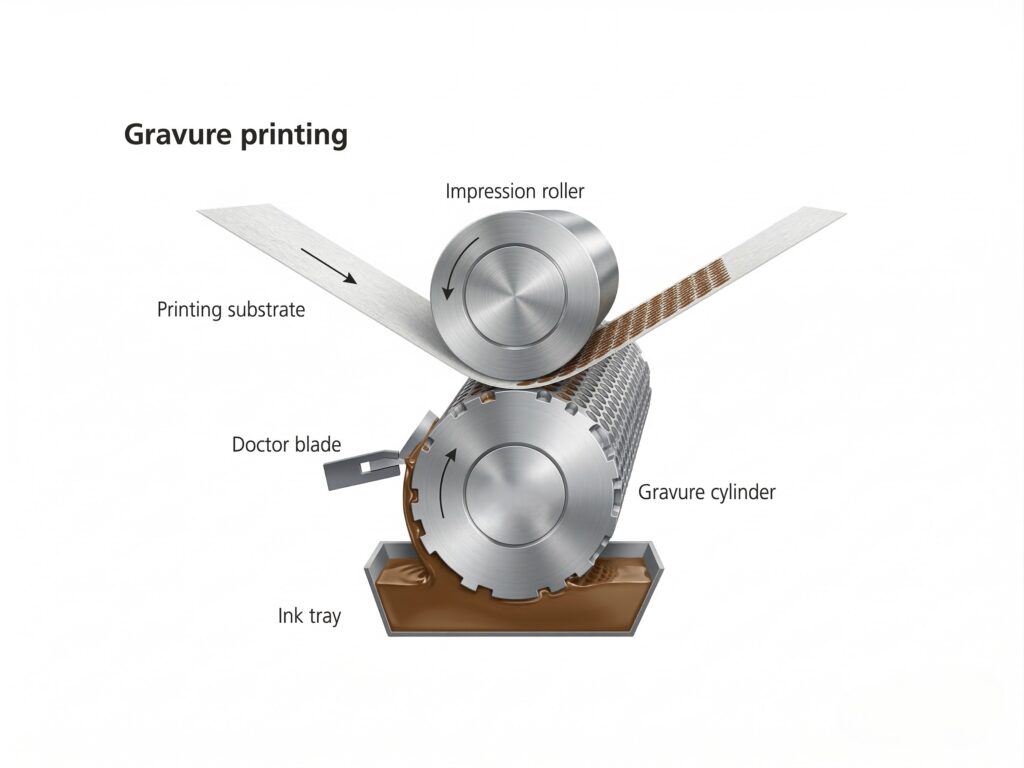
Gravure carries ink in engraved cylinder cells, supporting controlled repeat production when the run can justify the cylinders.
Gravure is associated with long, stable runs because engraved cylinders require substantial preparation but can be durable production assets. Applications include publication gravure, flexible packaging, decorative materials and other continuous web products.
It is inaccurate to call gravure the universal “highest quality” process. Quality must be judged against the product. A premium art book may be better served by sheet-fed offset and a contract proof. A short set of labels may be more rational digitally. Gravure becomes compelling when its tonal behavior, speed, repeat stability and substrate system align with a sufficiently stable volume.
ISO 12647-4 covers process control for four-color publication gravure, including magazines, catalogs and commercial materials. The standard was reviewed and confirmed in 2025; its current ISO listing describes the relevant process stages from color separation and cylinder preparation to proofing and production printing.
For a buyer, the core gravure questions are:
- Is the forecast large and stable enough to justify cylinders?
- How many SKUs and artwork revisions are expected?
- Who owns, stores and maintains the cylinders?
- What substrate and lamination structure will be used?
- How will color be approved and controlled on repeat orders?
- Would flexo or digital reduce version and obsolescence risk?
Printing Process and Finishing Process Are Not the Same Decision
Foil stamping, embossing, debossing, die cutting, lamination and many spot-UV applications occur after or alongside the main image-printing stage. They should not be used as synonyms for offset, digital, flexo, screen or gravure.
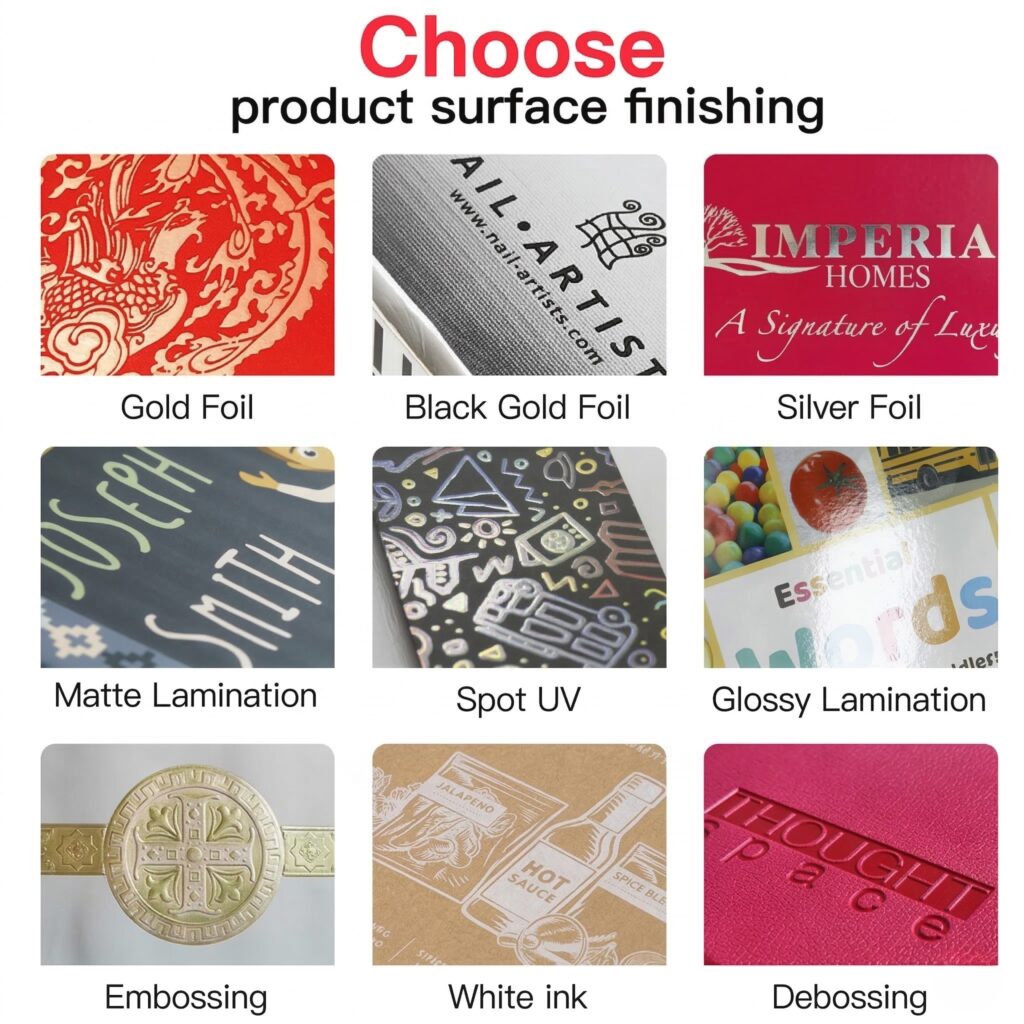
The image-printing method and the finishing route must be specified separately.
A hardcover cover, for example, may combine:
- Offset-printed CMYK artwork on coated paper
- Matte or anti-scratch lamination
- Hot foil stamping
- Embossing or debossing
- Wrapping over greyboard
- Case-making and binding
The foil did not make the job “foil printed” in place of offset. It added a separate tooling and registration stage to an offset-printed component. Print buyers planning premium covers can compare the production roles in PrintPack360’s hardcover book finishing guide and its deeper guide to foil stamping on book cloth.
The same distinction matters in packaging. A box may be offset printed, laminated, foil stamped, die cut, folded and glued. A rigid box may use an offset-printed sheet wrapped over board. A label may be digitally printed, varnished and die cut on a converting line.
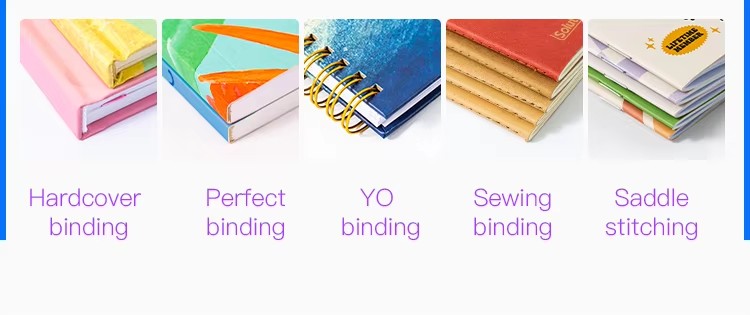
A finished print product is the result of presswork, converting, assembly, quality control and packing.
A Better Six-Question Selection Method
Instead of asking a printer, “Which machine is best?” provide the information that changes the decision.
1. What is the finished product?
A book, roll label, folding carton and wrapped rigid box have different production sequences. Name the structure before the process.
2. What must be printed on?
Specify paper, paperboard, corrugated liner, self-adhesive film, flexible film, cloth or another substrate. Include coating, color, texture and required certifications. A process that images well on white coated paper may need white ink or a primer on clear film.
3. How many units and how many versions?
Ten thousand identical labels are not economically equivalent to ten SKUs of one thousand labels. Version count can move a job toward digital even when the aggregate quantity looks substantial.
4. What must the color do?
State whether the goal is pleasing CMYK reproduction, a contract proof match, a named spot color, metallic ink, opaque white or repeat-order brand consistency. A screen value copied from a Pantone library does not itself prove that a physical ink or process build will match.
5. What happens after printing?
Folding, binding, lamination, foil, embossing, die cutting, gluing, label application and filling can eliminate an otherwise attractive print route. The ink and coating must tolerate later heat, pressure, creasing, adhesive and product exposure.
6. How will the job repeat?
Record paper or film code, color target, proof, process condition, tooling version and approved sample. Repeatability depends on keeping production references, not merely ordering from the same supplier.
Product-by-Product Decision Table
| Buyer project | Likely process path | Main commercial reason | Approval object |
|---|---|---|---|
| 6 x 9 inch black-and-white novel | Digital or offset book production | Compare total cost at the required page count and quantity | Bound proof using representative paper |
| Full-color photography book | Sheet-fed offset or suitable production digital | Image reproduction, paper range and binding compatibility | Contract color proof plus finished bound sample |
| Annual product catalog | Offset for stable volume; digital for shorter or regional versions | Balance setup against versioning and inventory | Printed proof and controlled production sample |
| Premium folding carton | Offset on paperboard, sometimes digital for short runs | Fine graphics, coatings and downstream die cutting | Printed and converted structural sample |
| Shipping carton with one- or two-color branding | Direct flexo on corrugated | Efficient direct print suited to transport packaging | Drawdown or press sample on intended liner |
| Premium litho-laminated corrugated box | Offset-printed sheet mounted to corrugated | Higher-detail retail graphics on a structural board | Mounted sample, not a flat print alone |
| Short-run labels across many SKUs | Digital label printing | Reduced plate exposure and easier version changes | Finished roll, die cut and wound for application |
| Stable repeat label program | Flexo, digital or hybrid | Compare tooling, running efficiency and embellishment | Press proof plus application test |
| Cloth bag with bold spot-color logo | Screen printing | Opaque ink deposit and substrate suitability | Cured production sample with rub or wash test |
| Very long stable flexible-packaging program | Flexo or gravure | Repeat web production and established artwork | Converted, laminated and filled-package testing |
For image-led commercial work, PrintPack360’s catalog printing service is a useful route for discussing format, paper, binding and quantity together. The printing method should be selected after those variables are visible, not used as a substitute for them.
Hybrid Production Is Normal
Many projects do not stay inside one process family.
A publisher may use digital printing for an advance proof and offset for the bulk run. A label converter may combine digital imaging with flexographic white, varnish or cold foil. A corrugated retail box may use offset lithography for the printed liner and a separate corrugated laminating process for structure. A hardcover may combine offset-printed pages, screen-printed cloth, foil stamping and hand assembly.
This does not mean the specification can remain vague. Hybrid work needs more explicit control because components made through different routes must align in color, dimensions and sequence.
PrintPack360’s sample strategy separates a digital content proof, material swatch, structural dummy and project-specific finished sample by the decision each can approve. A digitally printed sample should not silently become the color standard for an offset bulk run unless the supplier has explained how that match will be controlled.
File Preparation: Ask for the Output Condition, Not a Generic Rule
“Always send CMYK” and “always keep RGB” are both too broad when detached from a supplier’s workflow.
For process-controlled offset work, the printer may request a print-ready PDF/X file with the correct output intent and CMYK conversion for the agreed paper condition. A digital workflow may accept RGB elements and perform device-specific conversion through its RIP. Packaging can add spot colors, white ink, varnish and cutting paths that must remain separate named channels.
Before final export, request written confirmation of:
- PDF standard and accepted applications;
- bleed and safe area;
- image resolution at final size;
- expected RGB or CMYK handling;
- ICC profile or output condition;
- spot-color naming and overprint behavior;
- white-ink, varnish and finishing layers;
- dieline and non-printing layer names;
- barcode or variable-data workflow;
- proof type and what it is intended to approve.
ISO/TC 130’s guidance for using print production standards recommends identifying the printing condition and using process-appropriate data and proofs. That is more reliable than exporting one universal file and expecting every device to interpret it identically.
What to Include in a Comparable Printing Quote
Send each supplier the same scope:
- finished product and end use;
- flat and finished dimensions;
- quantity plus quantity breaks;
- number of artwork versions or SKUs;
- page count for books and catalogs;
- substrate, weight, thickness, color and coating;
- CMYK, black-only and spot-color requirements;
- white ink, varnish and special layers;
- finishing, converting and binding;
- proof and sample requirements;
- packing, carton and pallet requirements;
- destination, deadline and delivery term;
- required testing, certifications or retailer standards.
Ask the supplier to identify the proposed process and any sample-to-production differences. If two quotes use different technologies, papers or proofing scopes, compare the finished outcome and delivered cost rather than only the unit line.
FAQ
Is digital printing always cheaper than offset printing?
No. Digital often reduces conventional setup costs and can be efficient for short or versioned work. Offset can become more economical when a stable run distributes plate and makeready costs across more units. Format, page count, paper, coverage, finishing and equipment determine the real crossover.
Can the same artwork file be used for every printing process?
Not without process review. The design may be reusable, but separations, profiles, trapping, white ink, varnish, minimum detail, dielines and overprint settings can change. Request the printer’s file specification before final export.
Are foil stamping and spot UV printing processes?
They are normally finishing or embellishment processes rather than substitutes for the main image-printing method. A component may be offset or digitally printed first, then laminated, foil stamped, embossed or spot UV coated.
Can one project combine several printing methods?
Yes. Hybrid production is common in books, labels and packaging. The supplier should document which component uses each method, how colors and dimensions will align, and which proof approves the assembled result.
Why do identical CMYK values look different on different papers or presses?
CMYK numbers describe input values, not one guaranteed physical color. Paper color and absorption, ink or toner, the press condition, ICC conversion, calibration and coating all affect the result. Approve critical color against the intended substrate and process, preferably with a physical reference. Related public discussion: Pantone versus CMYK for print production.
Should a print file be RGB or CMYK?
Use the format and profile requested for the confirmed production workflow. Many offset workflows expect process-ready PDF/X data for a named output condition, while some digital systems prefer to perform device-specific conversion from well-tagged RGB elements. Do not guess from the word “digital” alone. Related public discussion: Designers discussing RGB and CMYK handoff.
Is offset printing being replaced by digital printing?
Digital has taken work where short runs, fast versioning and variable data create more value. Offset remains commercially relevant for many books, catalogs, folding cartons and stable runs. Many manufacturers use both and route each job according to its economics and quality requirements. Related public discussion: Commercial printers discussing the future of offset.
Should a multi-SKU label order use digital or flexographic printing?
Digital is often attractive when each SKU has a short run or frequent artwork changes. Flexo can be stronger for stable repeat volume and inline converting. Compare total linear meters, number of versions, colors, substrate, white ink, varnish, die cutting and repeat frequency before choosing. Related public discussion: A label producer comparing flexo and digital investment.
Choose the Route From the Product Backward
The most useful printing-process decision is not a technology preference. It is a documented answer to five connected questions:
- What must the finished product do?
- Which substrate and construction support that use?
- Which process can reproduce the artwork on that substrate?
- Which proof can approve the real production risk?
- At what quantity and version mix does the complete route make commercial sense?
PrintPack360 works across books, marketing materials, labels and paper packaging, coordinating prepress, printing, finishing, inspection and export packing. Send the product type, dimensions, quantity, versions, materials, finishes and delivery country through the PrintPack360 solutions page. The team can then compare a realistic production route instead of forcing the project into a process selected too early.