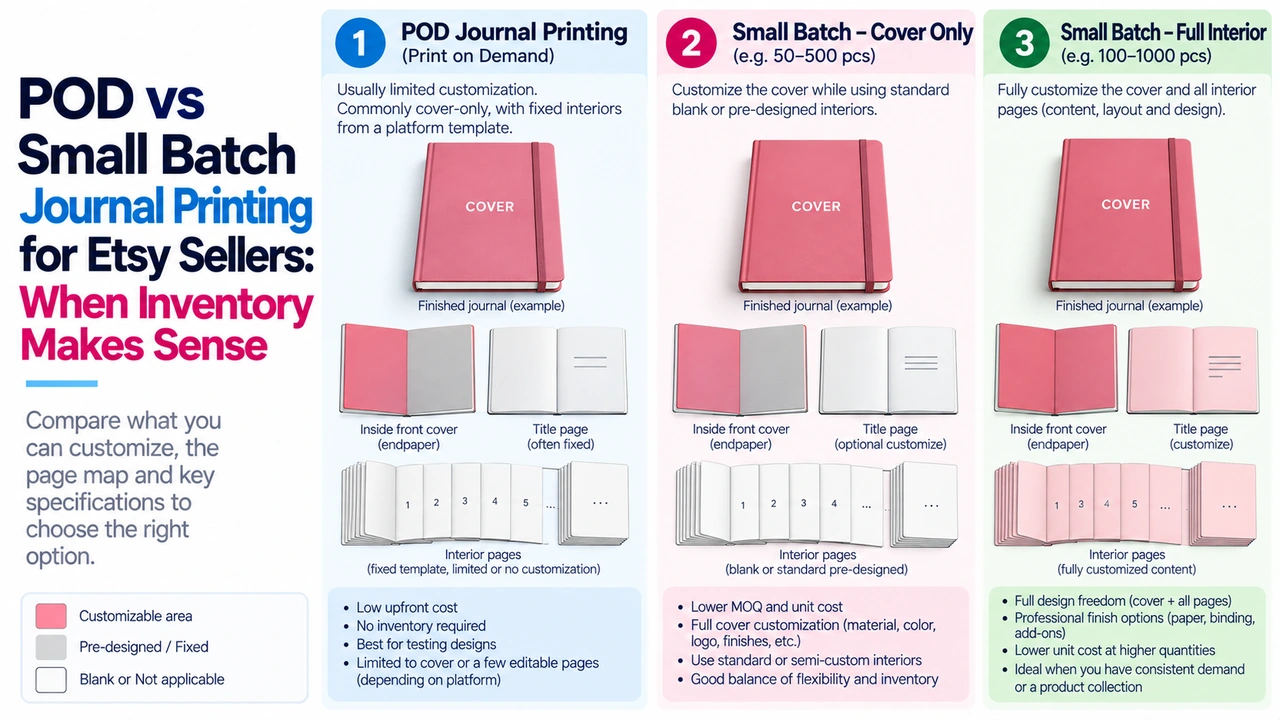
A US-based Etsy stationery seller described a familiar constraint in a public discussion about POD journals: the shop wanted to add notebooks but could not afford a large order or much inventory. The seller also wanted acceptable quality and enough margin to justify the product. That is a documented purchasing problem, not evidence that either production model delivered a successful outcome.
For Etsy sellers, POD vs small batch journal printing is a decision about cash, product control and who handles each order. POD purchases production as demand arrives. A batch purchases a quantity ahead of sales and transfers inventory, local dispatch and sometimes personalization work to the seller.
Switch when the proposed product solves a verified limitation, the sales forecast can recover the batch commitment and the fulfillment plan is workable. Keep POD when the product is still untested or the shop requires stock-free, automatic single-order dispatch that a manufacturing quote does not include.
PrintPack360’s notebook and journal printing category is the commercial route for discussing batch specifications. This article explains whether that route fits the business; it does not assume that every Etsy seller needs factory inventory.
A small batch can be manufactured digitally or by another qualified process. The purchasing decision here concerns stock, cash recovery and dispatch responsibility; the press method must be selected for the confirmed product specification.
First identify the exact limitation, not just the platform
“I need custom inside pages” can mean a welcome page, six branded pages or an entire guided journal. Those are different products.
As checked on October 13, 2026, Printify’s Softcover Journal with Inside Prints lists 120gsm paper, 100- or 200-page versions and six customizable inner pages. Its total page count is not the customizable page count. A seller whose product depends on prompts throughout the book should verify that distinction before preparing the artwork.
Full-interior POD also exists. Prodigi’s fully customizable spiral-notebook instructions describe a 120-page interior PDF, while excluding printing on the inside covers. The correct comparison is therefore specific: does the available SKU support the intended content, paper, page count, binding and accessories?
An Etsy Guided Daily Journal listing provides a public product example: a linen hardback with structured interior spreads. The differentiation is visible inside the notebook, not only in a name on its cover. The listing does not reveal manufacturing costs or prove profitability; it demonstrates a product requirement that a cover-only option would not satisfy.
Before requesting a batch quote, write down the actual limitation: all pages must carry original prompts; a particular paper must pass the intended pen test; the journal needs a sewn block; or a ribbon, pocket and retail sleeve must form one approved product. If the current POD SKU already meets the requirement, inventory must justify itself through another measured advantage.
Replace each pain point with a production decision
| Seller’s problem | Decision to make | Evidence before committing |
|---|---|---|
| The product cannot fit the provider’s interior template | Confirm finished size, page count, repeated versus unique pages and usable margins | Checked PDF, supplied template and representative printed spreads |
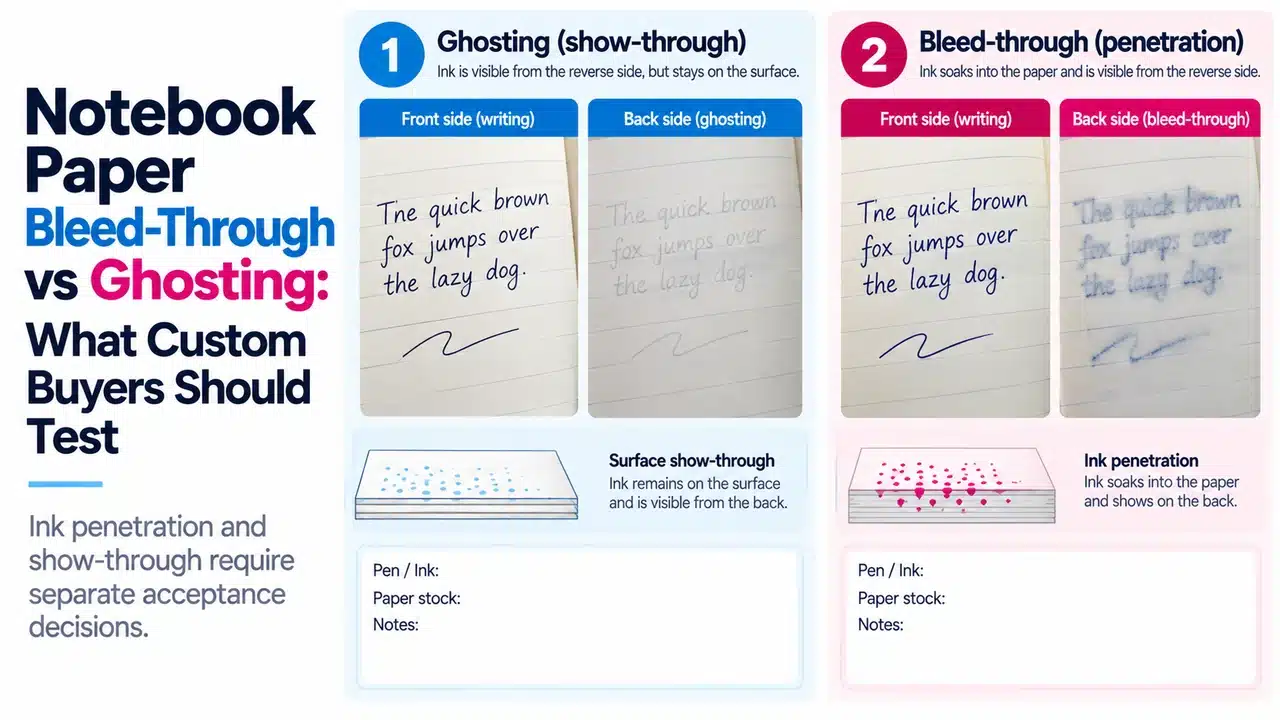
| Buyers complain about writing paper | Specify the exact grade and tested pens/inks | Labeled front/reverse writing samples, not GSM alone |
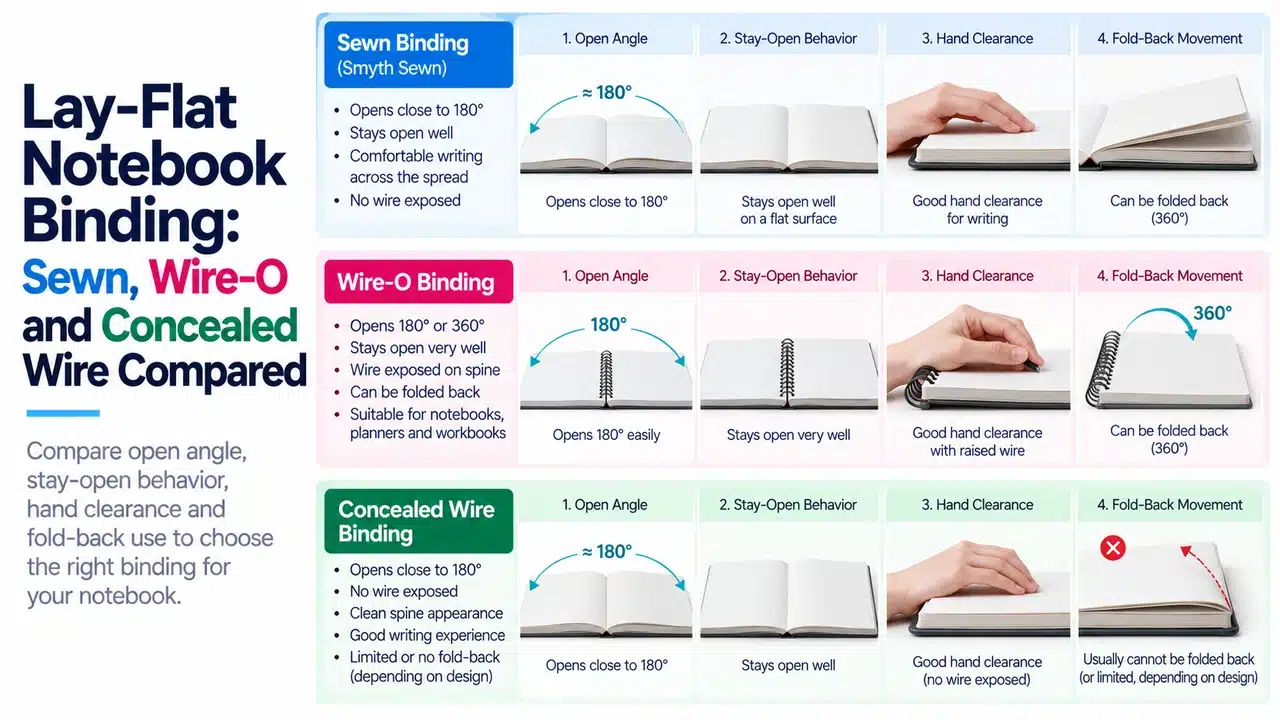
| A premium journal will not stay comfortably open | Choose and test the actual construction | Bound sample evaluated near the gutter and throughout the block |
| Several covers create too much slow inventory | Reduce launch SKUs and confirm per-design setup/minimums | Per-SKU sales records and written split-quantity quote |
| A factory quote looks cheap but profit remains unclear | Compare landed stock and per-order fulfillment at expected sell-through | Itemized batch budget and actual POD invoice/delivery costs |
| Names and photos change with every order | Identify who performs final personalization | Tested material/process pairing and order-to-file approval record |
For a premium hardcover notebook, the quote should name the writing paper, construction, interior layout and finish. It should also state what is included in sampling and delivery. A broad product name is insufficient for comparing it with a particular POD item.
Do not select heavier paper simply to signal quality. Approve writing with the intended tool on the actual printed interior and retain the reference. Likewise, confirm opening behavior in a bound sample rather than inferring it from the word “hardcover.” PrintPack360’s sample strategy separates the decisions covered by swatches, proofs and project samples.
POD vs small batch journal printing: count unsold stock
Calculate against one defined sales period and one SKU. Use actual orders or a documented conservative forecast. Shop-wide sales, review counts and the number of listings do not tell you how quickly this journal will sell.
Define three inputs:
- B: the batch commitment, including samples/setup, manufacturing, packing, inbound freight and import costs, plus storage or other fixed costs allocated to the chosen period.
- L: the incremental local cost for each sold batch unit, including any personalization, handling, packaging, labor and delivery to the buyer.
- P: the comparable POD cost per fulfilled order, including production, shipping and any relevant allocated provider charges.
For S sold copies, the comparison is:
Batch cash cost = B + (L x S)
POD cash cost = P x S
When P exceeds L, the cash-cost crossover is B / (P – L) sold copies, rounded up to the next whole copy. If that number exceeds the usable batch quantity or cannot be reached within the chosen period, the batch does not win this cash-recovery comparison.
This is a deliberately conservative cash model. It gives no credit to the remaining stock at the end of the period. Unsold notebooks may retain value and sell later; treating that possibility as certain cash recovery would conceal the risk the seller is trying to evaluate.
Illustrative calculation: a 100-copy batch
The following inputs are hypothetical. They are not a PrintPack360 quote, market-average prices or a customer result. Assume a 90-day decision period, 100 usable copies, an $800 batch commitment, $5 local cost per sold copy and $18 POD cost per fulfilled order. Assume the same customer price, marketplace/ad expenses and service outcome, so those common items are excluded from this comparison. Add any real differences before making a decision.
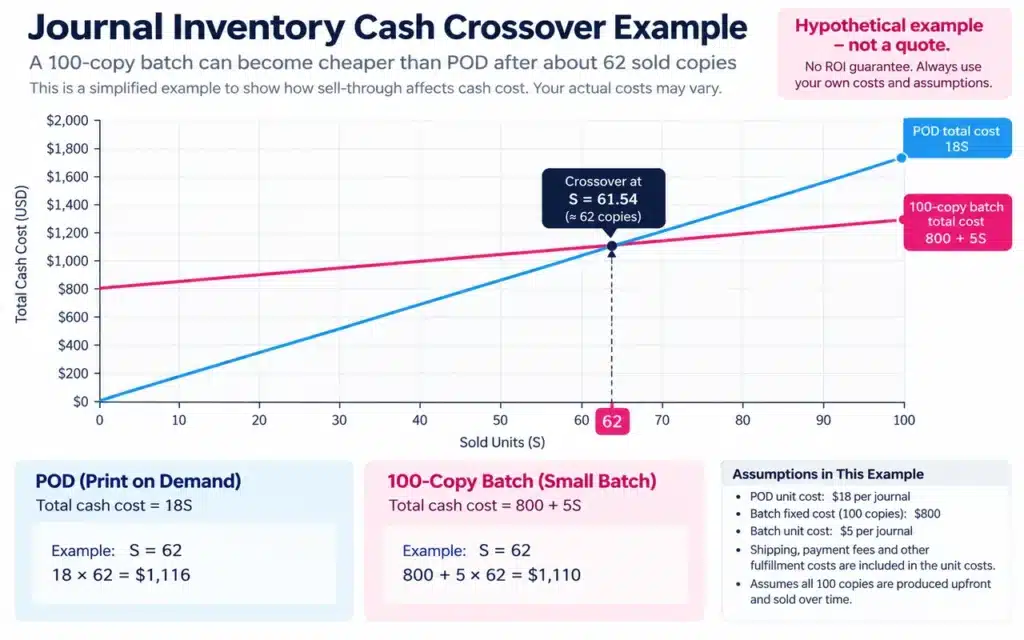
| Copies sold in 90 days | Copies remaining | Batch cash cost | Batch cash cost per sold copy | POD cash cost | Cash advantage of batch |
|---|---|---|---|---|---|
| 40 | 60 | $1,000 | $25.00 | $720 | -$280 |
| 65 | 35 | $1,125 | $17.31 | $1,170 | $45 |
| 100 | 0 | $1,300 | $13.00 | $1,800 | $500 |
The crossover is $800 / ($18 – $5) = 61.54, or 62 sold copies. Selling 40 makes the nominal $8 batch commitment per purchased copy a misleading shortcut: the period’s cash cost per sold copy is $25 after local fulfillment. Even at 65 sales, the $45 advantage leaves little room for omitted costs or forecast error.
Run a lower-sales case, not only a sellout. Add unsaleable units, storage, financing, revised shipping, personalization failures and returns where they are not already included. If the batch product has a different selling price or different demand, compare contribution and cash recovery under those separate forecasts rather than pretending the two offers are identical.
Marketplace fees belong in the full business calculation. Etsy currently lists a 6.5% transaction fee, a $0.20 listing fee and country-dependent payment-processing fees, with advertising and other services potentially adding charges (Etsy Fee Basics). The amount charged to customers for delivery is not automatically exempt from transaction fees. Do not use the forum participant’s rough fee estimate instead of the current rules and the shop’s payment account.
Personalized names change the fulfillment model
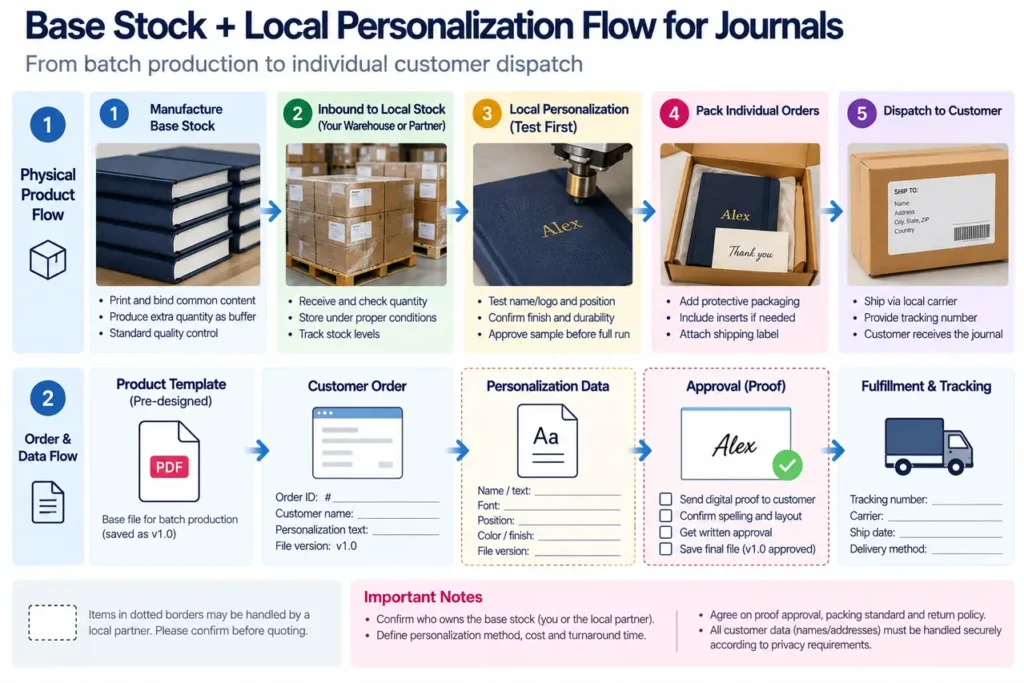
An individual name printed into every cover is not a shared inventory SKU. Either the manufacturing partner must support variable, order-level production, or the seller needs a separately qualified local personalization step.
One public photo-journal listing promises a proof within 24–48 hours and states that production waits for approval. The operational issue is concrete: receiving a photograph, matching it to an order and getting approval can delay dispatch even when manufacturing itself is fast. This is that seller’s stated workflow, not a recommended deadline for every shop.
A proposed hybrid route is to batch the common interior and approved base cover, then complete names locally. Before relying on it, test the seller’s device, the cover material, placement, adhesion or wear and final packing. Record the order ID, exact text/photo, proof version, approval and shipping address. Confirm who handles a personalization error.
PrintPack360’s Smyth-sewn premium notebook page lists a starting MOQ of 50 pieces. That is a product-page starting point, not permission to order 50 entirely different covers or a promise of automated Etsy dispatch. Ask for the minimum and setup charges for the actual paper, finish and design split. Batch manufacture alone does not establish an Etsy integration, warehouse or one-piece fulfillment service.
Keep proven sellers in stock; test uncertain variants separately
A mixed model can be more useful than moving the entire shop at once. Retain POD for uncertain designs or supported order-level personalization. Request a batch comparison for the best evidenced common product. Assess each SKU’s demand and specification independently.
This matters for journals with several colors or dated interiors. A popular notebook theme does not guarantee equal demand for every cover, and a dated planner has a limited selling window. If several covers share an interior, ask whether production can share that component; record the actual per-cover minimums. Do not assume pooled interiors eliminate every setup cost.
Etsy’s Spring and Summer 2026 trend report recorded traveler-journal searches doubling and memory journals growing 189%. Its data runs to February 10, 2026 and compares the preceding three months with the prior-year period. That supports topic exploration, not an October inventory forecast. A launch quantity still needs the shop’s own demand evidence.
Etsy also requires relevant production-partner disclosure and accurate shipping information (production-partner guidance). A listing dispatched from the seller’s stock and a listing dispatched by a partner should reflect their actual routes. For personalized listings, its Creativity Standards require a completed customized item in the first image rather than a blank placeholder. Use an approved physical sample for the product decision and accurate imagery for the listing.
What to request in the first batch proposal
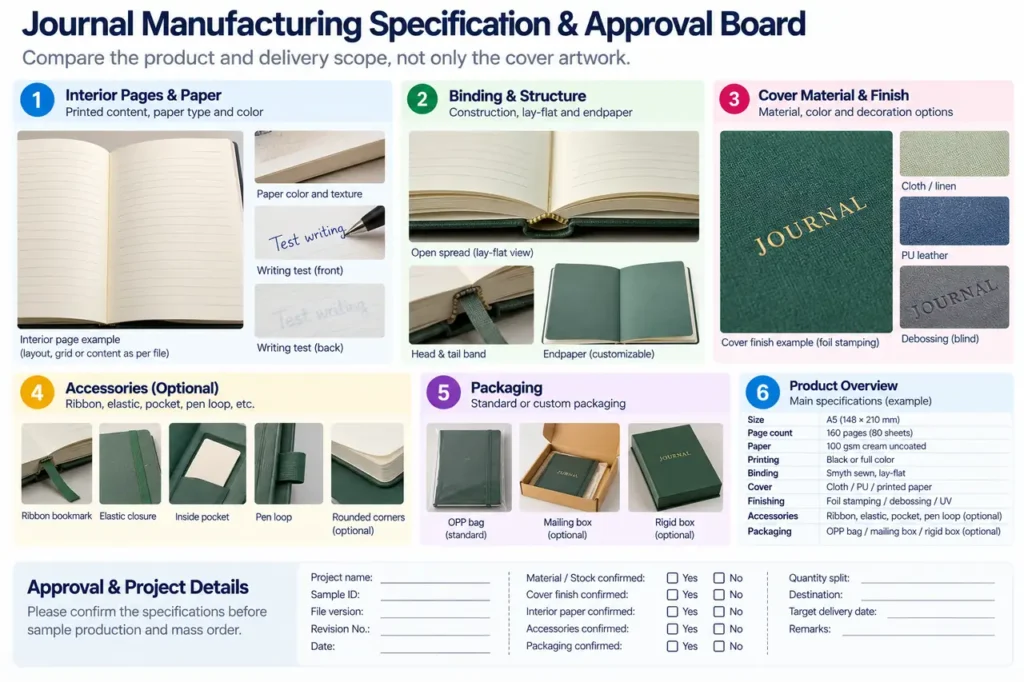
Send the manufacturer the trim size, final page count, original interior PDF, cover artwork and the exact changes the existing product needs. Include writing tools, paper expectations, opening behavior, accessories, individual packing and destination.
Attach a separate commercial note: number of covers, copies per cover, who performs personalization, expected sales period, arrival deadline and fulfillment location. Request a split quotation for sample/setup, manufacturing, packing and delivery scope. Ask which changes require a new setup, minimum or proof.
Use this release rule: approve the product, verify the downside sales case and qualify the fulfillment route before ordering the batch. A MOQ answers what can be manufactured. The cash crossover answers how many copies must sell under the stated assumptions. Neither substitutes for the other.
FAQ
Can several cover designs share one minimum order?
Only if the manufacturer confirms the split in writing. Ask for the total minimum, per-cover minimum, shared interior arrangement and separate setup charges. A published starting MOQ does not establish the minimum for every design combination.
What must be retained for the second batch?
Keep the approved file revisions, paper identity, bound sample, finish references and packing specification. Require proposed substitutions to be identified before manufacture. Otherwise, the reorder is a new product comparison even if its commercial name is unchanged.
How can I add journals if I cannot hold inventory?
Use a qualified POD route for that constraint, or arrange a separately costed storage and fulfillment service before committing to stock. A lower manufacturing price cannot compensate for a missing place to receive, store and dispatch the batch.
Related public discussion: An Etsy stationery seller comparing POD, quality and inventory limits.
Can I print my own prompts throughout a POD journal?
Yes, if the specific product supports full interior files. Verify the actual customizable page count, page format and blank areas. A SKU with six customizable pages and one requiring a complete 120-page PDF meet different requirements; do not choose from the platform name alone.
Related public discussion: An Etsy seller looking for original journal interiors.