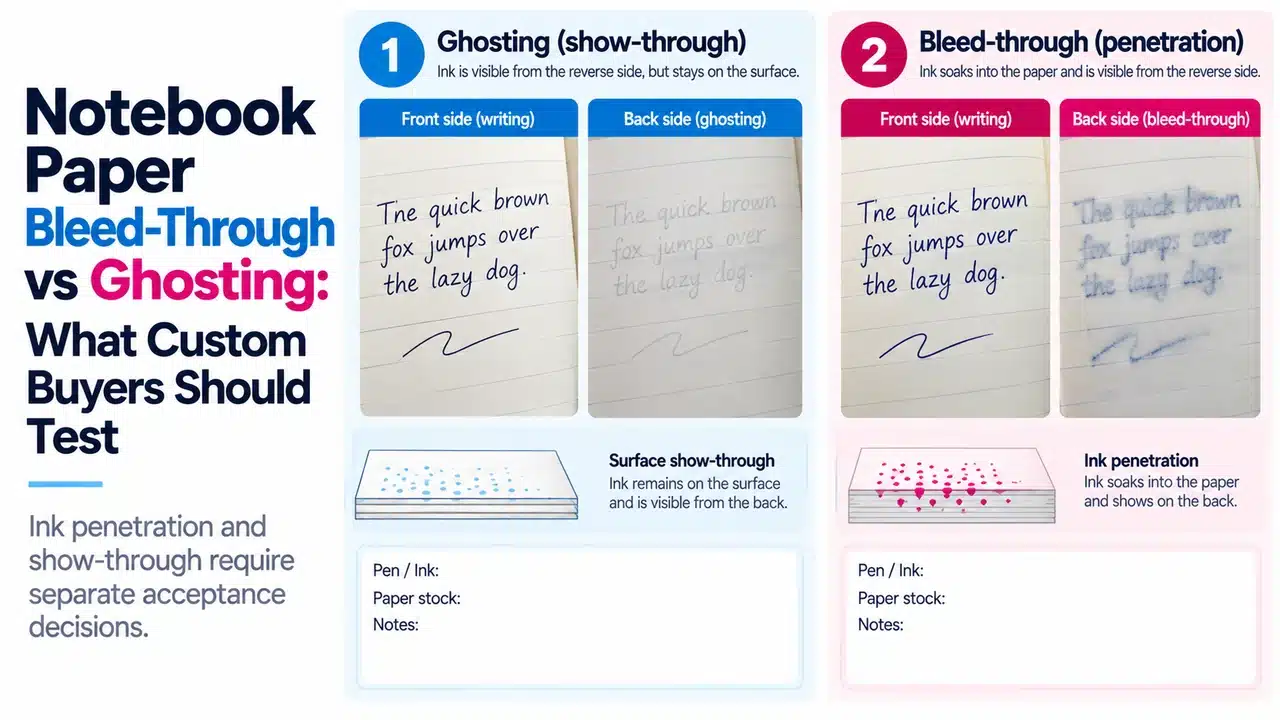
A custom journal intended for double-sided writing needs an approved reverse page as well as an approved front. Assess visibility and ink penetration separately. Photograph both sides, identify the pen and ink, and record which finding makes the reverse page unacceptable for its intended use.
Notebook paper bleed-through means ink has penetrated to the reverse side. Ghosting, also called show-through, means writing is visible through the sheet without that penetration. A notebook can resist bleed-through and still show enough ghosting to disappoint a customer who expects to write on both sides.
For buyers developing custom notebooks and journals, that distinction belongs in the product specification. “Premium paper,” “thick pages” and “fountain-pen friendly” leave important questions unanswered: which pen, which ink, how much ink and how much reverse-side visibility?
Name the failure before changing the paper
Inspect four separate behaviors. They affect different parts of the writing experience and require different acceptance decisions.
| Finding | What you observe | What the buyer must decide |
|---|---|---|
| Bleed-through | Ink penetrates the sheet and appears on its reverse | Whether the tested pen-and-ink combination is acceptable for this stock |
| Ghosting / show-through | The written shape is visible through the paper | Whether the reverse remains usable for the intended layout and audience |
| Feathering | Ink spreads sideways along fibers, giving strokes fuzzy edges | Whether line sharpness is acceptable with the intended pen |
| Smudging or transfer | Ink moves when rubbed or contacts the facing page before sufficiently dry | Whether the writing and page-turning interval suits normal use |
The Goulet Pen Company’s paper guidance describes how absorbency affects feathering and penetration, while paper thickness contributes to reverse-side visibility. Its explanation is useful here because the four observations should not be compressed into one “bleeding” score.
Judge ghosting under the agreed normal reading light, with the same backing for every candidate. Holding a page against a bright window exaggerates transmission and does not represent ordinary writing in a bound notebook. Record the condition rather than claiming that one photograph proves the paper is defective. If penetration and optical show-through are difficult to distinguish, retain the sheet for closer examination before assigning the failure.
Two public product examples show why claims need a scope
LEUCHTTURM1917 describes its 120g Edition as smooth paper with reduced show-through. That is a visibility claim tied to a particular product; it does not establish that every 120gsm writing sheet will perform the same way.
Archer and Olive makes a different distinction in its product FAQ: alcohol-based markers such as Copic or Prisma will bleed in its signature notebooks, while heavy watercolor use is directed toward a separate 200gsm watercolor notebook. A premium stationery brand can therefore define intended media and exclude others rather than promise compatibility with every writing tool.
These are manufacturer descriptions, not independent comparative test results and not PrintPack360 sample results. Their practical lesson is specific: define the writing tools and use conditions before making a paper-performance claim.
GSM belongs on the specification, but it cannot approve the sample
GSM is mass per unit area. It does not describe paper surface treatment, ink resistance or the exact appearance of writing from the reverse. ISO provides separate methods for grammage under ISO 536 and opacity under ISO 2471. Neither method is a universal certification that a notebook will work with every pen.
Ask the supplier to identify the proposed paper grade as well as its weight. Where available, request thickness and opacity data with the stated measurement method. Then test the actual writing combination. An opacity result helps characterize the sheet; it does not replace a handwriting test on the finished notebook page.
Do not approve “160gsm or equivalent” if the reason for choosing the paper is a tested writing behavior. Two grades of the same weight can still have different surfaces and absorbency. Likewise, substituting a lighter grade requires a fresh decision about writing performance, even if its dimensions and color appear similar.
The book-paper specification guide explains the broader differences between weight, thickness, bulk and opacity. For this notebook project, retain those material facts and add a pen-specific approval record. The purchase is for a writable product, not just a quantity of paper.
Test notebook paper bleed-through with the intended customer’s tools
Start with the product audience. An employee notebook supplied with a ballpoint pen needs a different test scope from a retail journal advertised for fountain pens and brush lettering. Choose the tools you intend to support, including a demanding example within that scope. Do not add an alcohol marker as a pass requirement if the product is not designed or advertised for alcohol-marker use.
Use the actual proposed interior paper and a representative printed page. Printed dots, rules, shaded boxes and other layout elements can affect where customers write and what they consider distracting. A blank mill swatch approves neither the final interior printing nor the complete writing experience of a bound notebook.
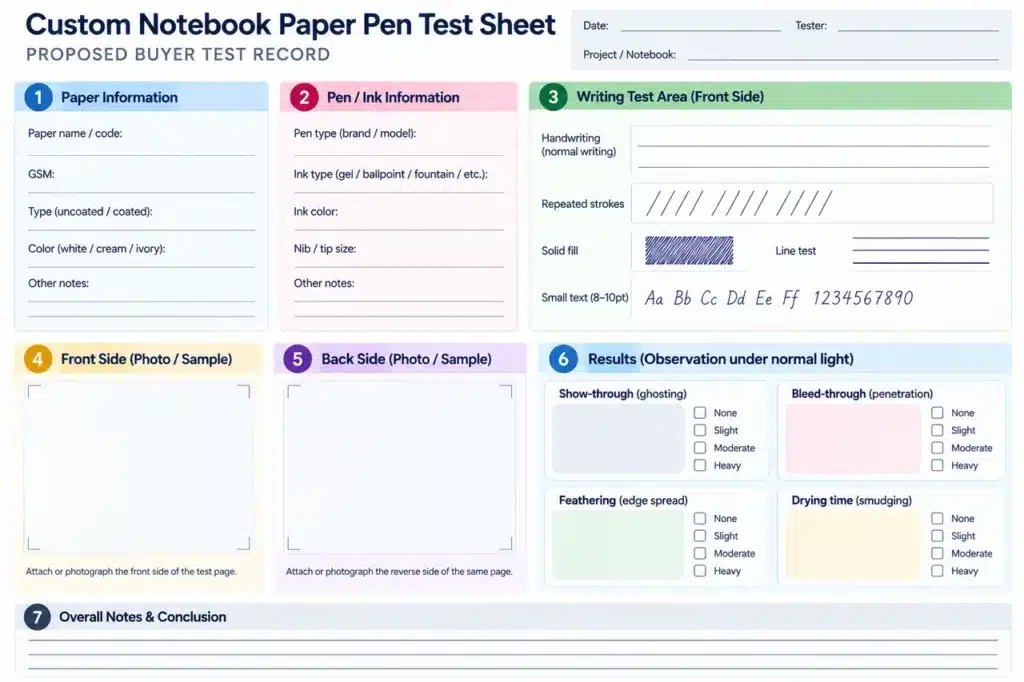
Use this proposed buyer test record for each candidate. It is an editorial procurement tool, not an ISO method or a claim that PrintPack360 has already run these tests.
| Record field | What to enter |
|---|---|
| Paper identity | Mill/grade or supplier code, GSM, shade, sample date and lot if available |
| Page identity | Blank or printed; layout revision; front and reverse orientation |
| Writing tool | Pen brand/model, nib or tip, exact ink or refill |
| Test mark | Normal text, a paused stroke and a defined repeated-stroke area |
| Time | Time of writing and the agreed inspection/smudge-check intervals |
| Viewing condition | Light, backing and inspection distance kept consistent |
| Results | Penetration, show-through, line edge and transfer recorded separately |
| Approval | Accepted tool/use range, exceptions and retained sample identifier |
Write the same sentence and marks on each candidate using consistent pressure and stroke count. Do not compare ordinary writing on one sheet with a soaked marker patch on another. Photograph the front and reverse with fixed exposure and white balance; label the paper and tool outside the writing area.
For a time-based smudge check, select intervals that reflect the intended page-turning behavior and apply them consistently. A buyer might choose 5, 15 and 30 seconds as a starting comparison, but those are proposed observation times, not required drying limits. Record what actually happens and agree the acceptance interval before production.
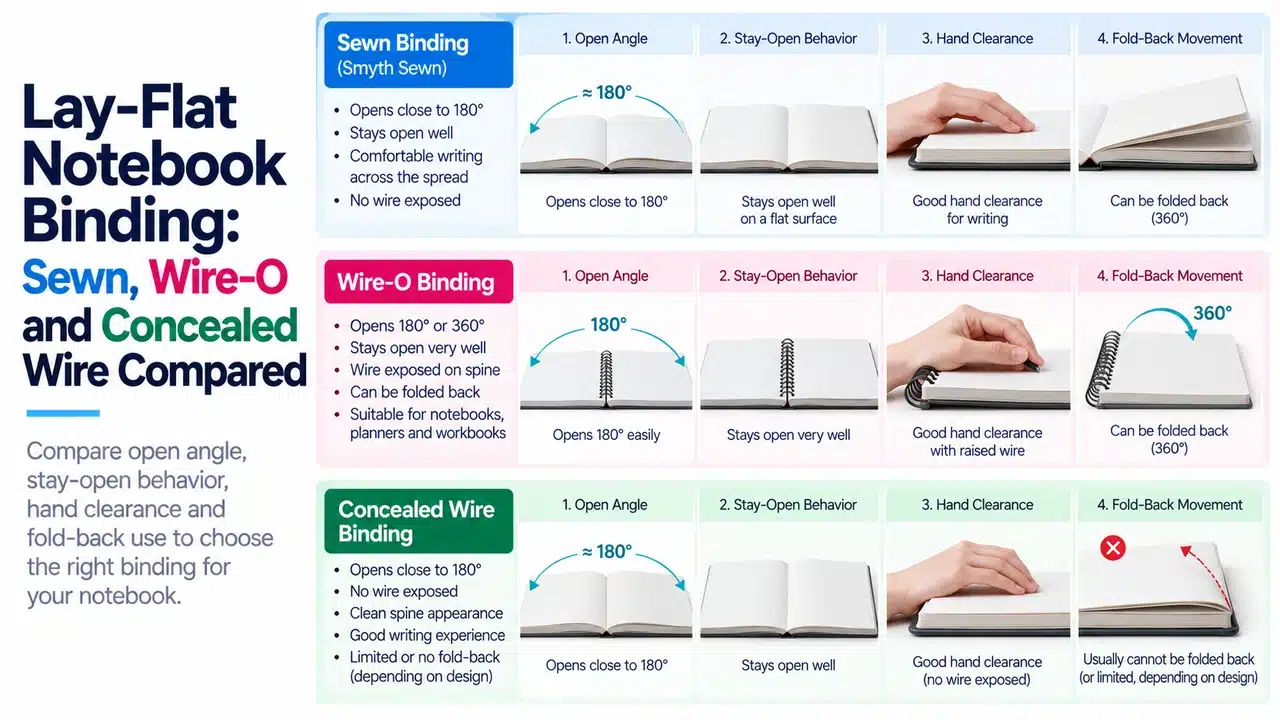
Then repeat a representative test on a bound sample. Check ordinary writing near the gutter and whether the notebook is comfortable to use on both sides. Opening behavior is a separate approval item; increasing GSM to reduce show-through can change the block’s thickness and handling, so the paper decision needs a physical product check.
PrintPack360’s premium hardcover notebook lists writing-paper options and custom interiors. Use that route to discuss the full specification, while agreeing the paper test separately. The product format itself is not evidence that every available stock meets a fountain-pen or marker claim.
Write an approval that another supplier could understand
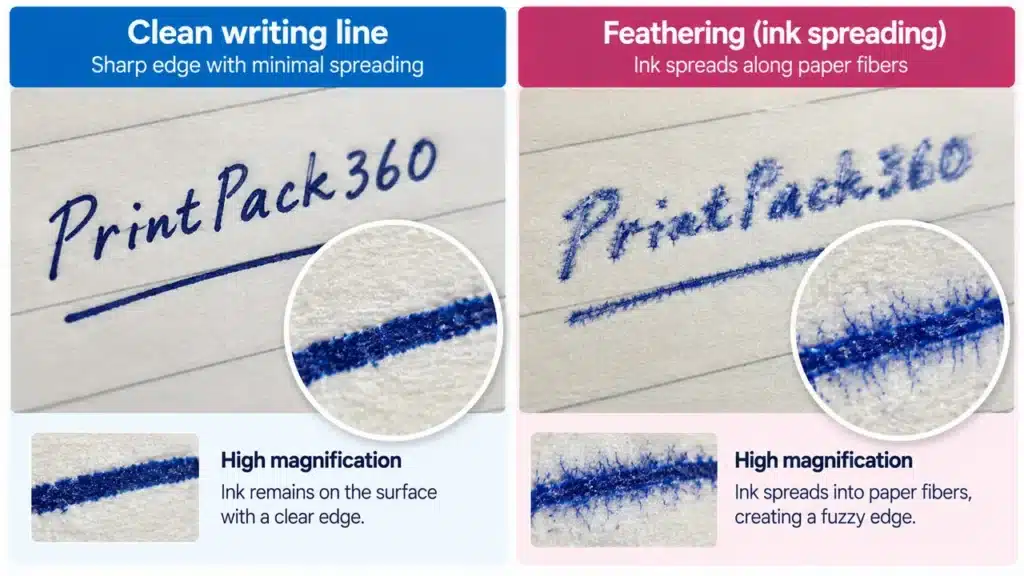
“No bleeding” is incomplete if it omits the writing tools and normal use. Record whether the requirement is no penetration, limited ghosting, sharp line edges or acceptable page-turning time. Treat each as a separate result.
For example, the following is illustrative approval wording, with fields to fill after testing:
Interior paper [grade/code, GSM, shade] is approved using [pen, nib/tip, ink/refill] for [ordinary writing/defined layering]. Acceptance is based on sample [ID/date], inspected under [light/backing]. Ink penetration, reverse-side visibility, feathering and transfer are evaluated separately against that retained sample. Any paper substitution requires confirmation and, where it changes writing performance, a new test. Unsupported media are excluded from the claim.
This prevents a sample tested with a fine ballpoint from silently approving a wetter fountain pen. It also gives a repeat-order inspector something to compare beyond the weight printed on a purchase order.
When requesting samples, send the intended tools or identify them precisely, provide the interior artwork and explain the reverse-page expectation. The sample strategy page is the appropriate next step for agreeing whether the job needs paper swatches, printed sheets or a bound sample.
Before placing the bulk order
Keep the approved paper identity, printed page revision and tested tools with the retained sample. Confirm that the production specification uses the same grade or a separately approved substitution. Ask how paper changes will be disclosed and how representative production samples will be compared.
For a retail journal, make the product description match the tested use. For a corporate notebook supplied with a pen, approve that actual pen-and-paper pairing. If acceptable ghosting remains, record it openly rather than renaming it “zero bleed-through” and expecting customers to infer the difference.
FAQ
Can we approve paper before the notebook artwork is ready?
Yes, for preliminary material selection and pen compatibility. Confirm it again on a representative printed page before approving the final interior. A paper-only test does not show the appearance of rules, shaded layouts or writing over printed areas.
What happens if the approved paper is unavailable for the repeat order?
Require the proposed replacement to be identified before production. Compare it with the retained reference using the same tools, marks and viewing conditions. Matching GSM alone is insufficient when the original approval depended on writing behavior.
Is ghosting the same as bleed-through?
No. Ghosting is visibility through the sheet; bleed-through is ink penetration. Decide whether the reverse is usable separately from whether ink passed through. An acceptable result for ordinary notes can still be unsuitable for a journal whose buyers expect visually clean reverse pages.
Can one journal paper support fountain pens, markers and watercolor?
Do not promise that combination without testing the named media and use. Water-based markers, alcohol markers and watercolor are different applications. Specify the intended tools and amount of layering or water; exclude unsupported uses or select a purpose-made paper.
Related public discussion: A request for a notebook that supports several drawing and writing media.