Put the notebook on a desk, open its first writing spread and complete a sentence near the inner margin. Leave it open while reaching for another document. Then repeat near the back.
Those three actions expose what a photograph of the center spread leaves out: whether the pages stay open, whether the binding obstructs the hand, and whether the writing area remains usable throughout the notebook. For a stationery brand buying lay flat notebook binding, these are separate requirements. Specify each one.
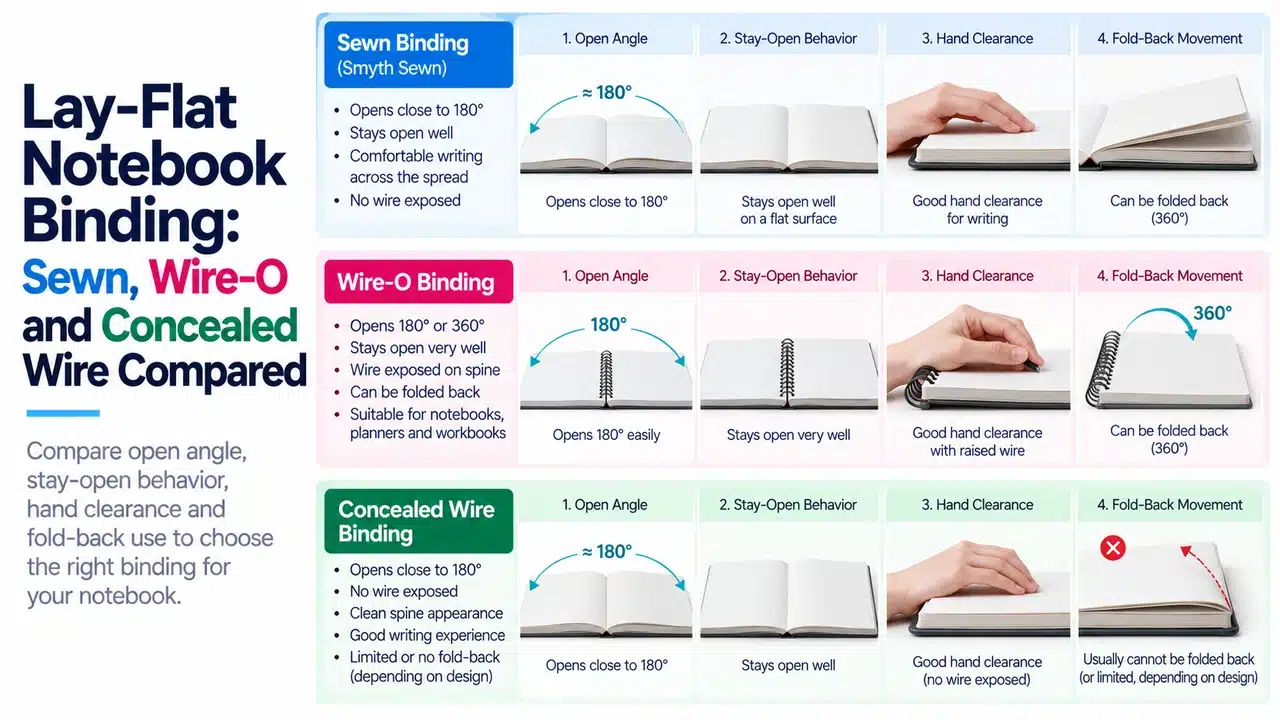
Choose a sewn construction when an unobstructed inner writing area and a book-like cover are priorities. Choose exposed Wire-O when page turning and fold-back use lead the brief. Consider concealed wire when the product needs a protected binding and a continuous-looking exterior, but approve its actual movement before promising fold-back use. The word hardcover answers none of those questions by itself.
Write the use requirement before choosing the binding
A notebook can open to approximately 180 degrees yet spring shut when released. Another can stay open while its wire obstructs the writer’s palm. A third can fold back for one-page use but provide an uncomfortable height difference near the beginning.
Use four descriptions in the purchase brief:
- Opening: the spread reaches the intended open position without forcing the spine.
- Stay-open behavior: the spread remains available without a hand or clip holding it.
- Writing access: the user can reach the specified inner writing boundary comfortably.
- Fold-back use: one cover and the used pages can rotate behind the active page, if required.
Do not use “360-degree opening” as shorthand for all four. For an everyday journal, stay-open behavior and writing access may matter more than folding the covers behind each other. For a field checklist used on a small surface, fold-back use can be the deciding requirement.
PrintPack360’s notebook and journal printing category is the commercial starting point for these specifications. State the writing task there, rather than requesting a “premium notebook” and leaving the construction undecided.
Three constructions, three different compromises
Sewn sections: keep hardware away from the writing hand
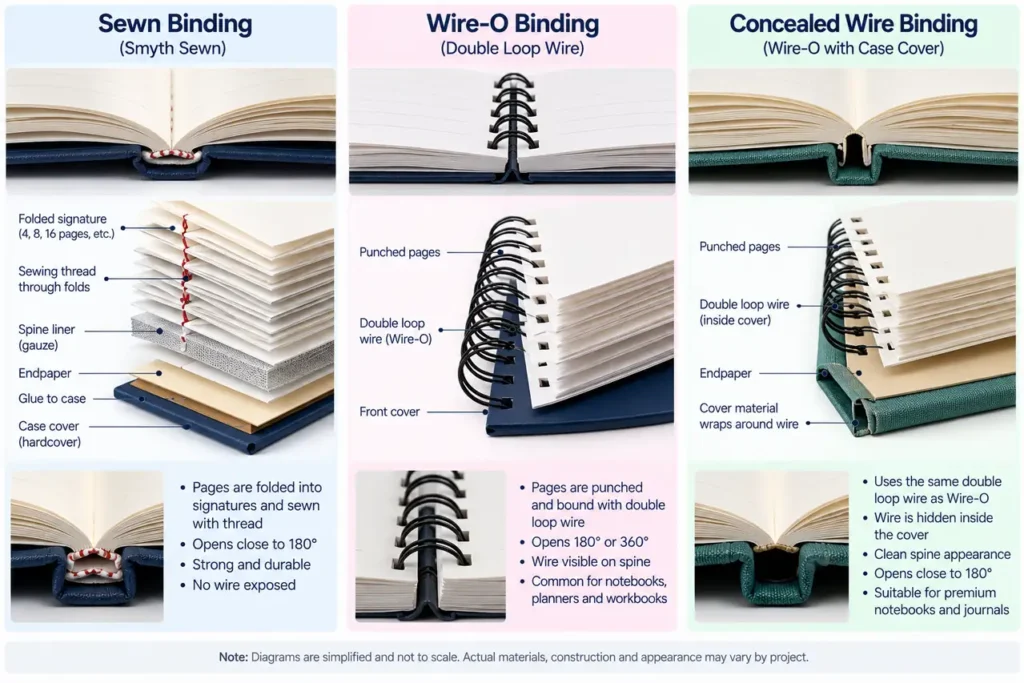
A section-sewn notebook holds folded groups of pages together with thread. The completed block also uses adhesive and other structural materials; sewn does not mean glue-free. Its useful writing advantage is the absence of a row of wire loops along the inner page edge.
That makes sewing a strong candidate for journals, meeting notebooks and guided writing products. It does not guarantee that every spread stays flat. Paper stiffness, grain direction, section configuration, spine adhesive and lining, endpapers and case geometry work together. The existing Smyth-sewn versus PUR hardcover guide explains the general construction distinction; the notebook decision is whether the finished product supports repeated writing.
A real product example helps define the claim. MIDORI describes its Book Style Diary in the 2027 diary collection as thread-sewn, cloth-hardback and able to open flat at 180 degrees. That is a manufacturer statement about a particular diary, not evidence that every sewn hardcover behaves identically.
For a related production route, PrintPack360 lists a Smyth-sewn custom hardcover notebook. Request the proposed paper, page count and cover combination in the sample; a different notebook from the same binding family cannot approve those variables.
Wire-O: separate easy page turning from hand clearance
Wire-O is double-loop wire binding, not a single continuous spiral coil. James Burn, the system’s originator, identifies the double-loop construction and its open-flat behavior on its Wire-O product page.
The punched pages turn around the wire rather than flexing as sewn sections. This construction is useful for worksheets, training notebooks and planners that need rapid page turning. A suitable exposed-wire assembly can support fold-back use, but cover size, tabs, accessories and closure geometry must leave that movement clear.
The trade-off is the hardware beside the writing area. A flat page is not necessarily a comfortable page: the wire can meet the user’s palm, particularly when the active page stack is thin. Test both sides of the spread with the intended user. This is not exclusively a left-handed issue; right-handed writers can encounter the wire on the left-hand page.
Record the binding edge, wire type, pitch, element size, hole pattern and closed-wire condition in the supplier specification. Do not select the element from page count alone. Sheets, covers, dividers and any other punched components contribute to the assembled thickness.
Concealed wire: protect the exterior without assuming a new mechanism
“Hidden spiral” describes a presentation arrangement unless the underlying mechanism is also identified. The case can enclose a twin-loop element or another specified binding. Ask for an open-spine photograph or construction section showing what holds the pages.
PrintPack360’s hardcover notebook with spiral-edge protection lists hidden spiral construction and Wire-O-style options. Treat that as a configuration discussion, not proof that every version has the same movement. In particular, enclosing the hardware does not automatically remove its obstruction from the writing side, and a continuous case may restrict fold-back rotation.
Check whether the cover protects the binding when closed, whether the pages turn without catching the case, and whether the spine structure collides with the desk when opened. Those observations decide whether concealment serves the product or merely improves its closed appearance.
Run a writing-access check, not a center-spread demonstration
The following is a proposed buyer screening method, not an industry test standard or a claim of completed PrintPack360 testing. Agree the tasks and acceptance criteria before the sample is made.
Use the intended trim size, paper, page count and cover. Include planned pockets, pen loops, tabs and elastic closures: they can change how the notebook rests or how pages move. Release the closure and place the sample on a level desk. Do not flatten it with weights or aggressively break its spine first.
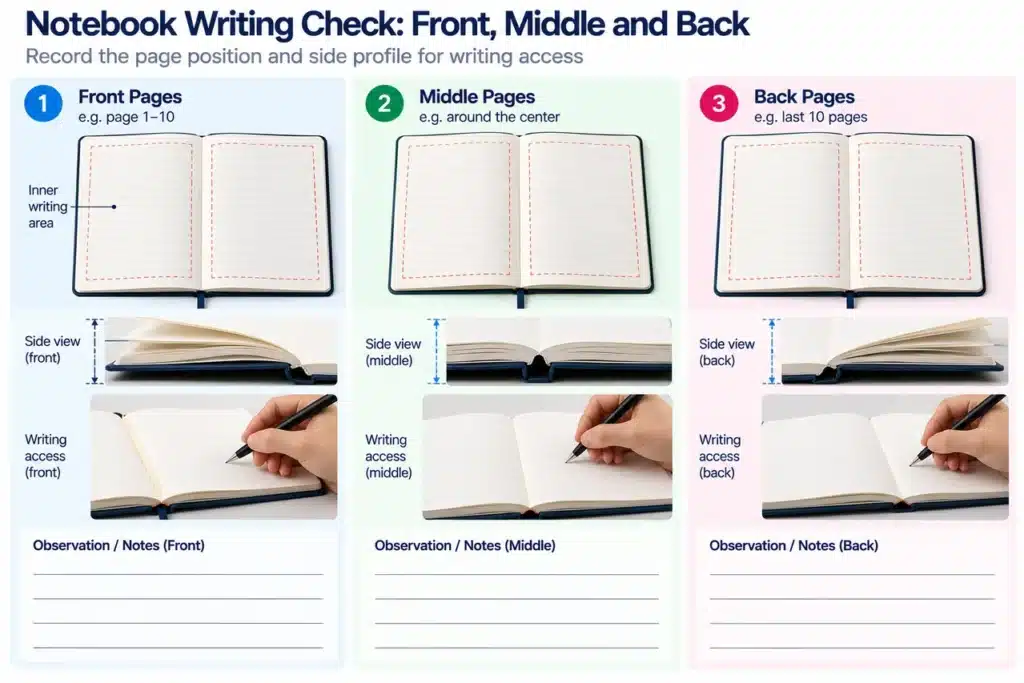
Inspect the first normal writing spread after the front matter, a middle spread, and the last normal writing spread before the end matter. For sewn blocks, include both a section-center opening and an opening between sections. That prevents one favorable position from representing the whole book.
| Task | What to record | Rejection condition to agree |
|---|---|---|
| Release the open spread | Position, movement and whether it closes | Cannot remain usable for the agreed hands-free task |
| Write at the inner boundary on both pages | Hand contact, wrist position and reachable area | Required writing area obstructed by wire, case or page rise |
| Turn one page, then several | Snagging, tearing, displaced wire and interference | Page catches or component movement interrupts normal use |
| Fold back, only if specified | Cover and page clearance | Requires forcing the case or bending hardware |
| Reclose after normal use | Cover alignment and closure behavior | Permanent distortion or closure interference |
Photograph the sample from the side as well as above. A top-down picture hides page rise and hand clearance. Label the page position and construction on every record. If a defect occurs only near the front, replacing that photograph with a center-spread image does not resolve it.
This screening approves usability at the sampled positions. It does not establish lifetime durability. If the buyer requires a repeated-use test, agree the cycle count, movement, conditioning and failure criteria separately; an arbitrary “opened ten times” exercise is not a validated service-life claim.
Let the inner margin follow the approved sample
Do not issue one universal gutter allowance for sewn, Wire-O and concealed-wire notebooks. Start with the supplier’s actual template, then mark a required writable boundary on a representative printed spread.
For punched construction, distinguish the holes from the hand-clearance zone. Keeping a printed line outside the holes prevents punching through it; it does not prove that the user can write comfortably beside the wire. For sewn construction, keep prompts, checkboxes and page numbers out of the area that rises into the binding.
Consider a guided journal whose prompt ends beside the inner margin. The text can remain readable while the answer space becomes awkward to use. Move the answer field or revise the binding before approval. Shrinking the type does not fix the physical problem.
For quotation comparisons, hold trim size, total pages, paper grade and accessories constant first. Request a separate price for each construction and identify any required layout change. Otherwise the cheaper alternative may simply contain fewer pages, thinner paper or a different writing area.
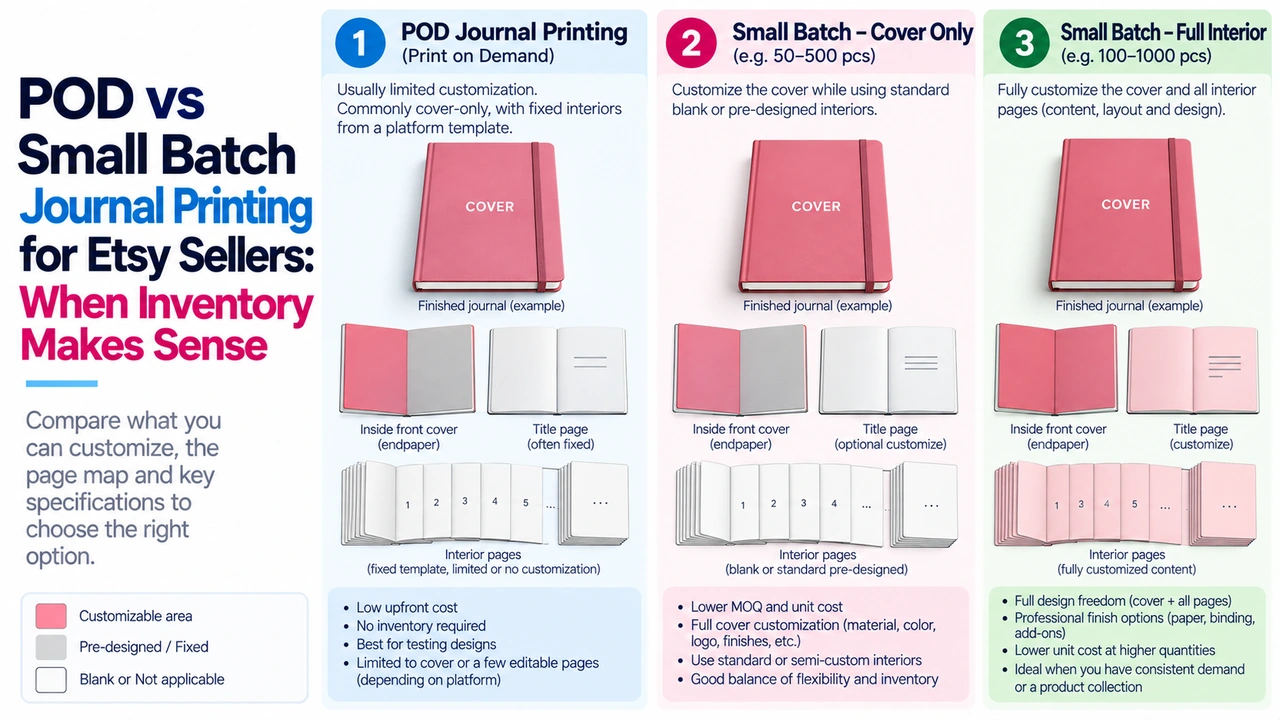
PrintPack360 notebook orders start at 50 copies for standard specifications. Fully customized projects involving foil stamping, spot UV, recessed cover decoration, different interior-page designs, front or back pockets, card inserts or a combination of these features typically start at approximately 100 copies. Confirm the minimum against the complete specification; one optional finish alone does not define the order category.
When requesting a physical notebook sample, provide the representative spread and the actual writing task. Retain the approved sample ID, materials, page positions and observations with the order. A PDF establishes page content; it cannot establish wrist clearance or stay-open behavior.
FAQ
Can we approve lay-flat performance from an unprinted dummy?
Yes, for the structural features it accurately represents. It must use the proposed stock, page extent, binding and case. Add a representative printed spread when ruling, prompts or inner margins are part of the approval. Record which features remain unapproved; a blank dummy does not approve printing or pen performance.
What must remain unchanged after sample approval?
Retain the agreed paper grade and caliper, page count, grain direction, section or punching plan, binding element, case construction and accessories. A substitution requires a review of the affected writing tasks. Matching GSM alone does not establish an equivalent opening result.
Can a notebook stay open without a coil getting in the way?
Yes. A purpose-specified sewn notebook is a suitable route to evaluate. Confirm the front and back writing spreads, not only the center, and do not infer the result from “thread-sewn” alone. Related public discussion: a notebook that stays open without a coil beside the hand.
Does a flat-opening notebook automatically suit left-handed writers?
No. Test palm clearance, both page sides and the user’s writing angle. A stay-open sewn product, an appropriately configured top-bound format or another arrangement can solve different tasks; none earns a blanket comfort claim from its binding name. Related public discussion: a left-handed writer’s lie-flat notebook requirements.