On a four-color press, the order of four inks is not just a color theory question. It is also a transfer problem and a risk-management decision.
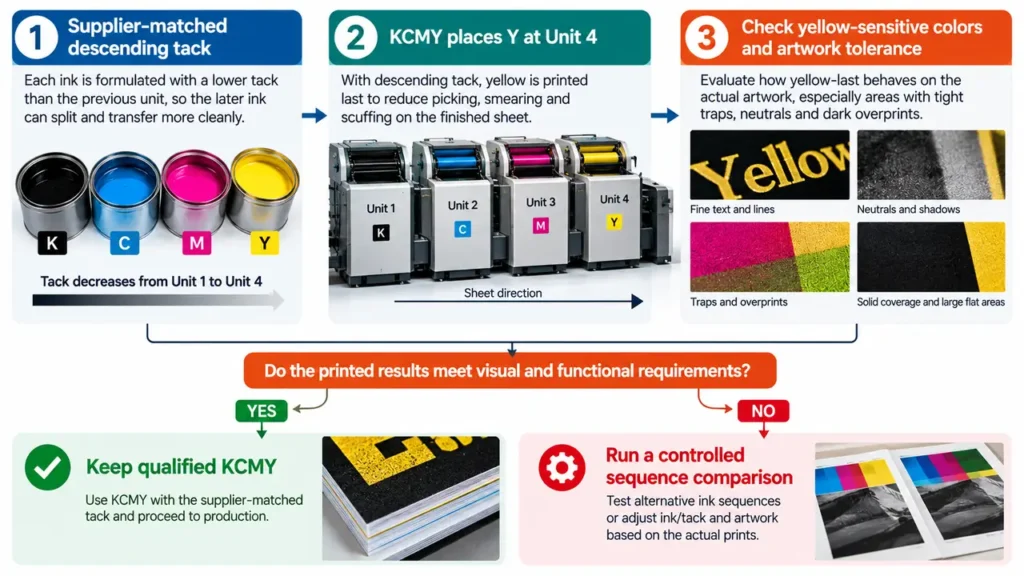
In a KCMY sequence, black prints first, followed by cyan, magenta and yellow. A conventional KCMY setup can match a descending-tack ink set and place a comparatively low-visibility process color on the final unit when that unit is the source of a small, known mechanical variation. That is the practical case for yellow-last.
The rule is useful, but it has limits. Yellow-last does not make every overprint more accurate, and yellow is not visually unimportant in every image. The defensible pressroom logic is three-part:
- Tack decreases through the units: the first-down ink should generally have the highest tack in a matched tack-graded set.
- Yellow is a practical final color in a KCMY house sequence: its light appearance can make some small mechanical variations less conspicuous than the same variation in a critical dark color.
- That tolerance is conditional: if yellow is changing a brand red, neutral, skin tone or saturated overprint, it is no longer the low-risk color in that job.
This article focuses on conventional four-color sheetfed offset. It explains why KCMY can be a sound house sequence, what the evidence does and does not establish, and how to decide whether the sequence fits a specific job.
Start With the Word “Tack,” Not “Viscosity”
In shop-floor conversation, people may call the ink sequence a “viscosity order.” That wording can cause confusion. Ink tack and viscosity are related aspects of ink behavior, but they are not interchangeable measurements. Tack describes the force or resistance involved when a thin ink film splits between surfaces at printing speed. Viscosity describes resistance to flow under a specified measurement condition.
For a conventional wet-on-wet offset set designed for tack grading, the pressroom rule is clear: print the highest-tack ink first and step down through the succeeding units. The later ink then has less tendency to disturb or pull the earlier wet film. TAGA’s technical paper on color sequence describes this order directly and notes that sequence can be adjusted to manage production problems.
That does not mean a printer should compare four numbers from unrelated ink series and arrange them by the printed values alone. Tack values depend on the instrument, temperature, speed and ink formulation. The ink supplier’s recommended color sequence and the actual press condition take precedence over an isolated number. Sappi’s wet-trapping bulletin describes trapping as an interaction of tack, absorption and time, not a single ink value.
| Press position | KCMY color | Tack role in a matched tack-graded set | Practical check |
|---|---|---|---|
| Unit 1 | K, black | Highest in a matched KCMY tack-graded set | Confirm the ink series is designed for this order; watch picking and heavy black coverage |
| Unit 2 | C, cyan | Lower than the first-down ink | Check transfer onto the first wet film and the intended overprint patches |
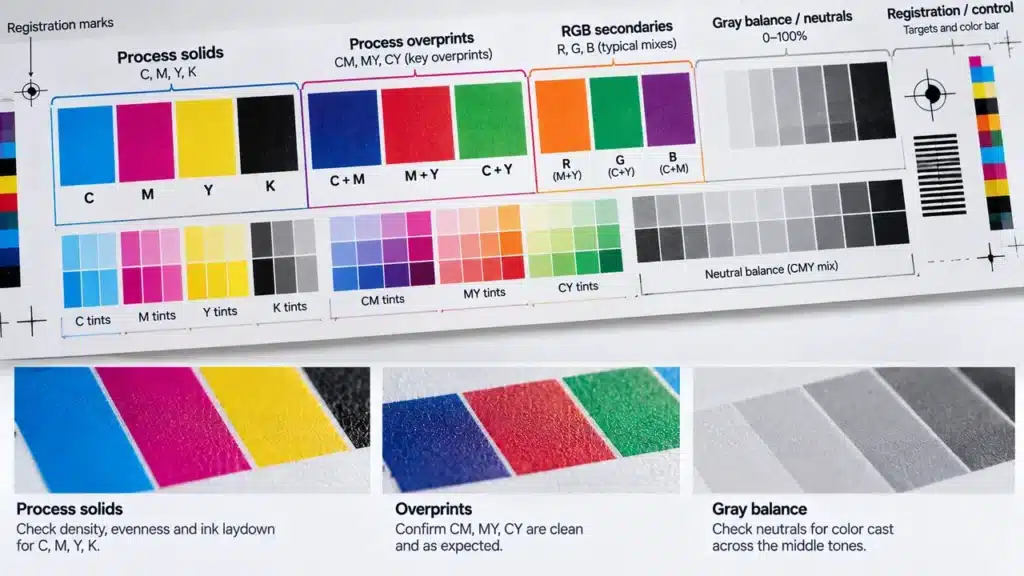
| Unit 3 | M, magenta | Lower again in the selected sequence | Confirm reds, blues and neutral balance under the approved condition |
| Unit 4 | Y, yellow | Lowest in some KCMY tack-graded sets | Verify the supplier’s set; assess yellow tints and yellow-containing overprints |
The table describes a sequence design, not a universal tack specification. A different ink series may use different values or order recommendations.
Why Tack Should Decrease Through the Press
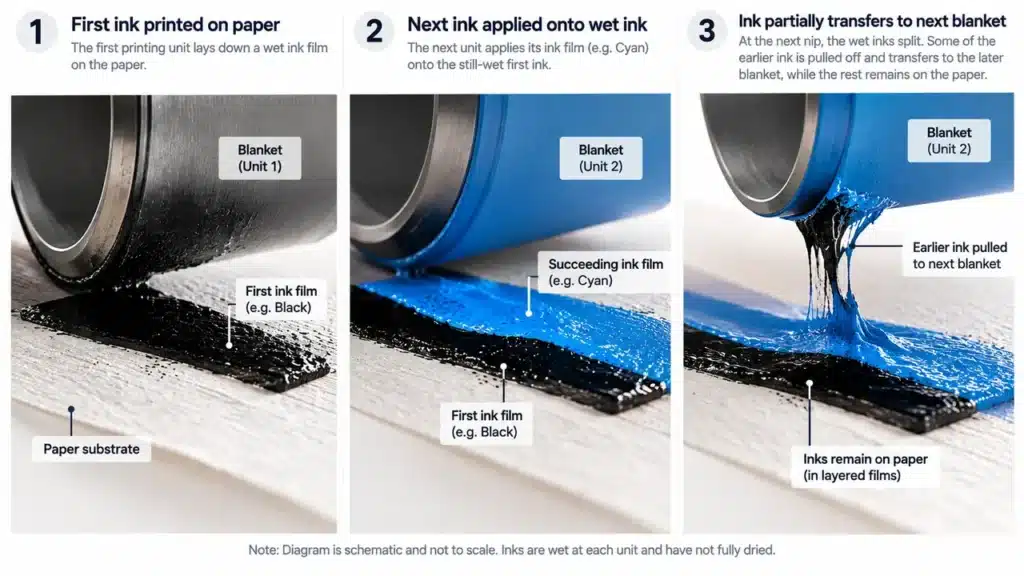
Each succeeding offset unit transfers a new ink film onto a surface that already carries one or more wet films. If a later ink has too much tack for the existing condition, it can split unevenly, disturb the earlier film or contribute to picking and back-trap mottle. The visible result can be weak overprints, uneven solids, hue drift or contamination on a later blanket.
Descending tack reduces one avoidable source of instability. It does not solve every trapping problem. Ink strength, ink-film thickness, fountain-solution balance, paper absorption, press speed, blanket release and the interval between printing nips also matter. Sappi’s wet-trapping bulletin frames the interaction around tack, absorption and time; the Printing Industries of America notes that there are no official published wet-trap figures that apply across all ink, sequence and paper combinations.
The operator’s job is not to make the tack values look tidy on paper. It is to achieve stable transfer on the actual substrate without sacrificing color, detail or runnability.
What the term “wet trapping” means here
Wet trapping is the transfer of a later ink onto an earlier ink film before that earlier film has completed its setting or drying process. It is different from dry trapping, where a later ink is printed after the earlier layer has dried. On a multicolor press, the unit interval is short; the process is governed by ink transfer and film splitting, not by the final oxidative cure occurring between units.
That is why “yellow dries fastest, so it belongs last” is not a dependable general explanation. Conventional offset ink sets and substrates vary. Physical setting through vehicle penetration and later chemical hardening are different stages; neither gives a universal drying order for C, M, Y and K. A University of Wuppertal technical review, “Drying Mechanisms for Printing Inks,” distinguishes several physical and chemical mechanisms. Check the data for the actual ink series and stock.
Why Yellow Can Be a Sensible Last Unit
The argument for yellow-last is not that yellow has no effect. It is that, in a KCMY setup designed around a descending-tack ink set, yellow can be a workable final ink and may be the least visually conspicuous color to place on a unit with a small, known mechanical limitation.
This is a tolerance strategy. If the last unit shows slight slur, doubling or register movement that cannot immediately be eliminated, a light yellow screen may make the defect less noticeable than a similar error in black text or a dense dark image. The TAGA paper lists this as one factor in sequence selection: when a particular unit has a mechanical problem, yellow may be placed there because it is less visually discernible. That is a narrowly stated workaround, not permission to run a defective press or accept an out-of-tolerance job.
The same TAGA paper also records a historical shift toward yellow-last in several offset surveys. It reports KCMY among the sequences used by printers and notes that KCMY became more common in one later web-offset survey. The surveys are decades old, use different populations and sample sizes, and should not be described as a current market-share measure. They do show that KCMY was a real production sequence, not an internet invention.
The Tolerance Argument Has a Color Limit
“Yellow is the least noticeable process color” is only useful when the affected image area supports that judgment. A yellow fluctuation can be obvious in a warm gray, a brand red, a skin tone, a large yellow field or a three-color neutral. Yellow printed over magenta or black also changes the final overprint; it is not optically invisible just because the ink looks light by itself.
Gary G. Field’s TAGA study is an important counterweight to simplistic explanations. In a laboratory comparison using historical SWOP inks and 60-pound proof stock, its measured four-color solid densities were 2.36 for CMYK, 2.31 for YMCK, 2.16 for YCKM and 1.87 for KCMY. The study also observed a yellow cast when yellow printed last. These are results from a specific laboratory method, including ink films dried between printings; they are not current production targets and do not predict the result of every modern press.
The useful conclusion is not “never print yellow last” or “yellow must always be last.” It is this: the final color can be a reasonable place to absorb a small mechanical risk, but only when the color-critical content and approved reference tolerate that choice. The same TAGA paper stresses that sequence depends on multiple optical and production factors and that no one order suits every circumstance.
| What the job contains | Yellow-last tolerance: likely reading | What to verify |
|---|---|---|
| Mostly text, modest process coverage and few critical yellow overprints | Often a practical KCMY candidate | Black text edge, gray balance, overprint patches and register |
| Brand reds, skin tones, warm grays or dense CMY neutrals | Do not assume yellow is visually low-risk | Compare the actual sequence against the approved proof and brand target |
| Large yellow solids or high yellow coverage | Yellow behavior is directly visible | Solid uniformity, setoff, drying/setting and rub resistance |
| Known slight mechanical issue at the final unit | Yellow may reduce the visual prominence of some defects | Correct the mechanical issue; use yellow placement only as a documented temporary mitigation |
| New stock, new ink series or changed press condition | Previous tolerance judgment may no longer hold | Requalify the sequence and proof condition |
Transparency and Gloss: Relevant, but Not a Blank Check
Modern process yellow pigments are generally more transparent than some historical yellow pigments, which gives printers more flexibility in sequence than early process-color systems had. But no process ink should be treated as perfectly transparent. In the TAGA study, overprint appearance shifted toward the top ink, and yellow’s position strongly affected some overprints, especially red. Field’s appendix also identifies possible gloss improvement as a secondary reason for running some yellows last; verify the actual ink and finished surface rather than assuming the benefit.
Yellow-last can also affect surface appearance. Field’s paper notes that some process yellows can produce higher gloss and that placing such an ink last may increase print gloss. That is a possible secondary effect for a particular formulation and job; it is not a universal benefit and should not outweigh a color target or drying requirement. If gloss is a specification, judge the finished print under the agreed conditions rather than inferring it from the color sequence.
A Practical Rule for Choosing the Sequence
Use this order of decisions for conventional sheetfed four-color offset:
- Follow the ink maker’s tack-graded recommendation. If the ink series is specified for KCMY, do not rearrange it by color theory alone.
- Keep a qualified house sequence stable. Prepress separations, gray balance, proofing and press targets must match the production order.
- Use yellow-last as a tolerance choice only where the artwork allows it. Protect brand colors, neutrals, skin tones and high-coverage overprints with a representative proof.
- Fix mechanical defects at their source. Do not treat yellow as a substitute for repairing a unit with slur, doubling or register error.
- Recheck after a material or process change. A different paper, ink series, press, drying system or major coverage change can alter the result.
The same production-condition logic applies to custom hardcover book printing: the ink sequence, stock and proof condition need to be specified together. For image-led projects, PrintPack360’s book printing paper guide covers substrate properties that affect absorption and surface appearance. The broader guide to five printing processes explains why this wet-trapping discussion is specific to offset rather than a universal rule for every printing method.
What to Put on the Job Ticket
“CMYK” alone does not tell the press operator which unit prints first. Write the physical order, direction and approved condition explicitly.
| Job-ticket field | Record |
|---|---|
| Press and side | Press model, perfecting or straight printing, side being printed |
| Unit order | Unit 1 K, Unit 2 C, Unit 3 M, Unit 4 Y, or the actual approved order |
| Ink system | Supplier, product series and tack-sequence recommendation |
| Substrate | Paper name/grade, coating and lot where color-critical |
| Color target | Proof condition, reference sample and measurement method |
| Critical content | Brand colors, skin tones, neutral grays, large solids or other risk areas |
| Exception | Any approved sequence deviation, reason and approving person |
This prevents a common production mistake: one team discusses “yellow last” while another reads unit numbers from the opposite side of the press diagram or assumes the sequence from a generic CMYK label.
Bottom Line
For a conventional KCMY setup, descending tack is the technical starting point; yellow-last can be a practical choice for a light final color and a defined pressroom tolerance; the approved artwork and proof decide whether that tolerance is acceptable.
Do not justify the sequence by claiming that yellow always dries fastest, is perfectly transparent or cannot change the image. The strong operator’s rule is simpler: use the supplier-matched tack sequence, keep the qualified house order consistent, and let measured press condition and the approved color reference settle disputes.
FAQ
Does the first ink on a sheetfed offset press need the highest tack?
In a conventional wet-on-wet set designed for tack grading, yes: the first-down ink has the highest tack and each succeeding ink steps down. Follow the ink maker’s specification for the exact series; tack values from different products or test conditions are not directly interchangeable.
Is yellow always the last color in four-color offset printing?
No. KCMY is a recognized house sequence, but CMYK, YMCK and other orders have also been used. Yellow-last is appropriate when the ink sequence, press condition and color target support it; it is not a universal requirement.
“Will there be a big color shift if I print CMYK and not the usual KCMY?”
It can shift overprints and gray balance, so treat a sequence change as a change to the printing condition. A PrintPlanet production discussion raises this exact concern. The technically sound answer is to compare the new order against the approved proof and update the color condition if the sequence changes; historical TAGA testing also measured sequence-dependent color differences.
Why can yellow pick up cyan or magenta contamination in a KCMY run?
Yellow can be contaminated by an upstream ink through back-trap, but do not assume that sequence alone is the cause. Check the matched ink tack order, ink-water balance, ink strength, film thickness and the yellow unit’s roller and blanket condition. A PrintPlanet troubleshooting thread documents this as a recurring pressroom diagnosis; the thread is an example of the question, not a technical specification. Do not add reducer or transparent white as a first response without the ink supplier’s approval.