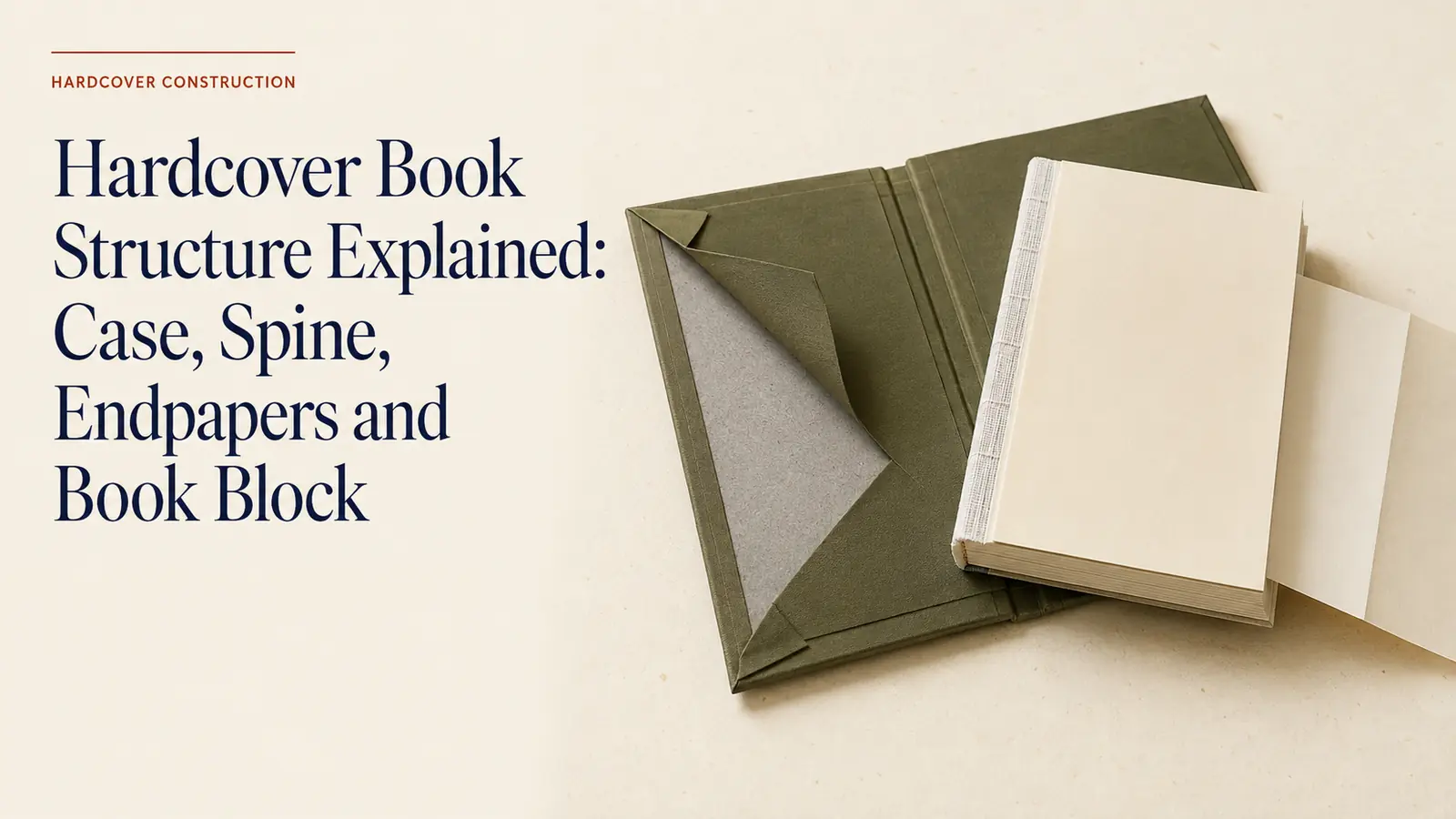
A hardcover can look straightforward from the outside: two rigid covers, a spine and a block of pages. In production, it is a coordinated structure in which paper, board, adhesive, covering material, endpapers and binding method have to move together.
That distinction matters. A book can have accurate color and attractive foil yet still feel wrong if the joint is too tight, the endpaper pulls at the first section, the spine width is inaccurate or the boards begin to warp. These are structural problems, not cosmetic ones.
This guide explains hardcover book structure from the outside in. It is written for publishers, independent authors, designers, museums, brands and special-edition teams that need to specify, proof and inspect a casebound book. For a full production route, start with PrintPack360’s custom hardcover book printing category.
Hardcover Structure Guide
Table of Contents
Hardcover Book Anatomy at a Glance
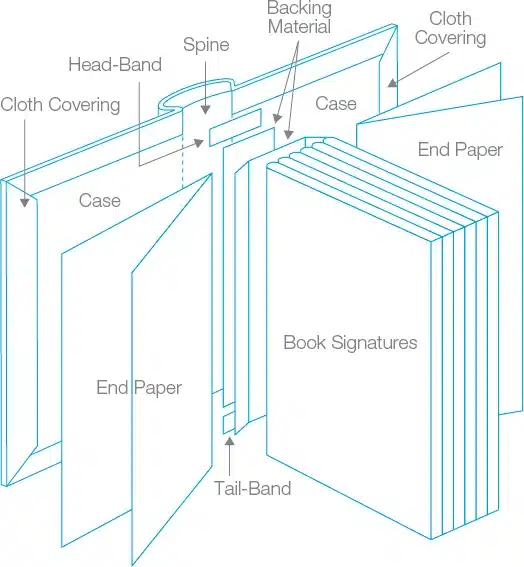
The Library of Congress preservation glossary defines a book case as the two boards, spine inlay and covering material. It describes casing-in as the stage at which the text block and its attached endpapers are secured into that separately produced case. That separation between case and book block is the key to understanding a conventional hardcover. Library of Congress preservation glossary
| Component | What it does | What the buyer should define or approve |
|---|---|---|
| Covering material | Wraps and decorates the case | Printed paper, cloth, PU or specialty material; finish and color |
| Front and back boards | Give the covers rigidity and shape | Board thickness, size, squareness and flatness |
| Spine inlay or spine board | Forms the case spine | Width, rigidity and compatibility with square or rounded construction |
| Joint or groove | Allows the cover board to open beside the spine | Width, placement, crease and covering-material behavior |
| Endpapers | Connect the book block to the case and create the first/last visible spread | Paper, grain direction, color, artwork and adhesion |
| Book or text block | Contains the printed pages | Trim size, page count, paper, folding, collation and edge treatment |
| Binding structure | Holds pages or sections together | Smyth sewing, thread sewing plus adhesive, or PUR adhesive binding |
| Spine lining | Stabilizes the bound book-block spine | Material, coverage and bond |
| Headbands and ribbon | Add visual finish and, for the ribbon, function | Color, position and whether they are decorative or required |
| Dust jacket or enclosure | Adds communication, protection or presentation | Jacket fit, slipcase clearance and abrasion risk |
Not every hardcover uses every component in the same way. A thin illustrated book, a 700-page novel and a large-format art monograph should not share an identical structural prescription.
Why Structure Matters More in the 2026 Collector-Edition Market
The current appetite for collector editions has increased the number of components expected to coexist in one book. Imago’s 2026 publishing trends highlights signed tip-ins, decorated edges, cloth slipcases and presentation clamshells. A 2026 trade review from PostPress similarly notes continued demand for heavier materials, embellishment, ribbons and decorated edges. PostPress book trends
Those features create a design opportunity, but they also add dependencies:
- A heavier text block changes the load carried by the endpapers and joints.
- Printed or sprayed edges require clean trimming and careful handling.
- A thicker jacket changes slipcase clearance.
- Cloth texture changes the behavior of fine foil and debossing.
- A ribbon affects head clearance and must be positioned before final assembly.
- Signed sheets or illustrated endpapers add collation and orientation checks.
Premium decoration does not compensate for weak structure. The more complex the edition, the more important it is to approve the base construction first.
The Two Main Assemblies: Case and Book Block
The case
The case is manufactured separately from the pages. It normally includes:
- Front board
- Back board
- Spine inlay or board
- Covering material
- Turn-ins around the board edges
- Any printed image, foil, embossing, debossing or other case decoration
The board pieces are positioned on the reverse of the covering material with controlled gaps beside the spine. The covering material is wrapped around the outer edges and turned in. The case may be decorated before or after assembly depending on the process and material.
A printed paper case can carry continuous artwork across the front, spine and back. A cloth case depends more heavily on separate decoration, such as foil or blind debossing. The decision should consider handling, artwork, finish compatibility and the way the book will be sold, not appearance alone.
The book block
The book block contains the interior pages after printing, folding, gathering, binding and trimming. It may also include:
- Bound or tipped-in inserts
- Endpapers
- Spine adhesive
- Mull, crash or another reinforcing spine lining
- Headbands
- Ribbon markers
- Decorated page edges
The book block is not simply a stack of pages. Its thickness, stiffness, paper grain, section plan and binding method determine how the finished book opens and how much force reaches the case.
The case and block come together during casing-in. If their dimensions or behavior do not match, later finishing cannot correct the underlying mismatch.
The Structural Parts of a Hardcover Book
1. Covering material
Common case materials include printed and laminated paper, book cloth, coated cloth, synthetic leather and specialty papers. Selection affects more than appearance:
- Adhesive compatibility
- Resistance to scuffing and moisture
- Ability to wrap corners cleanly
- Foil and debossing performance
- Joint flexibility
- Color consistency between sample and production
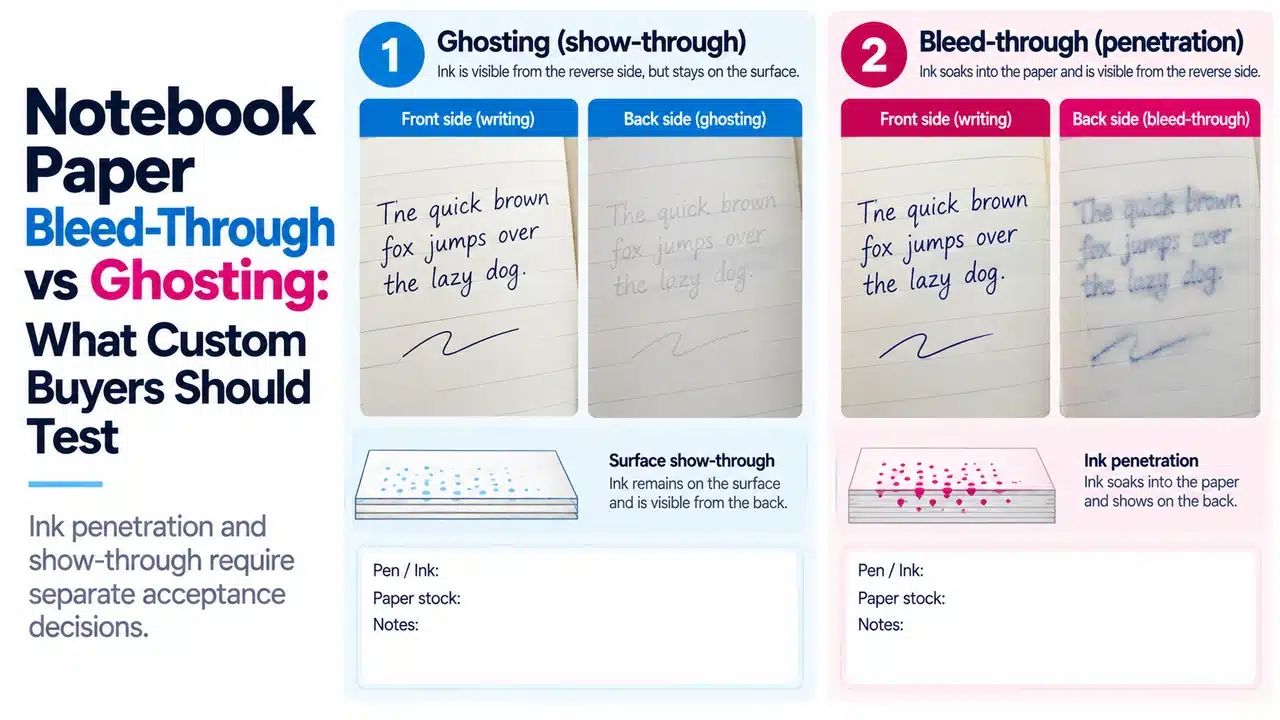
Coarse cloth may interrupt fine foil detail. A heavily coated paper may require a different adhesive approach from an absorbent cloth. A dark soft-touch surface may show handling marks more readily than expected. Material and decoration therefore need to be tested together.
For a tactile sewn edition, PrintPack360’s cloth-bound Smyth-sewn hardcover shows how cloth, foil, endpapers and a belly band work as one product system.
2. Cover boards
Front and back boards give a hardcover its rigidity. Greyboard thickness is often discussed first, but thickness alone does not determine performance. Board choice also involves:
- Density and internal consistency
- Moisture balance
- Flatness
- Cutting accuracy
- Book format and weight
- Covering and lining materials
Very thick board is not automatically more premium. On a small, thin book it may feel disproportionate and make the joint difficult to operate. On a large, heavy book, board that is too light may feel weak or show distortion.
Board warp often results from imbalance rather than one defective material. Adhesive moisture, grain direction, covering stock, pastedown, drying and storage conditions all contribute. A bound sample should therefore be allowed to condition before flatness is judged.
3. Spine inlay and spine shape
The case spine sits between the two cover boards. Depending on the design, it may be square, rounded, hollow, flexible or more rigid.
Spine width should be calculated from the actual production paper, page count, folding plan, binding method and compression. GSM is a mass measurement, not a direct thickness measurement. Two papers with the same GSM can have different calipers and produce different book-block thicknesses.
Do not finalize the cover spread by applying a generic online formula to GSM alone. The printer should confirm the production spine after paper and binding are fixed.
Round-spine books introduce additional questions: whether the block is merely rounded or rounded and backed, how sewing swell is managed, and how the case spine is formed. PrintPack360’s round-spine hardcover printing route is most relevant to thicker editions that need a traditional profile.
4. Joint, groove and hinge
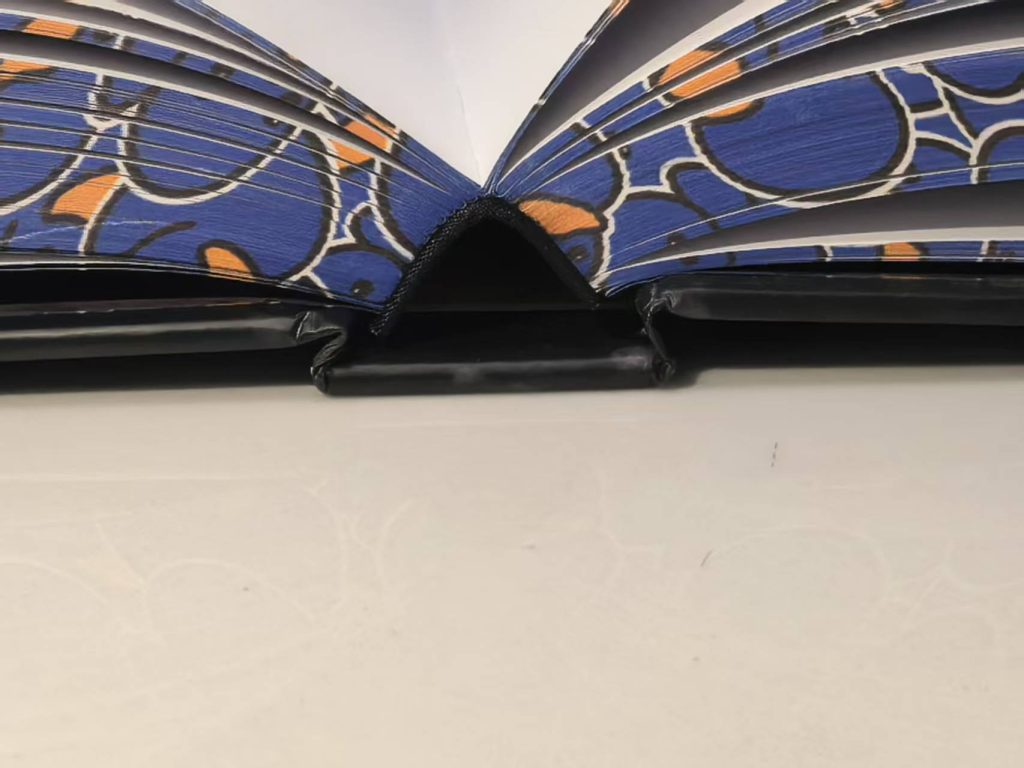
These terms are often mixed together. The Etherington and Roberts bookbinding dictionary distinguishes the joint as the exterior junction between spine and covers, while hinge is the more appropriate term for the internal flexing junction. Bookbinding dictionary: joint
In commercial specifications, teams may also use “groove” for the visible recessed line beside the spine. Whatever terminology is used, the drawing and approved sample must make the intended structure clear.
If the gap is too narrow, the cover may resist opening, strain the endpaper or crush decoration near the spine. If it is too wide or inconsistent, the book may look poorly proportioned and the boards may shift relative to the block.
Keep critical type, foil and image details away from this movement zone unless the design has been tested on the actual construction.
5. Squares, turn-ins and corners
The square is the small projection of the cover beyond the trimmed text block at the head, tail and fore edge. It protects the pages and contributes to the book’s proportions.
The covering material wraps around the boards to form turn-ins. At each corner, excess material must be managed so the corner is covered without becoming bulky or exposing board. Corner quality depends on material thickness, board thickness, cutting and hand or machine setup.
Buyers should inspect:
- Even squares on all sides
- Parallel boards and book block
- Clean corner coverage
- No exposed greyboard
- No excessive corner lumps
- Consistent turn-in width where visible beneath the pastedown
6. Endpapers, pastedowns and flyleaves
Endpapers help connect the book block to the case. One half is normally pasted to the inside board as the pastedown; the other remains free as the flyleaf.
They are both visual and structural. The paper must fold, bond and flex reliably. Grain should normally run parallel to the spine. Artwork also needs to respect the pastedown, joint and moving flyleaf as different zones.
Maps, character art and dark flood colors add file and handling risks that do not exist with plain stock. Artwork must account for the pastedown, moving flyleaf, joint and trim as separate functional zones.
7. Sections, leaves and the text block
In a sewn book, printed sheets are folded into sections or signatures, gathered in sequence and sewn through their folds. Section size depends on paper, format, imposition, bulk and equipment.
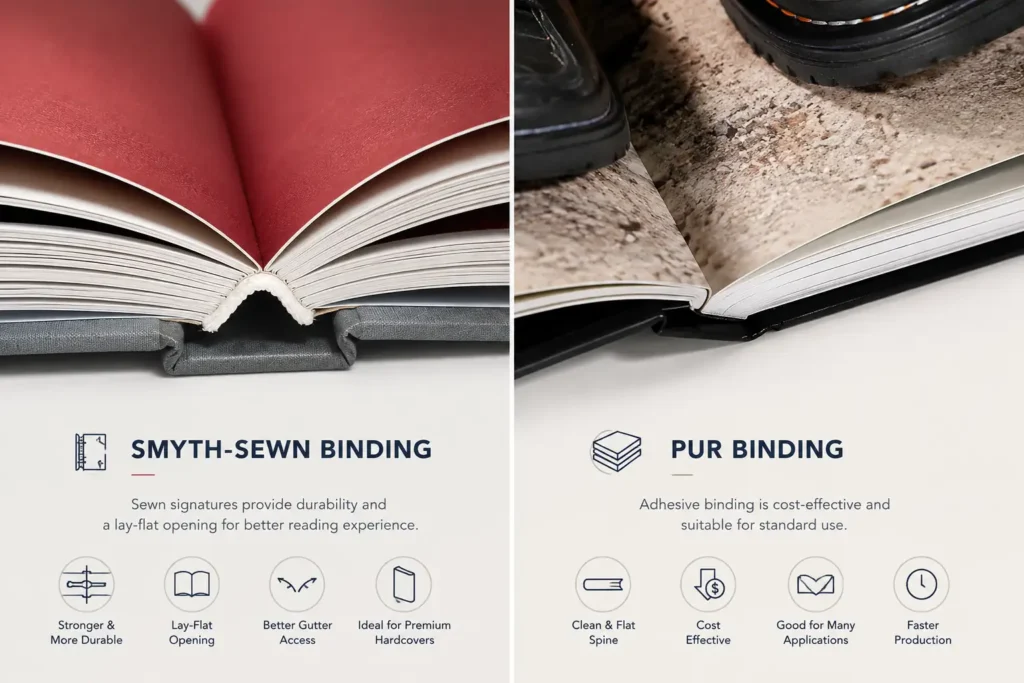
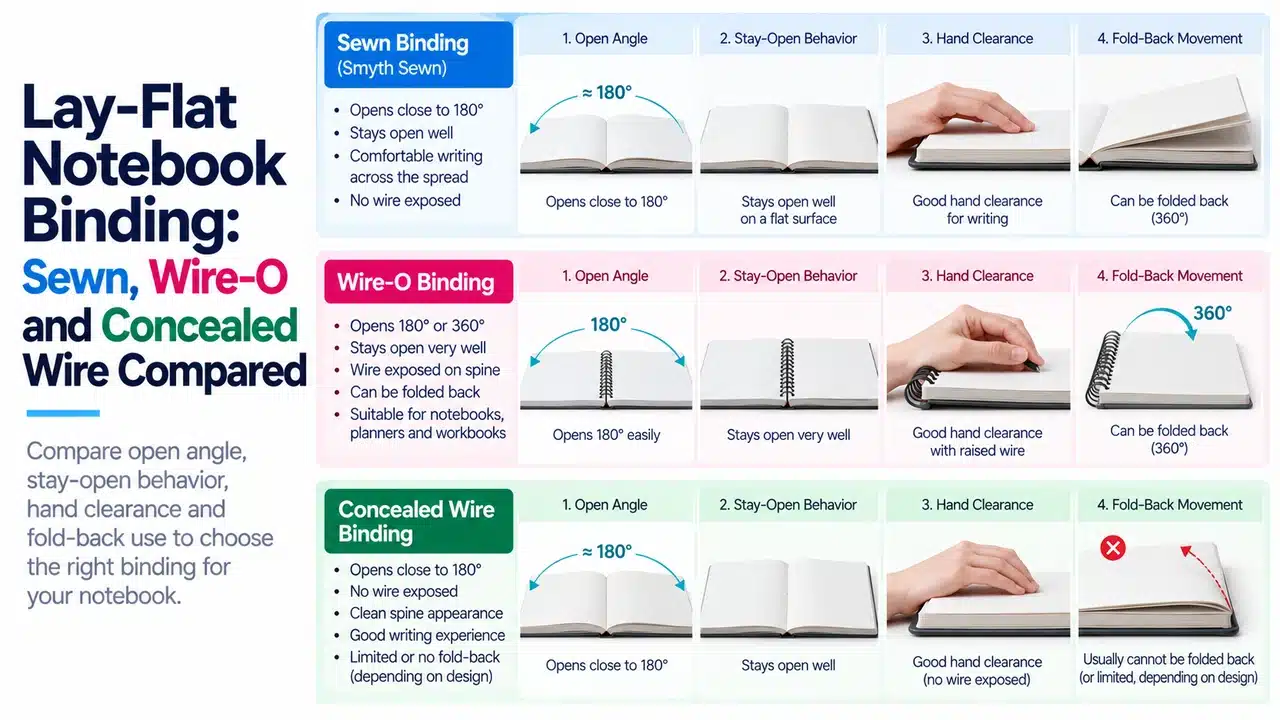
In an adhesive-bound block, individual leaves or prepared sections are held at the spine with adhesive. PUR is commonly chosen for demanding coated papers and cross-grain situations, but it does not make every adhesive-bound book equivalent to a properly planned sewn book.
The best choice depends on page count, paper, opening requirement, expected use and budget. Ask the manufacturer to identify the proposed book-block structure explicitly rather than describing both options only as “hardcover binding.”
8. Spine adhesive and lining
After sewing or adhesive binding, the book-block spine is consolidated and lined. Materials may include paper, gauze-like mull or crash, and other reinforcing layers.
The lining helps stabilize the block and participates in attaching it to the case. It must bond consistently without making the spine unnecessarily rigid. Coverage, adhesive application and drying affect both durability and opening.
The old assumption that “more glue means stronger” is unreliable. Excess adhesive can increase stiffness, create unevenness and conceal poor preparation. Strength comes from a compatible system and controlled application.
9. Headbands and ribbons
In most modern edition binding, decorative headbands finish the head and tail of the spine but are not the primary structural support. They should be cut cleanly, centered and securely attached.
A ribbon marker adds function and color but must be specified early. Confirm:
- Ribbon width and color
- One or multiple ribbons
- Attachment position
- Finished length below the book block
- Risk of fraying or color transfer
- Interaction with headbands and automated processes
10. Dust jackets, belly bands and slipcases
These are external components, but they depend on the finished hardcover dimensions.
A dust jacket needs the correct spine width, flap width and vertical fit. A belly band must slide into place without marking the case. A slipcase needs clearance for the finished book, including its jacket, foil relief and any dimensional variation.
When an enclosure is part of the edition, do not size it from an unbound text-block estimate. Size and approve it against the intended finished-book construction. PrintPack360’s book jacket and slipcase set shows the relevant complete-product route.
How a Casebound Hardcover Is Assembled
A typical commercial sequence is:
- Print interior sheets. Confirm color, pagination and imposition.
- Fold and gather. Assemble sections in the correct sequence, including inserts.
- Bind the book block. Sew sections or prepare and PUR-bind the spine.
- Attach endpapers. Method varies with the binding plan.
- Trim the block. Establish the final page dimensions and clean edges.
- Round or shape the spine if specified. Manage sewing swell and profile.
- Line the spine. Apply the required reinforcing materials.
- Decorate page edges if specified. Protect finished edges during later handling.
- Build and decorate the case. Position boards and spine, wrap the covering material and apply finishes.
- Case in. Join the prepared block and case through the endpapers and lining system.
- Press and dry. Control shape, bond and moisture balance.
- Add jacket, band or enclosure. Use final conditioned dimensions.
- Inspect and pack. Check structure, decoration and shipment protection.
The exact order can change with equipment, materials and special features. The purpose of a production schedule is not merely to list dates; it should reveal which approvals must happen before dependent components are released.
Structural Decisions That Must Be Made Together
Paper and binding
Paper caliper, grain, coating and stiffness affect folding, section size, opening and spine width. Choosing binding before paper is confirmed can create a specification that works only on paper.
Page count and spine
Page count changes thickness, but inserted plates, gatefolds, signed leaves and endpapers may also affect the block. The final spine calculation should include every physical component.
Cover material and joint
Thick cloth, coated paper and synthetic materials bend differently. The case layout and joint gap should reflect the selected covering material.
Decoration and movement zones
Foil crossing a groove, fine debossing near a joint or full-bleed dark ink on a high-contact corner may fail for predictable mechanical reasons. Decoration files should be reviewed against the case dieline and sample, not as isolated artwork.
Book and enclosure
Jacket, belly band and slipcase dimensions depend on the conditioned finished book. A late cover-material change can affect fit.
Common Hardcover Structural Problems and Their Likely Causes
| Symptom | Possible structural causes | What to verify |
|---|---|---|
| Boards warp or covers do not lie flat | Moisture imbalance, material grain, uneven adhesive, insufficient conditioning | Board, wrap, pastedown, drying and storage records |
| Cover resists opening | Joint too tight, stiff covering, rigid spine or endpaper pull | Joint width, case geometry and bound sample behavior |
| Endpaper tears near the joint | Excess strain, unsuitable paper, grain direction or poor attachment | Endpaper stock, grain, fold and casing-in setup |
| Book block sags inside the case | Heavy block, weak attachment, poor dimensions or insufficient support | Endpaper/lining system, squares and case fit |
| Spine artwork is off-center | Incorrect spine width, case placement or block compression | Approved spine dimension and case-making registration |
| Cover and block are not square | Casing-in alignment, board cutting or pressing error | Head, tail and fore-edge squares on both sides |
| Bubbles or wrinkles appear under the cover | Adhesive application, material stretch or trapped air | Material conditioning and case-making process |
| Foil breaks beside the groove | Detail crosses a movement zone or cloth texture is too coarse | Foil artwork, die, substrate and joint position |
| Slipcase is too tight | Sized before jacket/finish was final or insufficient tolerance | Finished-book sample and enclosure clearance |
These symptoms are diagnostic starting points, not automatic proof of one cause. A useful quality review compares the approved specification, approved sample and actual production sequence.
Hardcover Structure Decision Table
| Project | Structural priority | Common starting direction | Main risk to resolve |
|---|---|---|---|
| Text-heavy novel | Comfortable opening and manageable weight | Uncoated text stock; sewn or suitable PUR structure; square or rounded spine by thickness | Excess stiffness, show-through and inaccurate spine |
| Illustrated art book | Color, page support and spread behavior | Coated or selected uncoated stock; casebound structure tested with actual paper | Heavy block, gutter loss and board distortion |
| Children’s picture book | Durability, handling and appropriate materials | Robust case, suitable page stock and carefully engineered joint | Corner damage, hinge strain and surface cleanability |
| Collector edition | Coherent interaction of decoration and structure | Sewn block, designed endpapers, tested case material and optional enclosure | Too many finishes released without structural sample |
| Corporate or commemorative book | Presentation and repeatable branding | Printed paper or cloth case with controlled foil/debossing | Color/foil inconsistency and late specification changes |
| Large-format photography book | Board flatness and support for a heavy block | Paper and board chosen as a system; physical dummy or bound sample | Sagging, warp, opening resistance and shipping damage |
For image-led projects, use PrintPack360’s hardcover art book printing specification as the commercial route, then confirm paper and binding together.
What to Proof and Inspect

A PDF proof can confirm
- Page sequence and content
- Trim and bleed setup
- Position of case artwork and finish layers
- Basic spine text orientation
- Endpaper artwork orientation
It cannot confirm opening behavior, board flatness, cloth feel, joint movement, foil adhesion or slipcase fit.
A blank dummy can confirm
- Approximate bulk and proportions
- Board thickness relative to format
- Case dimensions
- Basic opening behavior using representative materials
- Jacket or enclosure concept
It may not confirm final print, decoration or production adhesive.
A printed and bound sample can confirm
- Interaction of actual paper, binding and case
- Color on the intended stock
- Endpaper behavior
- Joint and hinge movement
- Foil, debossing and lamination on the selected substrate
- Jacket or slipcase fit when all components are represented
Even a finished sample has limits if it is handmade or produced on different equipment from the bulk run. Record exactly what the sample approves. PrintPack360’s sample strategy explains how to separate content, color, material and structure approvals.
Bulk-production QC
Inspect a defined sample across the run rather than only the first carton. Check:
- Correct title, edition and components
- Page sequence and orientation
- Secure page and section attachment
- Consistent opening without abnormal cracking or pull
- Even head, tail and fore-edge squares
- Board alignment and flatness
- Clean joints, corners and pastedowns
- Spine centering
- Headband and ribbon position
- Decoration registration and surface condition
- Jacket, band or slipcase fit
- Packing protection at corners and decorated surfaces
If the project uses dark cloth, soft-touch lamination, foil or decorated edges, define acceptable appearance with physical references and controlled viewing conditions.
Information Needed for an Accurate Hardcover Structure Quote
Provide:
- Finished trim size
- Interior page count
- Endpaper count and whether they are printed
- Interior paper type and GSM, or required reading/image performance
- Print colors
- Binding preference and opening requirement
- Square or round spine preference
- Cover board thickness if already specified
- Covering material
- Case decoration and separate finish files
- Inserts, gatefolds, signed leaves or ribbons
- Decorated-edge requirements
- Dust jacket, belly band, slipcase or box
- Quantity and variant quantities
- Sample requirement
- Delivery destination and deadline
If the exact paper or board is not yet selected, provide the project goal rather than guessing. A useful request might say: “full-color museum catalog, 240 pages, low glare, substantial but not overly heavy, frequent double-page images.” That gives the manufacturer enough context to recommend and price alternatives.
For budgeting beyond the binding line, use PrintPack360’s hardcover book printing cost guide, which separates material, tooling, sampling, packing and freight decisions.
FAQ
What is the basic structure of a hardcover book?
A conventional hardcover has a separately made case and a bound book block. The case includes front and back boards, a spine component and covering material. Endpapers and spine-lining materials help connect the book block to the case.
What is the difference between a case and a cover?
In case binding, the case is the complete rigid cover assembly made from boards, spine inlay and covering material before it is attached to the book block. “Cover” is often used more generally in everyday conversation.
What is the difference between the joint and the hinge?
Technically, the joint is the exterior junction beside the spine, while the hinge is the corresponding internal flexing area. Commercial teams sometimes use the terms loosely, so drawings and physical samples should define the intended structure.
Are all hardcover books Smyth sewn?
No. Hardcover describes the case, not one mandatory page-binding method. A hardcover block may be Smyth sewn, thread sewn with additional adhesive, or adhesive bound with PUR, depending on paper, page count, use and budget.
How is hardcover spine width calculated?
It should be based on the actual paper caliper, page count, inserts, endpapers, section plan, binding method and compression. GSM alone is not enough because papers with the same GSM can have different thicknesses.
Why do hardcover boards warp?
Warp can result from moisture and material imbalance, grain direction, adhesive application, drying, storage or an unsuitable combination of wrap, board and pastedown. The complete case-making and conditioning process must be reviewed.
Do thicker boards always make a better hardcover?
No. Board thickness should suit the trim size, book-block weight and desired proportion. Excessively thick board can make a small book awkward and increase joint resistance without adding useful performance.
Are headbands structural?
In most modern commercial hardcovers, pre-made headbands are primarily decorative. The binding, spine lining, endpapers and casing-in system carry the main structural load.
Can a PDF proof approve hardcover structure?
No. A PDF can approve content and artwork placement but cannot demonstrate board flatness, material feel, joint movement, opening behavior or enclosure fit. Those require a dummy, material test or bound sample.
What should I inspect in a finished hardcover sample?
Check opening, page attachment, board flatness, even squares, case alignment, joints, pastedowns, spine centering, corners, decoration and any jacket or slipcase fit. Record which characteristics the sample formally approves.