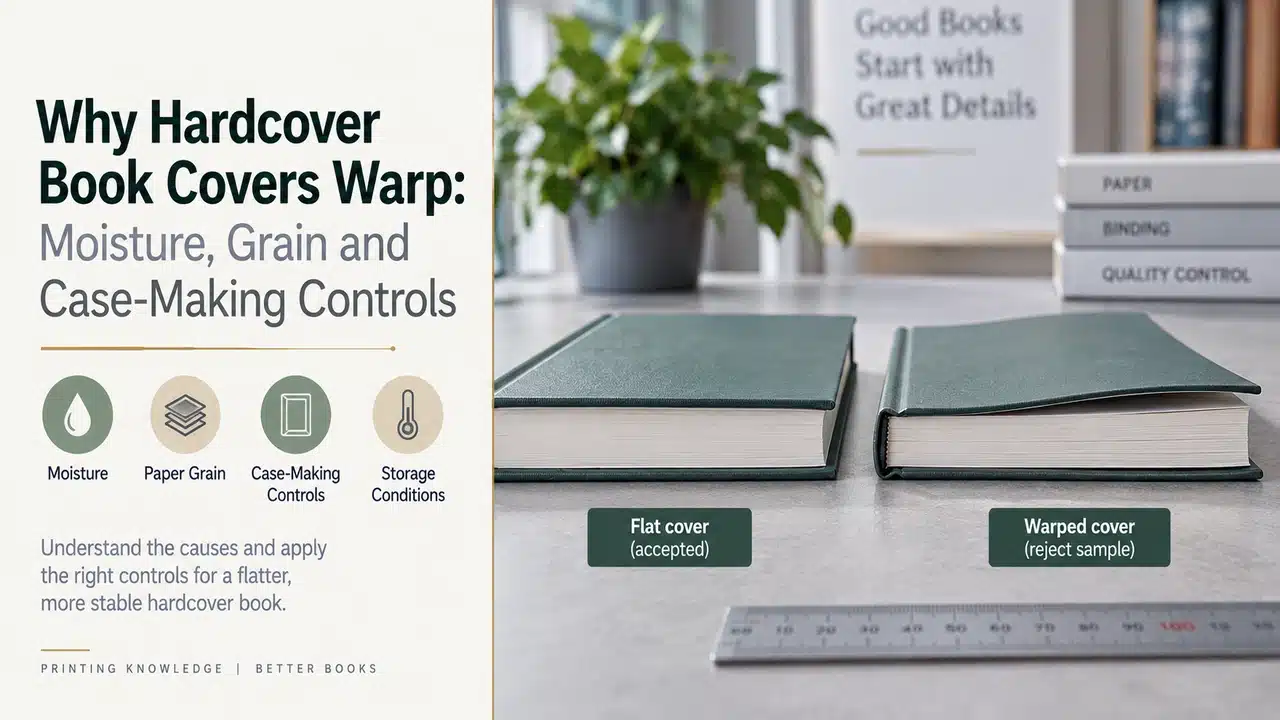
In June 2026, a bookbinder described an unusually useful failure: two covers made from the same materials, with the grain apparently correct, came out of the same assembly process, yet only the front board warped. The front also carried heat-applied foil and may have received more endpaper adhesive. The maker had tested a smaller prototype, but the defect appeared on the finished piece after casing-in.
That public case record does not prove whether heat, adhesive or drying caused the movement. It demonstrates something more valuable: hardcover book cover warping must be investigated as a sequence of material and process events, not blamed automatically on thin board.
A useful inspection starts with four facts:
| Record first | Why it matters |
|---|---|
| When the warp first appeared | Narrows the investigation to board storage, case-making, casing-in, decoration, conditioning or transit |
| Which cover moved | One-sided movement points toward an asymmetric material or process condition |
| Which direction it curved | Convex, concave and twisted covers do not carry the same evidence |
| Under what temperature and humidity it was checked | A measurement without conditioning context may not be repeatable |
Publishers ordering custom hardcover book printing should therefore approve more than the artwork and binding style. Board flatness, material grain, drying conditions and the time of inspection belong in the quality conversation, especially for large-format books, laminated cases and premium editions that will travel between climates.
Table of Contents
What Counts as a Warped Hardcover Cover?
A hardcover case is a laminated structure. Covering material is bonded to the outside of rigid board; turn-ins wrap around its edges; endpaper is pasted to the inside; the boards connect to a spine component through joints. PrintPack360’s hardcover book structure guide shows how these parts interact.
Warping occurs when a board no longer lies in its intended plane because the forces acting across those layers are unbalanced. It may appear as:
- bowing: the board curves mainly in one direction;
- cupping: corners or the fore-edge lift while another area remains closer to the book block;
- twisting: opposite corners move out of plane;
- one-sided warp: the front and back behave differently;
- delayed warp: the case looks flat at packing but moves after storage or transport.
Do not confuse cover warp with three different faults:
- A tight joint can make a flat board spring open.
- A wavy endpaper can indicate localized moisture without the board itself being permanently distorted.
- A crushed corner or bent case is impact damage, not moisture-driven curl.
The distinction matters because pressing a joint problem will not correct its geometry, and treating impact damage as a humidity issue sends the investigation in the wrong direction.
The Cover Is a Balance of Pulling Forces

Paper, board, cloth backing and many endpapers respond to moisture. They expand as they take up moisture and contract as they release it, but they do not all move by the same amount or at the same speed. Adhesive adds another moisture and drying event.
The classic bookbinding reference Bookbinding and the Conservation of Books defines warping as distortion caused by different expansion and contraction among cover cloth, board, board paper and adhesive films. It recommends mature board, grain parallel to the spine, minimum necessary adhesive moisture, adequate pressing and a stable atmosphere. Read the warping entry.
The important word is different. A board does not have to be visibly wet to move. It only needs one side or one layer to change dimension differently from the other.
Consider a printed paper-over-board case:
- The laminated printed wrap has its own stiffness and moisture permeability.
- Water-based adhesive is applied between wrap and board.
- The wrap is turned in, adding extra layers around the perimeter.
- During casing-in, the pastedown introduces moisture and contraction on the inner face.
- The closed book is pressed, dried, conditioned, packed and shipped.
If these forces reach a stable balance, the cover stays acceptably flat. If one layer dries faster, one face receives more moisture, materials run against grain, or the case is restrained before moisture has redistributed, the balance can move later.
Diagnose the Defect by the Time It Appears
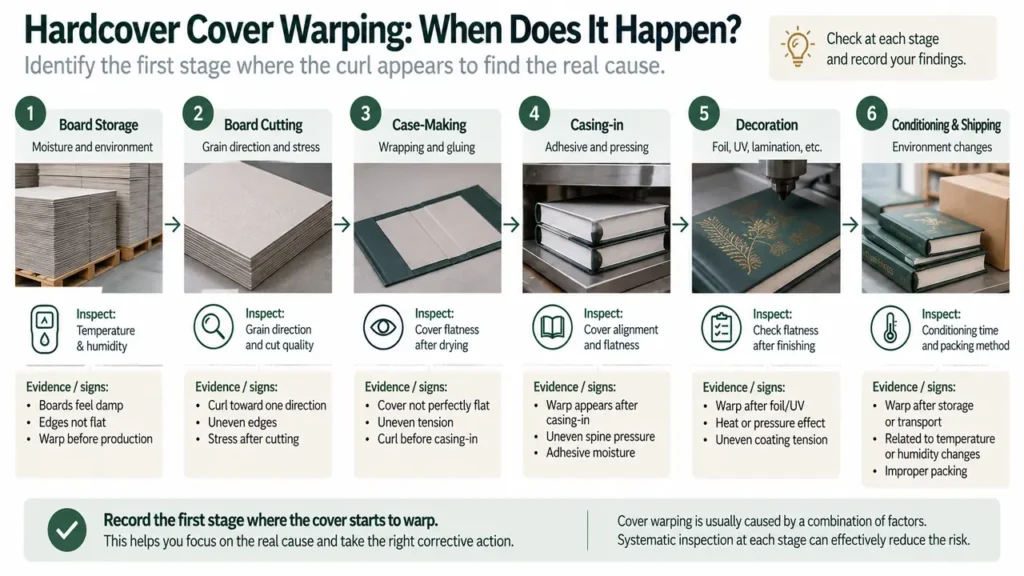
The timing of the first visible movement is often more useful than a photograph taken days later.
| First observation | Likely investigation area | Evidence to request |
|---|---|---|
| Board already curved before case-making | Incoming board moisture, storage, board lot, cutting and grain | Incoming inspection, lot record, flatness and grain check |
| Case warped after wrapping but before casing-in | Outer wrap, wrap adhesive, turn-ins, grain, case drying and pressure | Uncased case samples from the same run |
| One cover moved after casing-in | Pastedown adhesive amount, application uniformity, casing alignment and drying | Front/back process comparison and retained bound samples |
| Warp appeared after foil or another heated step | Local heat history, adhesive reactivation and material response | Decorated versus undecorated controls |
| Books were flat before packing but warped on arrival | Conditioning time, shrink wrapping, carton climate, route and storage shock | Pre-pack photos, packing date, transit data and carton-level pattern |
| Movement continues after unpacking | Product not at equilibrium or storage conditions still changing | Timed measurements under recorded conditions |
This table does not diagnose a book remotely. It tells the supplier where to preserve evidence. If every finished copy is simply pressed again before anyone records the stage, the most useful clue disappears.
Six Causes That Commonly Work Together
1. Unequal moisture across the board
The outer covering adhesive and inner pastedown adhesive do not necessarily enter or leave the board at the same rate. Uneven coating weight, extra glue near one edge, a delayed assembly step or different drying exposure can make one side pull harder.
An adhesive supplier’s technical note on bookbinding board warping identifies moisture imbalance in board or adhesive as a central cause. It also warns against adding water to a casing-in adhesive that is supplied ready to use, because added water raises the warping risk.
This is why “use less glue” is incomplete production advice. The process needs the correct adhesive for the material, a controlled application amount, complete coverage, suitable open time and repeatable drying. Too little adhesive can trade warp for weak bonding or bubbles.
2. Grain direction fights the structure
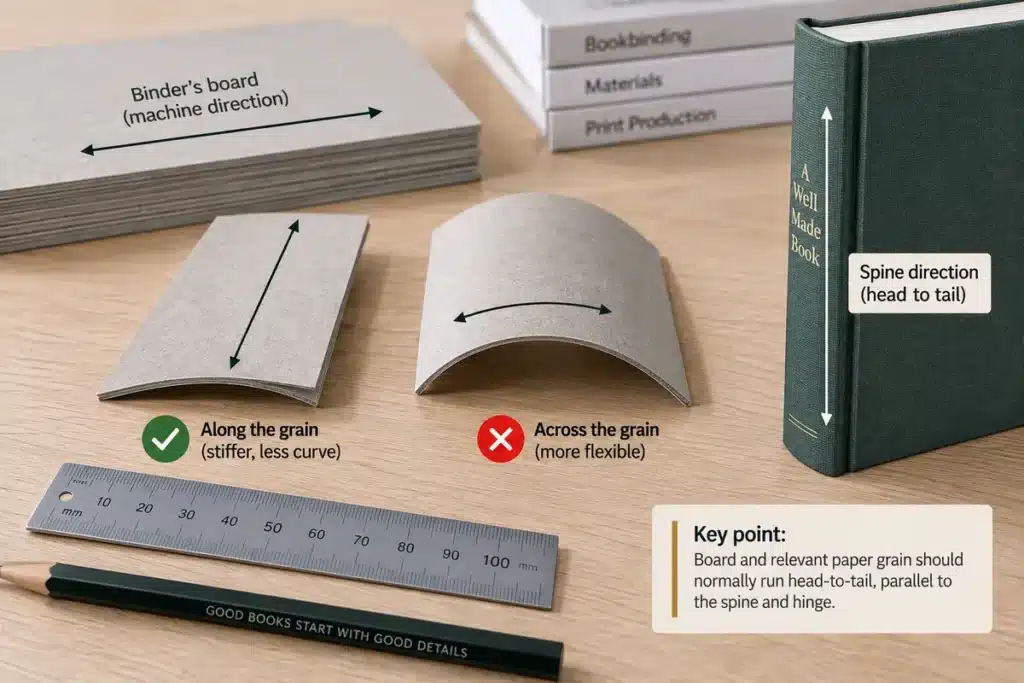
Board and paper have a machine direction. In a conventional hardcover construction, the grain of board, covering paper where relevant, and endpaper should normally run parallel to the spine or hinge. Cross-grain material moves and folds less predictably in the direction the case needs.
Correct grain does not guarantee a flat book, as the June 2026 case shows. It removes one major source of stress; moisture and layer balance still matter. Grain should therefore be checked and recorded, not assumed from sheet dimensions.
3. The two faces are mechanically unbalanced
A glossy or matte laminated exterior, coated printed paper, backed book cloth, thick decorative sheet or synthetic covering does not behave like the paper pastedown on the reverse. Turn-ins also make the board perimeter a different laminate from its center.
Material selection should be evaluated as a complete cover system. The decision is not simply “cloth or printed paper.” PrintPack360’s guide to book cloth versus a printed paper case explains the visual and production differences, while the bound sample confirms whether the chosen wrap, board, adhesive and endpaper remain compatible at the actual format.
4. Board specification is unsuitable or inconsistent
Thickness contributes stiffness, but flatness also depends on density, moisture condition, furnish, manufacturing quality and sheet consistency. A thicker board can still warp if it is cross-grain, unevenly conditioned or laminated with unbalanced layers.
Board should be selected in relation to:
- finished book height and width;
- text-block weight and thickness;
- square and joint geometry;
- cover material and decoration;
- opening behavior;
- slipcase or carton fit;
- expected handling and shipping route.
Large-format art books deserve particular attention because a long fore-edge gives a small curvature more visual and functional leverage. For an image-led edition, the custom hardcover art book route should be sampled at final format and material specification rather than judged from a reduced dummy.
5. Pressing and conditioning are incomplete
Pressure holds components in the intended plane while bonds form, but pressure does not erase an incompatible material stack. A book may look flat while restrained and then move as residual moisture redistributes.
NEDCC notes that thermal equilibration may take hours while moisture equilibration can take days, weeks or longer, depending on the object and environment. Rapid moisture change can distort paper and bindings. NEDCC environmental guidance.
For manufacturing, the practical lesson is not to borrow a museum storage number as a factory setting. It is to define when a book is considered conditioned enough for flatness inspection, decoration, shrink wrapping and carton packing.
6. The climate changes after the book leaves the line
A hardcover can move between an air-conditioned production room, a warm loading area, an ocean container, a winter warehouse and a heated retail space. Paper-based components continue to exchange moisture with the air.
The Library of Congress recommends a stable environment of no more than 55% relative humidity for most stored books and warns that levels above 60% or below about 30% can cause warping; rapid changes are also a concern. Library of Congress preservation guide.
Those ranges describe preservation storage, not a universal print-production tolerance. They are still useful evidence that both high and very low humidity, as well as fluctuation, can affect the finished object. Packing cannot be treated as separate from binding quality when books travel internationally.
Does Lamination Make a Hardcover Warp?
Lamination by itself is not a verdict. A laminated paper case can remain flat and durable when the total construction is balanced and properly processed.
However, lamination changes the exterior layer’s stiffness and its response to moisture. The inner pastedown remains a different material exposed to a different adhesive event. This makes sample scale, adhesive control and conditioning especially important. A supplier should evaluate the actual combination of:
- printed wrap stock;
- lamination film and bonding process;
- binder’s board;
- case-making adhesive;
- endpaper stock;
- casing-in adhesive;
- board size and format.
Do not solve a lamination concern by changing only the film name. The live guide to lamination film types for print covers can help with surface selection, while the bound proof determines structural behavior.
Does Thicker Board Prevent Warping?
Not reliably.
Thicker board resists bending more strongly, which can reduce visible movement under the same force. It can also add weight, change the joint, increase the case dimensions and affect opening. If the moisture and contraction forces remain unbalanced, added thickness may mask the problem temporarily rather than remove its cause.
Ask a better question:
Is the board specification suitable for this format, and is the complete case construction balanced and conditioned?
For a cloth-bound Smyth-sewn hardcover, for example, board choice should be reviewed together with cloth backing, foil pressure, endpaper, joint geometry and book-block weight. Substituting a thicker board without remaking the physical sample can create a new opening or fit problem.
A Practical Production-Control Plan
Before case-making
- Record board supplier, grade, thickness and lot.
- Inspect sheets for initial bow, twist, surface damage and mixed condition.
- Allow board and covering materials to reach equilibrium in the working environment.
- Confirm and mark grain direction parallel to the spine.
- Keep cut boards protected from local heat, damp walls, vents and loading areas.
During case-making
- Use the approved wrap, board and adhesive combination.
- Control adhesive rather than diluting or adjusting it informally.
- Check coating uniformity, open time and wrap position.
- Keep turn-ins even and avoid localized adhesive pools.
- Retain several uncased covers for comparison if the project is high risk.
During casing-in and drying
- Apply pastedown adhesive consistently across front and back.
- Check casing position and joint formation before pressure.
- Use suitable pressing or flat drying for the approved process.
- Do not move wet books prematurely into uneven stacks.
- Record when the books leave pressure and when flatness is checked.
Before decoration and packing
- Inspect a conditioned sample, not only a book fresh from the press.
- Compare decorated and undecorated copies when heat or pressure is added later.
- Recheck case dimensions before designing a close slipcase.
- Avoid trapping incompletely conditioned books immediately in shrink film or dense cartons.
- Keep a signed production sample and retained copies from the packed run.
These controls belong in the proofing plan. PrintPack360’s sample strategy helps separate what a digital proof, material sample, white dummy and finished bound sample can actually approve.
How to Measure Cover Curl Without Guessing
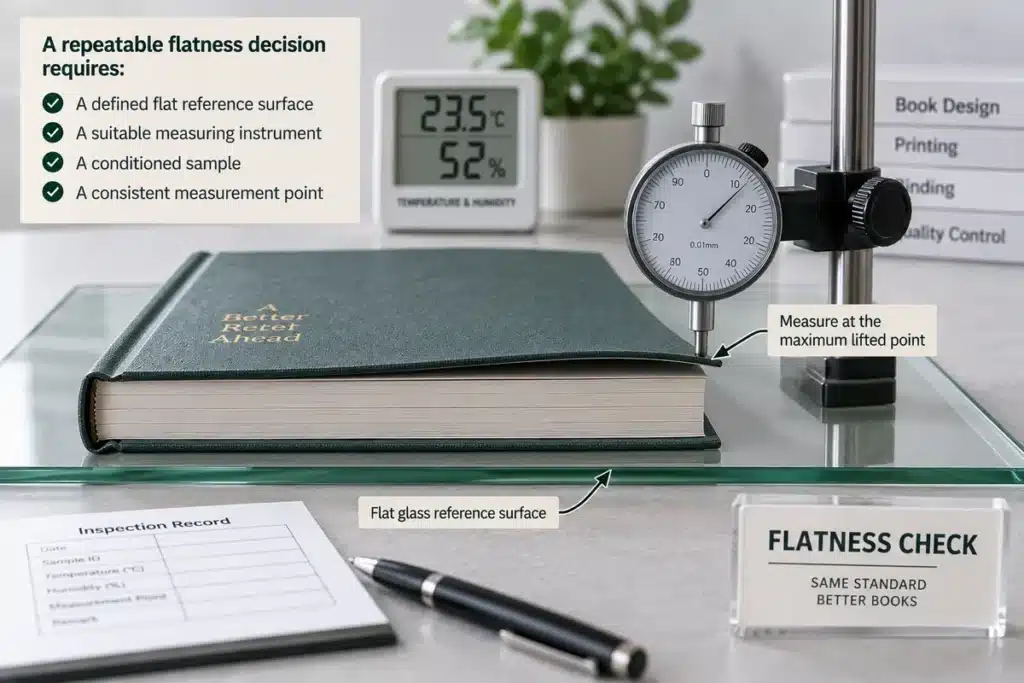
A casual visual check is useful for screening, but a contract needs a defined method.
Canada’s Quality Levels for Binding provides one published method for casebound books. Samples are conditioned to equilibrium at 21 degrees C and 50 +/- 2% RH. A micrometer dial gauge over plate glass records the maximum cover height; cover thickness is subtracted, and the direction is recorded as convex or concave. Under that specification, 3 mm or greater is a critical, unacceptable curl defect. See the Canadian government test method.
The same document lists maximum perpendicular deviation for different binding quality levels:
| Quality level in the published specification | Maximum page or cover warping |
|---|---|
| Prestige | 0 mm |
| Library | 0.8 mm |
| Informational | 1.0 mm |
| Office | 1.3 mm |
| Utility | 2.5 mm |
These values are valuable because they show that “looks slightly curved” can be converted into a conditioned measurement. They should not be copied blindly into every purchase order. The specification was written for defined government binding quality levels, while commercial books vary in size, board, materials and intended use.
For a custom project, agree in writing:
- the measurement surface and instrument;
- the temperature, relative humidity and conditioning period;
- whether front and back are recorded separately;
- whether convex, concave and twist are classified separately;
- the sample size and carton selection;
- the acceptable limit for that product;
- when inspection occurs relative to production and delivery.
A simple receiving check can place a closed book on a verified flat surface and record the maximum lift with a scale or feeler gauge. That is useful for sorting and evidence, but it is not automatically equivalent to the Canadian dial-gauge method.
Buyer Decision Table
| What you observe | Do not assume | First useful action | Production decision |
|---|---|---|---|
| Both boards curve similarly immediately after binding | All board is defective | Compare uncased covers and drying records | Review adhesive, pressure and conditioning before continuing |
| Only one board curves | Board thickness is the sole cause | Compare front and back adhesive, decoration and handling | Hold production until the asymmetric step is identified |
| Flat sample, warped bulk books | The sample approval was meaningless | Compare sample and bulk materials, timing and packing | Audit lot, process drift and pre-pack conditioning |
| Warp appears after a heat-applied finish | Foil always causes warp | Compare decorated and undecorated controls | Requalify heat, dwell, pressure and material stack |
| Warp is concentrated in certain cartons | The entire binding run failed identically | Map cartons, pallet position, route and moisture exposure | Separate manufacturing-wide and logistics-localized causes |
| Cover springs open but remains flat | Board is warped | Inspect joint width, endpaper pull and spine geometry | Diagnose opening resistance separately |
| Slight stable curvature with no function loss | It must be accepted or rejected by opinion | Measure under agreed conditions | Apply the project-specific tolerance consistently |
What to Do When a Shipment Arrives Warped
Do not immediately iron, mist, bend or clamp the books. Those actions change the evidence and may damage lamination, foil, cloth, endpapers or joints.
Instead:
- Photograph unopened cartons, pallet condition and any moisture indicators.
- Record delivery time, room conditions and when each sample was unpacked.
- Select books from different cartons and pallet positions.
- Photograph each book on a flat reference surface from the same angle.
- Record front/back, direction and maximum deviation.
- Keep affected and unaffected samples under the same documented conditions.
- Notify the supplier before attempting corrective treatment.
- Agree whether the next step is conditioning, expanded inspection, sorting, rework or replacement.
For a small movement caused by environmental transition, the shape may change as the book reaches equilibrium. That possibility is a reason to record timed observations, not a reason to dismiss the complaint. Severe curl, twisting, cracked joints, lifting pastedowns or a cover that prevents normal closure requires a formal corrective-action review.
What to Send With a Hardcover RFQ
To assess warping risk before quotation and sampling, provide:
- finished trim size and orientation;
- page count, paper type and paper weight;
- binding method and spine shape;
- board thickness preference, if any;
- printed paper, book cloth, PU or other covering material;
- lamination, foil, debossing, embossing or heat-applied decoration;
- endpaper stock and printing requirements;
- quantity and edition variants;
- slipcase or rigid-box fit requirements;
- individual wrapping and carton preference;
- delivery country, season and route;
- flatness or curl acceptance requirement, if contract-critical;
- proof, retained-sample and third-party inspection expectations.
If flatness is a critical-to-quality characteristic, state it before sampling. It is much easier to qualify the material stack and test method before production than to debate the word “warped” after delivery.
FAQ
The first four questions reflect recurring buyer decisions in hardcover quotation and proofing. The final four are adapted from visible public discussions among bookbinders, including recent 2025-2026 cases. Each answer begins with practical production guidance; the related discussion is listed at the end for traceability.
Is a slight curve in a hardcover book acceptable?
It depends on the agreed quality level, measurement condition, direction, stability and effect on use. A slight inward tendency is not equivalent to a twisted board or a cover that prevents closure. Replace visual adjectives with a measured, conditioned limit. Canada’s binding specification treats 3 mm curl as critical under its defined test, but your purchase order may require a stricter project-specific tolerance.
Will 3 mm board stop a hardcover from warping?
No board thickness guarantees flatness. Three-millimetre board may suit some large or heavy books, but warp also depends on board quality, grain, moisture, wrap, endpaper, adhesive and conditioning. Approve the complete bound construction rather than one isolated material number.
Can laminated paper-over-board covers warp?
Yes. Lamination gives the outer surface protection and changes its stiffness and moisture response, but the case remains a layered paper-and-board structure. Control the complete combination and inspect a full-size bound sample after conditioning.
When should cover flatness be approved?
Check it at more than one stage: after the case is made, after casing-in and conditioning, before packing, and again during receiving inspection. The contract should identify which stage and environmental condition controls formal acceptance.
Can a warped hardcover cover be corrected after casing-in?
Sometimes the visible curl can be reduced through controlled conditioning and pressing. However, repressing alone does not prove that the underlying moisture or material imbalance has been corrected.
For a commercial order, do not mist, iron or manually bend the finished books. Keep affected and unaffected samples under the same documented conditions, measure the direction and extent of the warp, and ask the manufacturer to validate any proposed rework on separate copies before treating the full shipment.
Related public discussion: Fixing warped boards after casing-in or assembly.
Should a warped case be used for casing-in?
No. In commercial hardcover production, a visibly warped case should be held before it is attached to the book block.
The supplier should inspect board condition, grain direction, covering and pastedown materials, adhesive application, drying time and pressure. Casing-in introduces another adhesive and moisture event, which can make the original cause more difficult to isolate. Production should resume only after a corrected or remade case remains within the agreed flatness tolerance following conditioning.
Related public discussion: Warped boards before casing-in.
Why can a book board warp after heat pressing?
Heat can accelerate moisture loss, change the stress balance between the cover layers and reactivate or soften some adhesive systems. The board may therefore remain flat before decoration but move after heat and pressure are applied.
Test the intended board, covering material, adhesive and decoration together. Compare decorated and undecorated samples using controlled temperature, dwell time and pressure, then inspect them again after conditioning. A result from a craft heat-transfer process should not be treated as proof of how industrial foil stamping will behave.
Related public discussion: Book board warping after heat pressing.
Why can hardcover boards and endpapers warp several days after binding?
Delayed warping usually indicates that moisture and internal stress were still redistributing after the book left the press. The pastedown, board and exterior covering can absorb and release moisture at different rates, so a newly bound book may appear flat before it has reached equilibrium.
Review adhesive amount and uniformity, material grain, the balance between the inner and outer layers, drying time and storage conditions. Extra pressing may temporarily reduce the curve, but the defect can return if the underlying imbalance remains.
Related public discussion: Book boards and endpapers warped after a week.
Flatness Should Be Specified, Not Hoped For
Cover warp is a system defect. Board thickness matters, but it sits inside a chain that includes grain direction, wrap, endpaper, adhesive, pressure, time, decoration, climate and packing.
For a new edition, send PrintPack360 the complete format, material stack, finishes, quantity and delivery route. The hardcover book printing service can then develop the case around the actual book, with a full-size bound sample and a written flatness check before bulk production.