An essential oil gift box can look excellent in a rendering and still fail when the bottles are packed.
The problem is usually inside the box. A cavity is a little too loose, so the bottles lean. The dropper cap sits too high and touches the lid. A label rubs against the insert edge. The customer cannot remove the bottle without pulling on the pipette. Or the insert holds everything neatly on a shelf but offers too little protection for parcel delivery.
Choosing an essential oil gift box insert is therefore not a matter of selecting EVA, paperboard or molded pulp from a material list. The insert has to work with the real bottle, closure, label, box structure, sales channel and brand position.
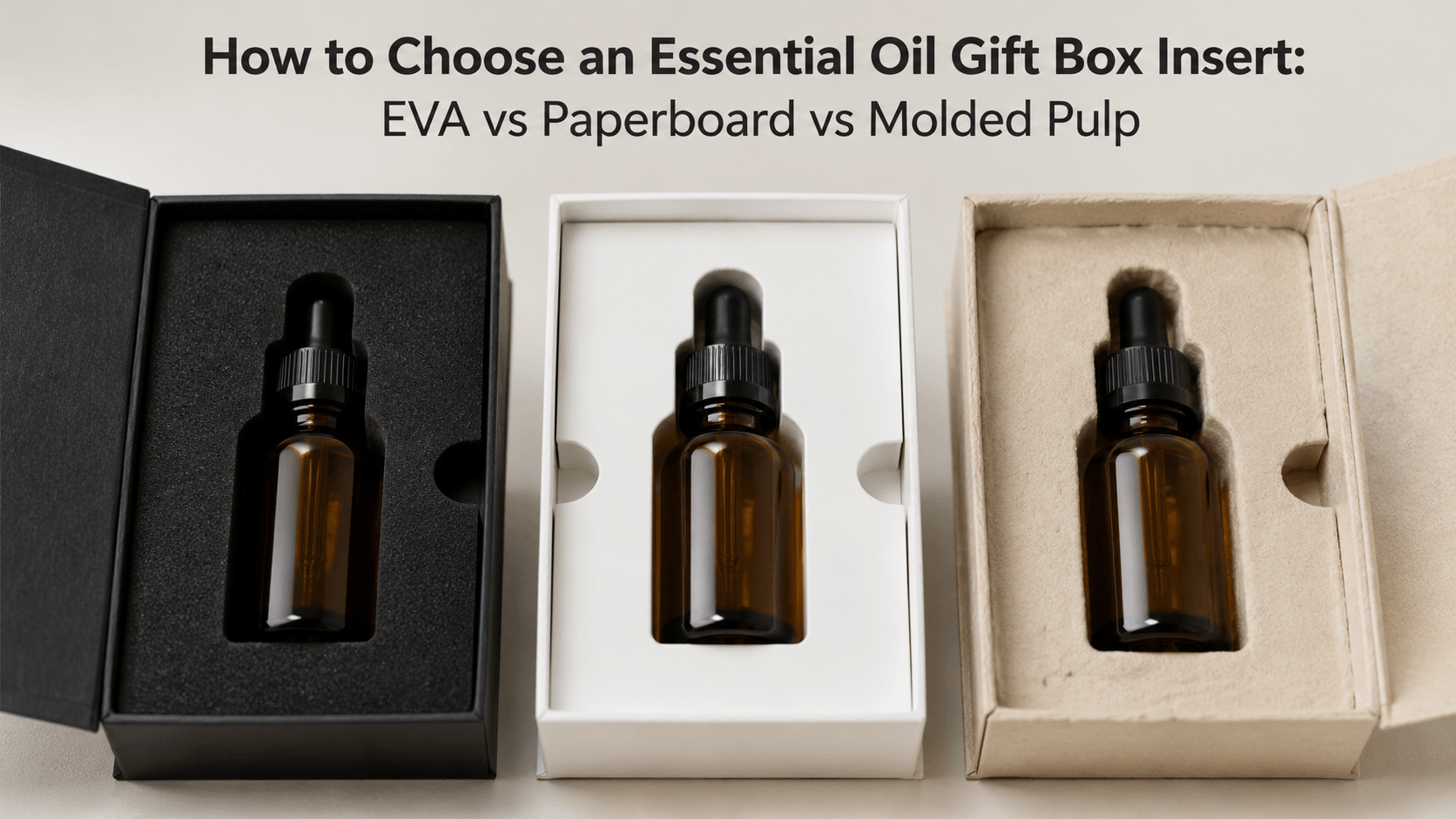
For premium retail sets, a precisely cut EVA insert may provide the cleanest presentation and the most controlled bottle fit. For a paper-led brand, a folded paperboard insert can reduce material variety and create more space for printed information. For larger programs with stable bottle geometry, molded pulp can provide a shaped fiber solution with a distinctive tactile character.
The best choice is the one that solves the product’s actual risks without adding unnecessary material or volume.
Table of Contents
The Short Answer: Which Insert Should You Choose?
Use this table as a starting point, not as a substitute for a fitted sample.
| Decision factor | EVA foam insert | Folded paperboard insert | Molded pulp insert |
|---|---|---|---|
| Best fit | Premium multi-bottle sets, glass bottles and complex layouts | Lightweight bottles, simple layouts and paper-focused packaging | Stable bottle ranges, larger programs and molded fiber presentation |
| Bottle retention | Very good when density, thickness and cavity dimensions are correct | Good when folds, locking tabs and support points are engineered properly | Good, but depends heavily on geometry, wall thickness and molding tolerance |
| Surface appearance | Smooth, precise and available in several colors | Clean, printable and visually integrated with the outer box | Natural, tactile and less geometrically sharp unless a higher-finish process is used |
| Oil and moisture exposure | Closed-cell EVA can offer useful resistance, but the selected grade still needs testing | Cut edges and uncoated fibers can stain or weaken after exposure | Fiber can absorb moisture or oil unless the material and treatment are designed for it |
| Tooling and setup | Die-cut tooling; practical for many custom gift box projects | Die-cut and crease tooling; often efficient for short and medium runs | Mold tooling and development are usually more involved |
| Branding options | Limited direct printing; can be laminated with paper, fabric or flocking | Can carry print, instructions, color and brand graphics | Usually used for form and texture rather than fine printed branding |
| Material separation | Foam normally needs to be removed from the paper box | Can support a more paper-dominant structure if coatings and adhesives are controlled | Can support a fiber-based presentation, subject to local recovery systems and added treatments |
| Main risk | Wrong density, visible cutting marks, odor, poor bottle clearance | Weak support, torn locking tabs, oil staining or an overly flat appearance | Tooling cost, rougher surface, moisture sensitivity and dimensional variation |
Choose EVA when precise presentation and firm bottle retention are the leading priorities. Choose paperboard when a printed, paper-led structure and efficient production matter more than deep cushioning. Consider molded pulp when the project has enough scale and design stability to justify a molded solution.
For sets that combine several bottles, accessories and premium finishing, PrintPack360’s custom aromatherapy essential oil gift box can be developed with EVA foam, paperboard, molded pulp or a mixed insert structure around buyer-supplied bottle dimensions.
Start With the Bottle, Not the Box
The insert cannot be engineered accurately from a nominal bottle volume alone.
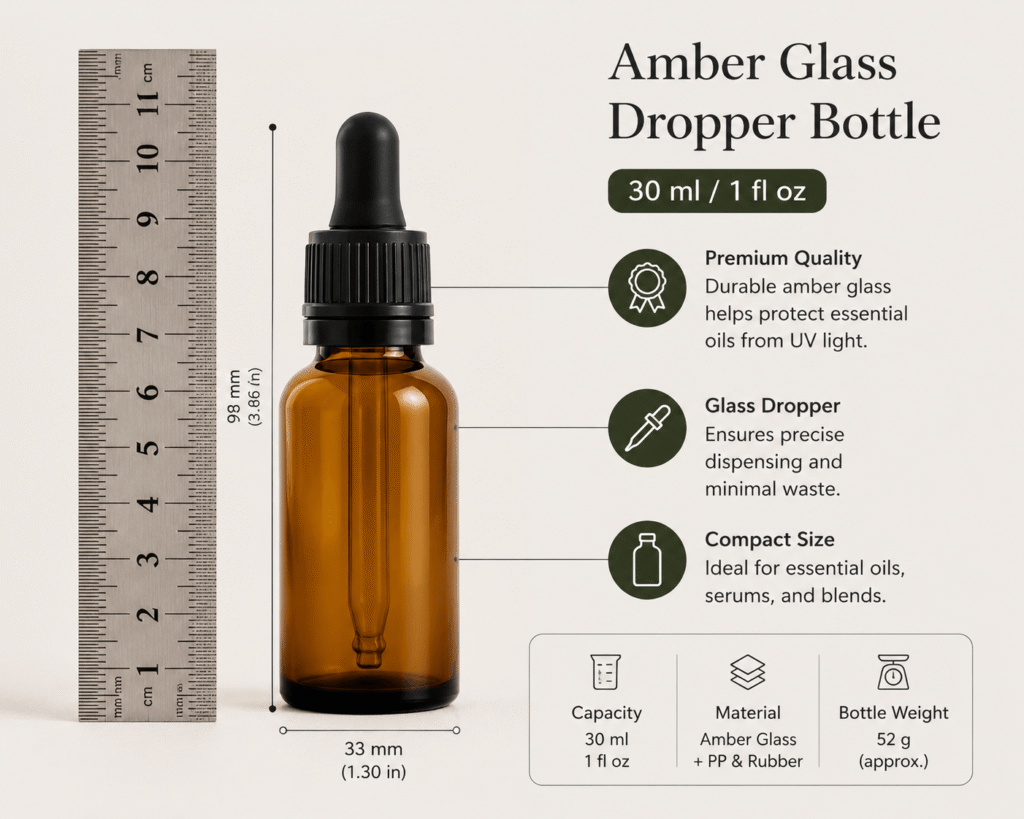
Two bottles sold as 30 ml may have different diameters, shoulder shapes, bases, cap heights and label panels. A 50 ml bottle with a dropper closure may be taller than a 100 ml bottle with a short screw cap. Decorative frosting, thick labels and tamper-evident bands also change the fit.
Before an insert dieline is created, record:
- Maximum bottle diameter or width
- Total height including cap, dropper, pump or atomizer
- Base shape and shoulder geometry
- Filled weight
- Label position and thickness
- Any tamper band, seal or collar
- Number of bottles and desired arrangement
- Accessories such as droppers, stones, instruction cards or applicators
- Required finger space for removal
A physical production bottle is better than a drawing. If the bottle has not entered production, supply a dimensioned drawing and confirm whether the dimensions are nominal or include manufacturing tolerance.
The insert should usually retain the bottle around a stable body area rather than place pressure on the dropper bulb, pump, fragile cap decoration or label edge. It also needs enough clearance above the tallest component so closing the lid does not transfer load into the bottle.
EVA Foam Inserts: Precise, Protective and Presentation-Driven
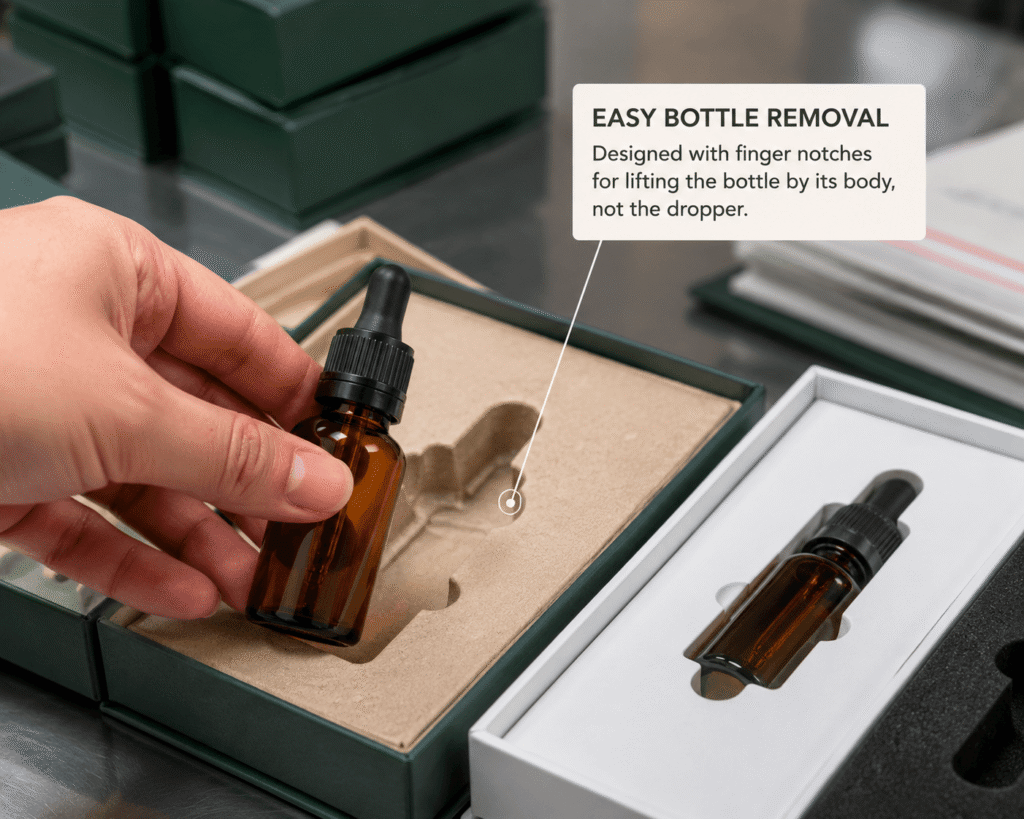
EVA is common in premium fragrance, beauty and wellness gift packaging because it can be cut into clean cavities and selected in different thicknesses, densities and colors. A dark insert can create strong contrast around amber or clear glass bottles, while white or light-colored EVA can support a softer wellness presentation.
EVA is a closed-cell foam. A technical data sheet from one established material supplier describes its EVA grade as flexible, chemically resistant and low in water absorption, while also making clear that buyers must determine whether the specific grade is suitable for their application. That distinction matters: an EVA data sheet describes one material, not every foam sold under the EVA name.
Where EVA works well
- Premium rigid boxes with one or several glass bottles
- Essential oil discovery sets
- Aromatherapy kits with bottles of different diameters
- Sets that must stay visually aligned when opened
- Heavy bottles that need firm lateral support
- Layouts with accessories or layered cavities
What buyers should specify
Density and compression: Foam that is too soft can allow a heavy bottle to lean or work loose. Foam that is too firm can make removal difficult or place pressure on labels and decorative coatings.
Cavity size: The cavity should retain the bottle without crushing a label or requiring the customer to pull on the closure. A small difference in diameter can materially change insertion force.
Thickness: A thin insert may not provide enough depth. A thick solid block can add cost, weight and material. Laminated or layered construction may be appropriate when the required depth exceeds the practical sheet thickness.
Surface finish: Standard cut EVA is functional, but premium projects may use paper-faced, fabric-faced or flocked surfaces. These treatments change appearance, friction, odor, material separation and cost.
Color: Black can show light dust or cut residue. White can reveal handling marks. A custom color should be evaluated against the box wrap, bottle glass and label rather than approved as an isolated swatch.
Odor: Fragrance packaging is unusually sensitive to smell. Ask for a representative material sample and evaluate it after the box has been closed. Do not assume that every foam grade or adhesive is odor-free.
EVA’s main trade-off
EVA provides control and a premium visual result, but it introduces a non-paper component. If easy material separation or a paper-dominant pack is central to the brand brief, the insert should be designed so the customer can remove it without dismantling the entire box. Recycling acceptance also varies by material and local collection system, so avoid broad claims such as “fully recyclable” without evidence for the finished pack and target market.
Paperboard Inserts: Efficient, Printable and Often Underestimated
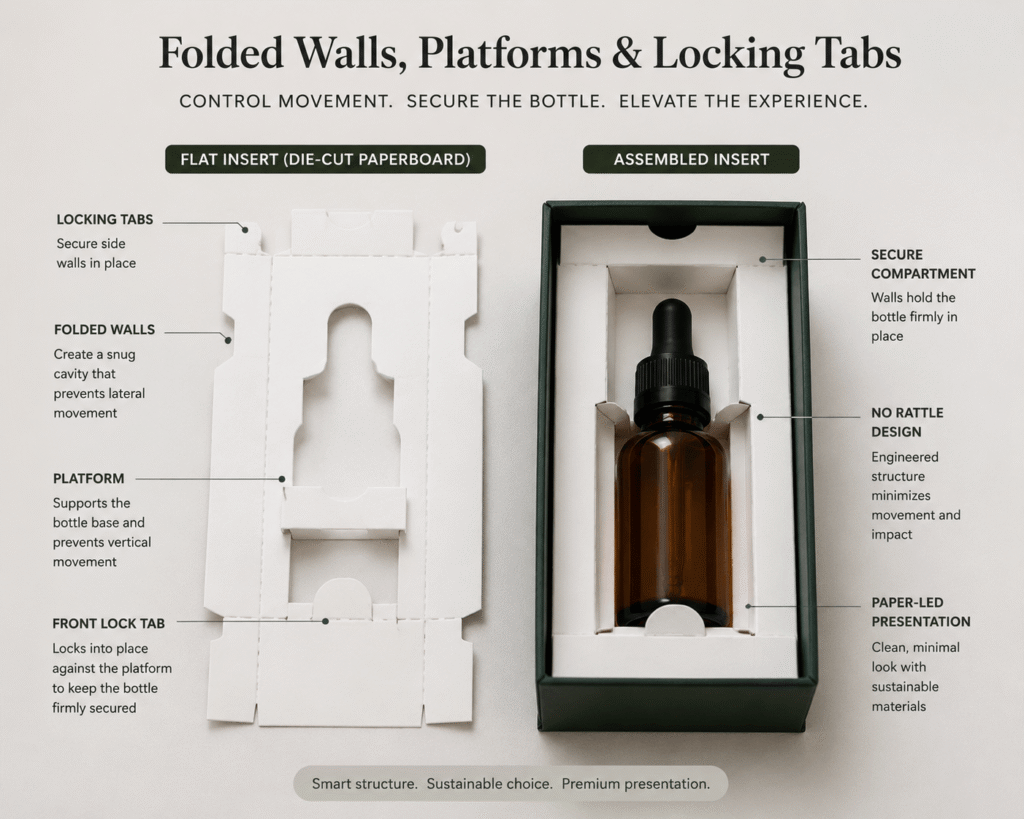
A paperboard insert is not simply a flat card with holes. A well-designed insert uses folds, bridges, locking tabs, shoulders and support walls to control movement and distribute load.
Paperboard is particularly useful when the outer packaging is a folding carton or when the brand wants the insert to carry instructions, product names or a printed scent story. It can also be appropriate inside a rigid box when the bottles are light enough and the geometry allows reliable folded support.
Where paperboard works well
- Single-bottle and two-bottle essential oil packs
- Lightweight bottles with regular cylindrical geometry
- Folding cartons for retail shelves
- Sets requiring printed instructions or scent identification near each bottle
- Projects that want a paper-led visual language
- Short and medium production runs where a molded tool is not justified
PrintPack360’s embossed essential oil packaging boxes are a natural fit for single-bottle and compact retail formats where the carton provides information space and the insert supports the bottle without the volume of a large presentation box.
What good paperboard engineering looks like
A paperboard insert should support the bottle at more than one level when necessary. A top opening can control lateral movement while a lower platform or base panel carries the weight. Locking tabs should remain closed during packing and transit but should not create sharp pressure points against glass or labels.
Finger notches matter. Without them, customers may have to pull on the cap or invert the box to remove the bottle. The notch must be large enough to use but not so large that it weakens the support panel.
The grain direction, board thickness, crease depth and fold sequence affect assembly. A structure that works in a handmade prototype can become slow or inconsistent when hundreds of inserts are packed on a production line. Sampling should therefore include an assembly check, not only a visual review.
Paper does not automatically mean recyclable
Paper and cardboard are accepted by many community recycling programs, as the U.S. Environmental Protection Agency notes. That does not mean every finished paper insert will be accepted everywhere. Plastic films, foam laminations, heavy coatings, magnets, adhesives and contamination can affect recovery.
The Paperboard Packaging Alliance points designers to guidance on how coatings and non-fiber additives affect paper-based packaging recyclability. Its paperboard design resources are useful because they treat recyclability as a property of the complete construction, not a slogan attached to the base material.
Molded Pulp Inserts: Shaped Fiber With Different Economics
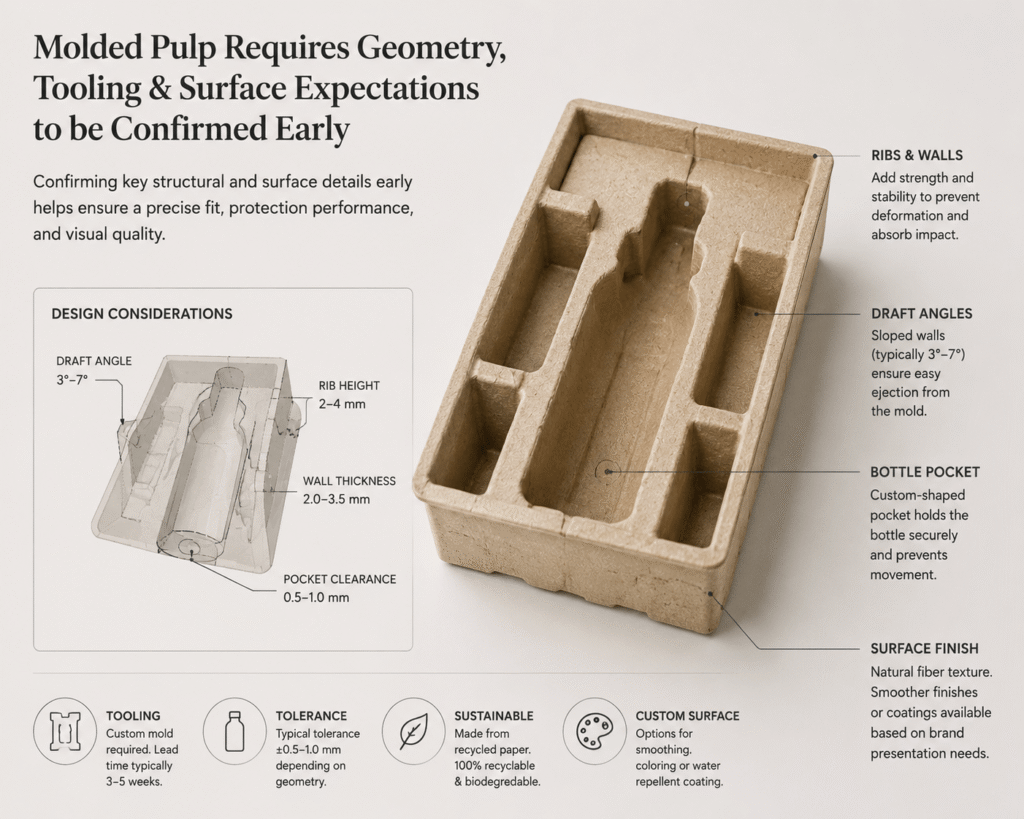
Molded pulp, also called molded fiber, is formed into a three-dimensional shape around tooling. It can create bottle pockets, ribs and protective walls without assembling several folded panels.
The material has strong visual relevance for natural, wellness and sustainability-led brands, but it should not be selected for appearance alone. Molded pulp has its own tooling, geometry, surface and moisture considerations.
Where molded pulp works well
- Stable bottle ranges expected to remain in production
- Larger quantities that can absorb mold development
- Brands that prefer a tactile fiber presentation
- Products that need shaped support and controlled spacing
- Programs where a molded insert can replace several separate packing components
Design realities to understand
Rounded transitions, draft angles, ribs and wall geometry influence molded pulp performance. Published research on molded pulp cushioning has shown that geometry affects static and dynamic strength; rounded and conical forms can behave differently from sharp rectangular shapes. This is one reason a molded pulp insert should be engineered around load paths rather than copied directly from an EVA cavity layout.
Surface finish varies by process. Some molded pulp has a visibly textured side and a smoother presentation side. Higher-finish molded fiber can look refined, but expectations about sharp corners, color uniformity and fine detail should be confirmed with samples.
Moisture and oil exposure also need attention. An untreated fiber insert may absorb a leak. A coating can change that behavior, but it may also change recyclability, appearance and cost. The finished material system needs to be assessed, not just the word “pulp.”
Molded pulp’s main trade-off
It is less forgiving of late bottle changes. If the bottle diameter, cap or arrangement changes after tooling, the insert may require modification or replacement. For a startup still testing several bottle suppliers, die-cut EVA or folded paperboard may provide a more adaptable development path.
A Fourth Option: Hybrid Insert Construction
The choice is not always limited to one material.
A premium rigid box might use a structural paperboard platform with small EVA retention pads only where the bottles need lateral control. A paperboard insert can carry printed product names while a thin foam layer protects a delicate bottle coating. A molded pulp tray can sit inside a printed sleeve that provides cleaner graphics and regulatory information.
Hybrid construction can reduce the amount of a high-cost or non-paper material, but every added layer introduces assembly, adhesive and material-separation questions. Use it only when each component performs a clear function.
Bottle Protection Is More Than a Tight Cavity
A tight fit can create the impression of security while moving stress to the wrong place.
The insert should be evaluated as part of the complete pack:
- Lateral control: Can the bottle lean, rotate or collide with another bottle?
- Vertical control: Can it jump upward and strike the lid during a drop?
- Base support: Is the filled weight carried by a stable platform?
- Closure clearance: Does the lid press on a dropper, pump or decorative cap?
- Label protection: Does the insert rub, crease or cover important information?
- Removal: Can the customer lift the bottle without pulling on a fragile component?
- Pack-out speed: Can operators load the set consistently without forcing parts?
- Surface protection: Can foil, soft-touch wrap or specialty paper rub against accessories during transit?
A gift box is also not automatically a shipping box. Glass bottles sold online normally need a suitable transport pack around the retail presentation box.
The International Safe Transit Association describes ISTA Procedure 3A as a general simulation test for individual packaged products shipped by parcel, including vibration and drop-related hazards. That does not mean every essential oil set requires formal ISTA certification. It does show why a shelf presentation test is not enough for a product expected to travel through parcel networks.
How Sustainability Changes the Decision
Sustainability should be translated into design requirements that can be verified.
Possible requirements include:
- Reduce total insert weight
- Reduce unused internal volume
- Use fewer material types
- Make different materials easy to separate
- Source eligible paper through a documented chain of custody
- Avoid unnecessary laminations or decorative layers
- Maintain enough protection to prevent product loss
The last point is important. A lighter insert that allows glass bottles to break is not a meaningful improvement.
The EU Packaging and Packaging Waste Regulation calls for packaging weight and volume to be minimized while preserving necessary functionality. It also treats filler material as empty space when calculating certain packaging ratios. The official PPWR text is relevant to brands selling in Europe because it pushes packaging development toward documented function rather than volume added only for perceived size.
For FSC claims, using paper from an FSC-certified source is not by itself enough to place an FSC mark freely on a finished box. Chain-of-custody and trademark rules need to be followed for the applicable product and supply chain.
A Practical Sampling Process
The insert should be approved in stages.
1. Confirm the product data
Send final bottles, closures, labels and accessories whenever possible. Record the filled weight and identify any components that can scratch, leak or deform.
2. Review the proposed layout
Confirm bottle count, orientation, spacing, removal direction and the location of cards or accessories. This is the least expensive point to change the arrangement.
3. Make a structural sample
A blank sample can confirm the box dimensions, cavity positions, opening behavior and general fit before premium printing and finishing are added.
4. Test the actual fit
Load production bottles. Check insertion force, removal, label clearance, cap clearance and bottle movement. Close the box and turn it through different orientations.
5. Review appearance and odor
Inspect the insert under normal retail lighting. Close the complete pack for an agreed period, then evaluate whether foam, adhesive, ink or wrap introduces an unwanted smell.
6. Evaluate distribution risk
Test the final retail and transport pack according to the actual sales channel. Parcel delivery, pallet shipment to a retailer and local hand delivery do not create the same hazards.
7. Keep an approved standard
Retain an approved sample or clearly documented specification covering material, color, density or board grade, dimensions, cavity layout and acceptable appearance.
PrintPack360 can provide digital proofs, blank structural samples, printed samples and insert-fit samples for a custom aromatherapy essential oil gift box. The appropriate sample route depends on the structure, insert material and finishing requirements.
What to Send for an Accurate Quotation
Prepare the following information before asking suppliers to compare prices:
- Bottle dimensions and filled weight
- Bottle quantity per box
- Production bottle sample or dimensioned drawing
- Label position and any fragile surface coating
- Preferred box structure, such as drawer, book-style, sleeve or lift-off lid
- Insert preference, if already known
- Required insert color and presentation style
- Box artwork and Pantone references
- Foil, embossing, debossing, spot UV or lamination requirements
- Order quantity and number of SKUs
- Target market and sales channel
- Shipping destination
- Sample and launch deadline
Do not request quotations from box dimensions alone if the insert fit matters. Two suppliers can quote the same outer size while allowing very different material thickness, cavity tolerances, assembly methods and protection levels.
The Right Insert Is the One You Can Defend
EVA, paperboard and molded pulp can all be professional choices.
EVA is often strongest when a premium set needs precise cavities and controlled presentation. Paperboard is effective when print, efficient conversion and a paper-led structure matter. Molded pulp becomes attractive when the bottle range and order program are stable enough to support a shaped fiber solution.
The decision should be explainable in practical terms: how the insert holds the bottle, protects the label and closure, supports the unboxing experience, fits the production volume and behaves in the intended distribution channel.
If you are developing an essential oil set, send PrintPack360 your bottle dimensions, filled weight, bottle count, target market and preferred box style. We can review suitable insert routes as part of a custom aromatherapy essential oil gift box specification before sampling.
For a broader overview of boxes, labels, finishing and compliance planning, read our Aromatherapy Packaging and Label Printing Guide.
Frequently Asked Questions
Is EVA the best insert for essential oil bottles?
EVA is a strong option for premium glass-bottle sets that need clean cavities and firm presentation, but it is not automatically the best choice. Paperboard may be more appropriate for simple, lightweight or paper-led packs, while molded pulp may suit stable higher-volume programs. Final selection should follow an actual bottle-fit sample.
Can EVA foam react with essential oil?
The answer depends on the selected EVA grade, exposure, oil formulation and contact time. Under normal use, the oil should remain inside its bottle rather than contact the insert. If leakage is a foreseeable risk, test the actual foam, adhesive and surface treatment with the relevant product instead of relying on a generic chemical-resistance claim.
How tight should an EVA cavity be?
It should hold the bottle securely without crushing the label, scuffing a coating or making removal difficult. The correct allowance depends on bottle tolerance, foam density, cavity depth and application method. Approve the fit using production bottles, not only nominal dimensions.
Can paperboard inserts protect glass bottles?
Yes, when the structure supports the bottle at the correct points and the complete package is tested for its distribution channel. Paperboard can control movement effectively, but it behaves differently from foam and may require folded walls, platforms or dividers rather than a single flat panel.
Is molded pulp always more sustainable than EVA?
Not automatically. Material source, total weight, coatings, tooling, transport volume, recovery infrastructure and product protection all matter. A credible comparison should assess the complete pack in the target market rather than compare material names alone.
Can one insert hold different bottle sizes?
It is possible, especially with a stepped EVA cavity, modular paperboard structure or carefully designed shared pocket. However, a universal cavity can weaken presentation and retention. If several bottle sizes are sold together, supply every production bottle during development.
Do I need a physical sample before mass production?
For a glass-bottle gift set, a physical fit sample is strongly recommended. A digital proof cannot demonstrate cavity tolerance, bottle removal, cap clearance, material odor, surface rubbing or shipping behavior.