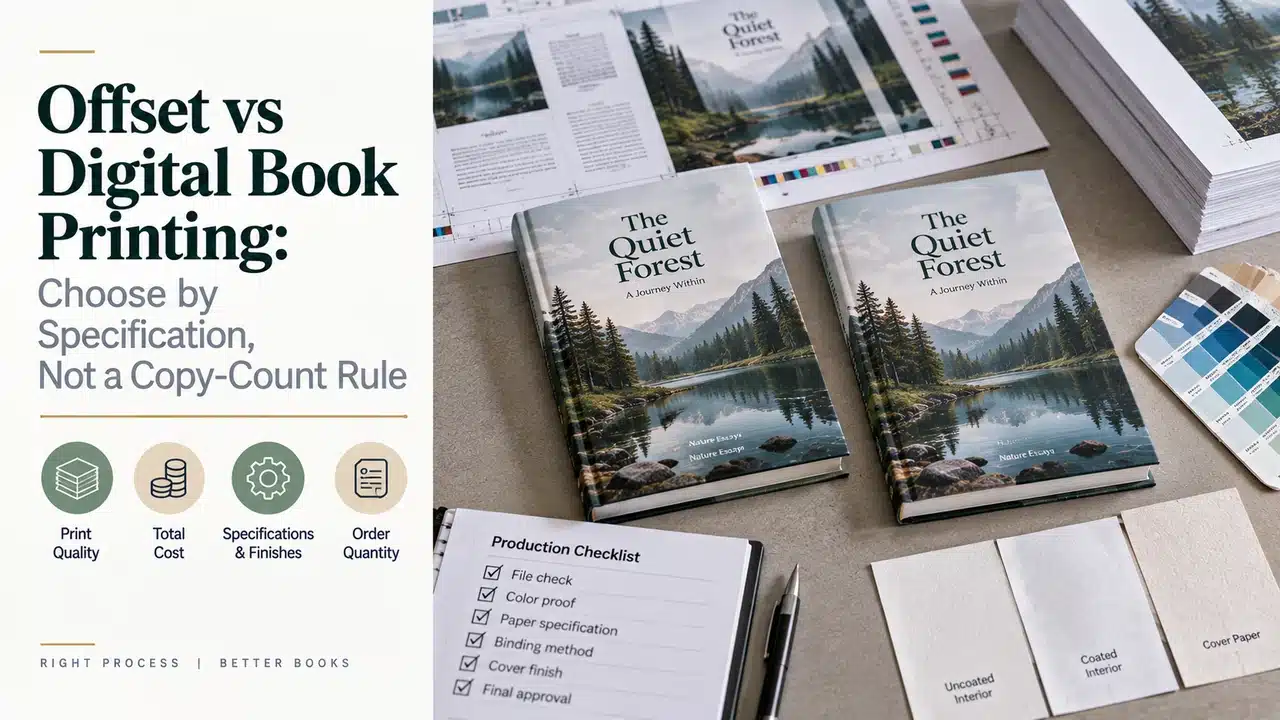
An inquiry that says “800 hardcover books, full color” is not yet a printing specification. Are all 800 identical? Is the interior on coated or uncoated stock? Does the edition contain photographs with critical shadow detail, a spot-color brand mark, or revised pages for different markets? Is the deadline for finished books in hand or merely for sheets off the press?
These questions can change the answer before the print quantity does. Offset vs digital book printing is a decision about the complete book, from file and paper to binding, delivery and reprint plan. A blanket rule such as “digital below 500, offset above 500” hides the variables that determine the real cost and the acceptable result.
Table of Contents
Start With Three Different Orders
Consider three illustrative specifications, not customer case studies or price quotations:
| Project | Initial production question | Likely route to quote |
|---|---|---|
| A 280-page, black-text paperback with a modest first order and frequent corrections | How much stock can the publisher safely commit to? | Short-run digital against a small offset batch |
| A 160-page, image-led hardcover on a specified coated stock, with identical copies for a museum shop | Can the press, paper and proof reproduce the approved images consistently? | Sheet-fed offset against a qualified production-digital route |
| A 64-page catalog with several regional price and language versions | How many unique interiors are there, and how many copies of each? | Digital for versioned content; assess offset if each version has meaningful volume |
All three are “books” in a quotation form. Their production economics are not interchangeable. The broader guide to five printing processes explains where offset and digital sit alongside flexography, screen and gravure; here the question is specifically how to choose for bound books and catalogs.
What Changes on the Press?
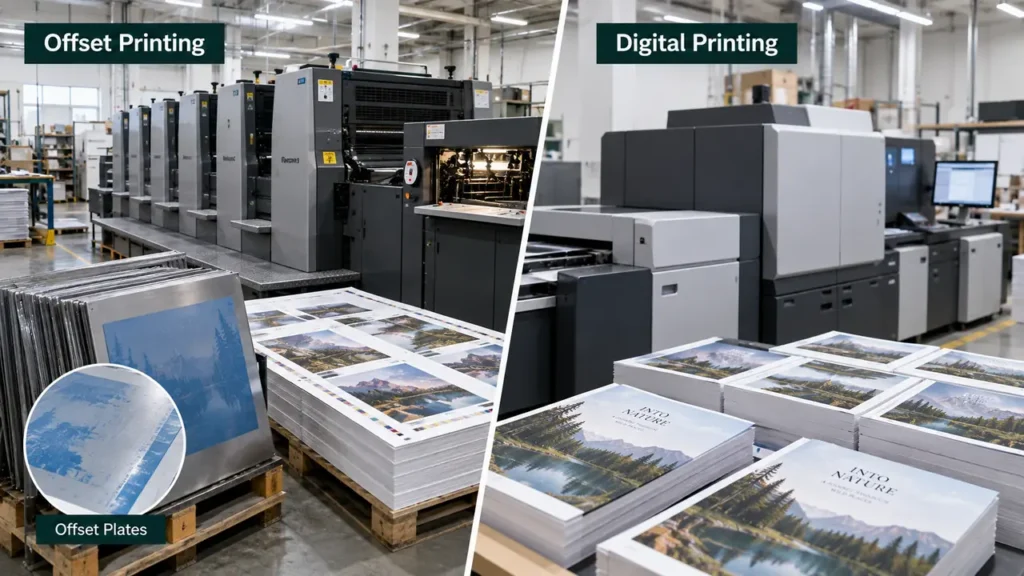
In conventional sheet-fed offset, each color separation is made into a printing plate. Ink transfers from plate to blanket and then to paper. Plates, imposition, press setup and makeready create work before the first approved sheet. Once the job is running, those fixed costs are spread over more copies. The exact crossover depends on the press, sheet size, ink coverage, paper and finishing, not just a single number of books.
“Digital” is not one press specification. Production electrophotographic presses and inkjet presses use different image-forming and drying systems. Neither requires the conventional offset plate set for each title. Digital is therefore particularly useful when a title has a small initial quantity, multiple versions or pages that may change. But its paper range, maximum sheet or web format, color configuration and binding workflow must be confirmed for the specific machine proposed. HP’s description of Indigo liquid electrophotography and Ricoh’s production inkjet specifications illustrate why “digital” alone is too broad to serve as a quality specification.
Modern offset can also be economical at shorter runs than old rules suggest. Heidelberg’s FINIDR book-production account discusses a book printer whose average run is below 3,000 sheets and describes automated makeready; another Jostens book-production example describes average press runs of 400 sheets. Those are manufacturer-reported press sheets, not 400 finished books or a universal break-even point. They demonstrate why the right answer has to be quoted against a real production plan.
The Cost Comparison Has to Include the Whole Job
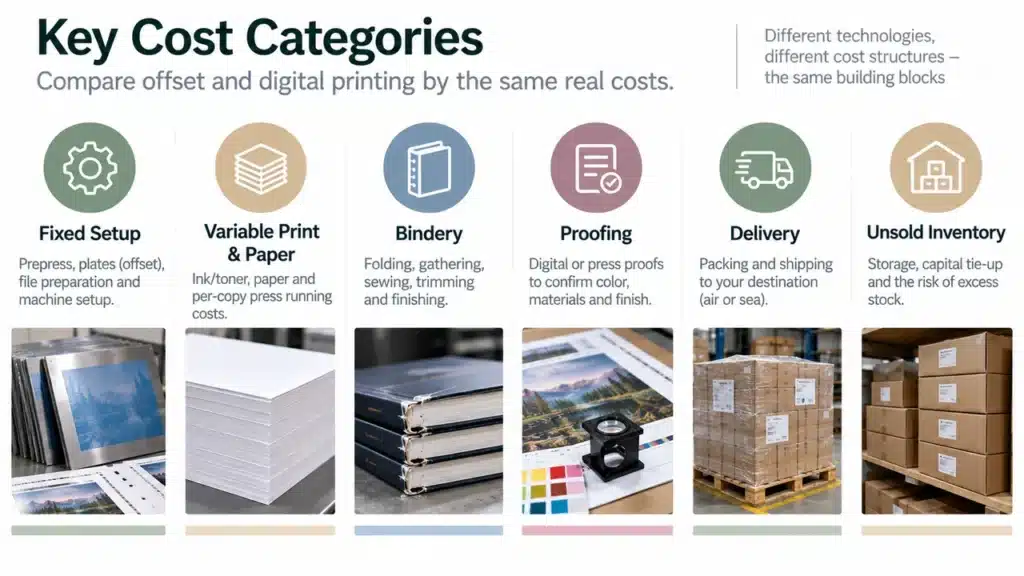
The useful equation is not simply unit print price:
Decision cost = prepress and setup + print and paper + bindery and finishing + proofing + packing and delivery + expected storage, obsolescence and reprint cost.
Ask for the same finished specification at two or three quantities, with any permitted process alternatives identified. A low digital quote for an uncoated text stock cannot be compared fairly with an offset quote for a heavier coated sheet. Nor can a delivered price be compared with an ex-factory price.
The most common distortions are practical:
- Quantity is confused with demand. A lower price per copy on 2,000 books is not a saving if half the stock is unlikely to sell before a revision.
- Versions are pooled incorrectly. Three covers or three interior languages may require separate files, makereadies and inventory, even if the total quantity looks attractive.
- Trim and pagination are treated as free variables. A change in format can alter sheet yield; an awkward page count can leave blank pages or require a different signature plan. Have the printer show the imposed layout, especially for sewn sections.
- The cheapest print route breaks a finishing requirement. Cover foil, laminated cases, foldouts, printed endpapers and sewn binding must be priced as a manufacturable sequence, not as decoration added after the printing decision.
- Freight masks the production choice. International freight, duty treatment and destination handling may outweigh a small difference in press cost. Ask for the agreed Incoterm and delivery point.
Our hardcover book printing cost guide breaks down the larger cost structure. This article addresses the narrower choice of production process within that structure.
Paper and Color May Decide Before Quantity Does
A novel and an art book should not be put on the same “standard paper” without a sample. Paper shade changes the perceived warmth of photographs; opacity affects show-through; caliper affects spine width and case fit. A digital press may be qualified for a particular coated or uncoated paper but not for every stock a buyer names. Even within one paper category, the actual mill grade and surface treatment matter.
For art book printing, specify the paper and color target together. Ask whether the printer is quoting process CMYK, extended-gamut simulation or a physical spot ink. A Pantone reference named in a file does not by itself guarantee a spot ink on the finished page; a digital press may simulate the color unless a suitable ink configuration and agreement are in place. Likewise, offset is not automatically more accurate: calibration, separation, paper white, measurement and press control determine whether the output meets the agreed reference.
ISO 12647-2 describes process-control parameters for sheet-fed and web-fed offset production. ISO 12647-7 addresses hard-copy digital proofs intended to simulate a defined print condition. These are not certificates that every printer or book complies with; they are useful references for asking which production condition is being simulated and how approval will be checked.
The Proof May Not Be the Production Copy
The phrase “physical proof” covers several different objects. A folded white dummy tests size, paper bulk and binding geometry without validating printed color. A calibrated hard-copy proof can check images against a target print condition but may not be on the final paper or made by the production press. A digitally printed bound sample of an offset job can reveal pagination, trim and much of the construction; it is not a literal offset-press sample. A press sheet or production-representative sample gets closer to the actual process, but may require setup and extra cost.
Before approval, record what each sample is meant to sign off:
| Approval question | Useful evidence | What remains unproved |
|---|---|---|
| Are pages, bleeds and versions correct? | Checked PDF and bound content proof | Final stock feel and press color |
| Does the book open and feel right? | Dummy or bound sample on proposed materials | Repeatability across the production run |
| Will critical images print as agreed? | Agreed color proof for the stated print condition; press check where warranted | Final appearance after lamination or coating unless represented |
| Do the case, spine and finish fit? | Production-representative constructed sample | Batch-to-batch variation and transit performance |
PrintPack360’s sample strategy explains the available proof levels. Put the approval reference, permitted tolerances, paper identity and finish on the purchase specification; do not rely on a phone photo of the first copy.
A Practical Selection Table
| If your binding constraint is… | Start by evaluating… | Verify before choosing |
|---|---|---|
| One title, very low initial demand or frequent revisions | Production digital / short-run replenishment | Paper, color, binding, minimum economical reorder and consistency between batches |
| Stable artwork and a substantial identical run | Offset plus any suitable production-digital alternative | Imposition, makeready, proof, sheet yield and total delivered cost |
| Many language, cover or customer-specific versions | Digital, or a hybrid of common offset sections and versioned digital components | Collation, file control, SKU labeling and color consistency between components |
| Critical photographic reproduction on a specified stock | Both routes only if each is qualified on that stock | Controlled proof, substrate white, ink behavior and approved reference |
| Actual spot ink or specialty finishing | Offset for the relevant component; confirm digital alternatives individually | Whether “match” means physical ink, simulated color or postpress foil/UV |
| A premium casebound edition with sewn signatures | Quote the entire book and binding route, not just interior sheets | Signature layout, fold behavior, grain direction, endpapers, case and packing |
For a text-heavy launch, paperback book printing may be the better commercial starting point. For a sewn casebound edition, begin with the hardcover book printing specification. A changing catalog program should be assessed by version count and update cycle, not by total pages alone. The short-run book printing guide discusses launch and inventory strategy in more detail.
What to Send for a Quote You Can Actually Compare
Send one specification sheet to all bidders: finished trim; page count (including endpapers and blank pages); interior and cover color; paper grade, weight, shade and grain requirements; binding; case or jacket construction; finishing; quantity per version; destination and requested delivery term; target date; and the proof you need before release. Flag photographs, solid brand colors, fine type and any supplied Pantone references. If the file is not final, say what may still change.
Ask each printer to return the proposed printing technology, paper substitution if any, imposed signature plan, sample type, production lead time, finishing method and exclusions. Ask for a second quantity only after the specification is frozen. This is how a comparison becomes a purchasing decision instead of a contest between incomparable numbers.
The best process is the one that makes the approved book reliably, in the quantity you can use, at a total cost you understand. Send the specification through the relevant book printing category for a process recommendation and a quote that states its assumptions.
FAQ
Can I print a short-run hardcover digitally and still use foil and a sewn binding?
Possibly. Printing method and binding/finishing are separate operations, but the proposed sheets, signature format and cover construction must work with the bindery and finishing equipment. Ask for a bound, finished sample of the actual specification rather than assuming every digital book has the same options.
What quantities should I request when comparing digital and offset?
Quote the quantity you can realistically sell or distribute, then one plausible replenishment quantity and one larger batch. Give the quantity for each version, not only the combined total. There is no universal break-even number because paper, imposition, press, color and finishing differ.
Can an offset book use a digitally printed cover or other mixed components?
Yes, if the printer validates format, lamination, color alignment, spine calculation, collation and finishing. A hybrid route can make sense for versioned covers with a common interior; it should be specified and proofed as one finished product.
What must I approve before an offset run begins?
Approve final files and version list, paper and binding specification, an agreed color reference where critical, the type of physical proof, and the changes that would require re-approval. A digital bound proof can approve content and construction without automatically approving offset color.
Can one digital proof tell me exactly what my offset books will look like?
No. It can check content and approximate a defined color condition if produced and evaluated as a proper contract proof, but its paper, ink behavior and finishing may differ from production. Name the target condition and the attributes the proof does and does not approve. Related public discussion: authors comparing the cost and purpose of physical book proofs.
Is offset still worth considering for only a few hundred books?
Sometimes, especially for a demanding specification or efficient short-run press, but ask for a real comparison. A press run measured in sheets is not the same as the number of finished books, and a low unit price does not justify unsold stock. Related public discussion: a publisher weighing a small deluxe hardcover offset run.
Why can’t a digital printer use the same cream book paper as the novels on my shelf?
It may be able to, but compatibility is press- and stock-specific: feeding, drying or fusing, shade, opacity and availability must all be checked. Request named paper swatches and a printed sample rather than treating “uncoated” as one uniform grade. Related public discussion: a novelist comparing digital services with traditional novel stocks.
Does a premium art book have to be offset printed?
No. Evaluate the particular digital press against the chosen paper, image quality, edition size and finishing. Offset may be a strong route for a stable, identical run, but finish compatibility and approved proofs matter more than a process label. Related public discussion: a self-publisher’s account of producing a collector hardcover art book. The author’s experience is useful context, not proof that digital cannot produce premium books.