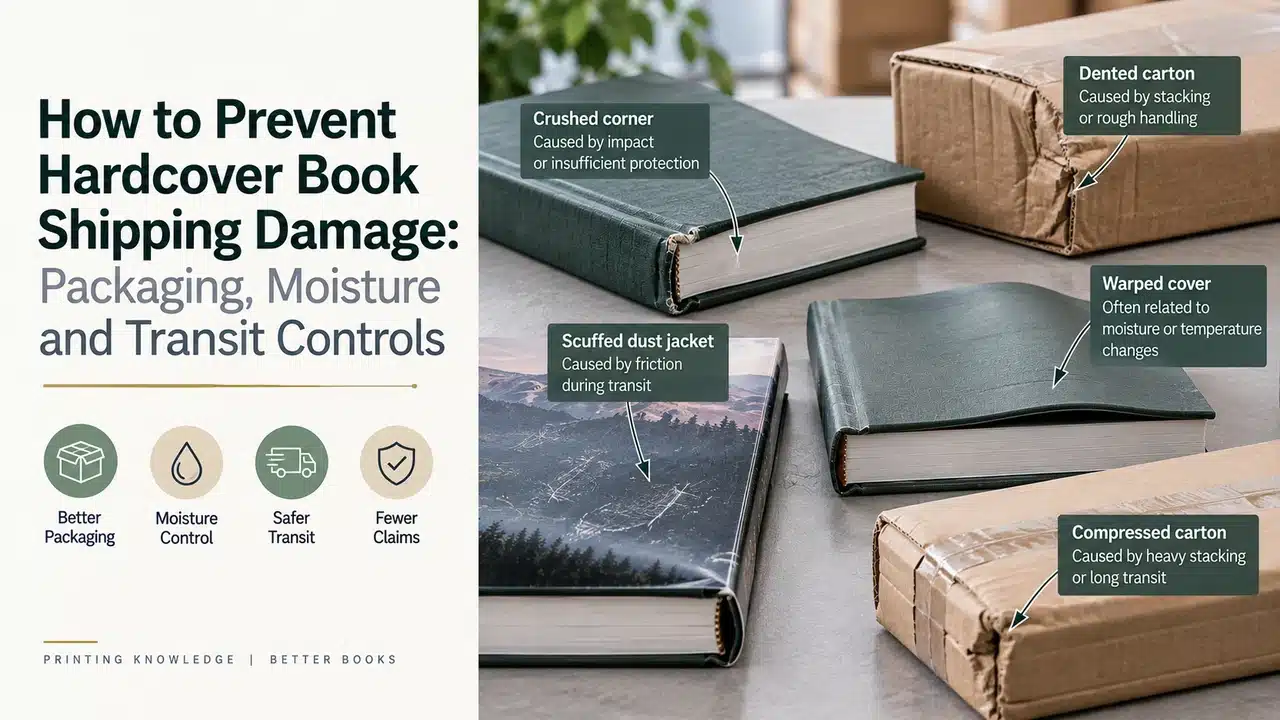
One crushed corner in one carton. Rubbed dust jackets in every carton. Wavy boards concentrated near a container door. Lower cartons on a pallet that have lost their shape.
All four may be reported as shipping damage. They are not the same failure.
The first points toward a shock event or weak corner clearance. The second suggests repeated movement or surface contact inside the pack. The third makes moisture exposure and climate change part of the investigation. The fourth raises questions about stacking load, pallet geometry, corrugated performance and warehouse conditions.
For publishers and brands buying custom hardcover book printing, the useful question is not simply whether the courier handled the shipment badly. It is whether the book, its individual protection and the complete distribution pack were designed for the route they actually travelled.
That distinction matters because a stronger outer box cannot correct every problem. A book can move inside an intact carton. A tight shrink film can distort a jacket. A premium slipcase can be scratched inside a master carton. A structurally sound case can still change shape when paper and board move between climates.
Read the Damage Pattern Before Changing the Packaging
Damage location is evidence. Record it before damaged copies are separated, repacked or pressed flat.
| Observed pattern | More likely mechanism | Evidence to preserve |
|---|---|---|
| One corner crushed, with a matching carton dent | Local drop or impact; insufficient corner clearance | Carton face and corner photos, book orientation, cushioning position |
| Similar corner damage across many books, cartons intact | Pack too tight, force transferred through carton, or damage before packing | Packing-line photos, retained pre-shipment samples, carton dimensions |
| Scuffs repeated in the same area of jackets or cases | Internal movement, rough wrap, divider contact or ink/coating transfer | Unopened carton, wrap material, contact surfaces, rub-test samples |
| Dust jacket folds bent but case corners sound | Tight film, poor jacket positioning or compression around the book | Unwrapped and wrapped comparisons, film tension and fold position |
| Page edges rubbed or chipped | Unprotected edge contact, loose fit or abrasive insert | Orientation, insert geometry, individual sleeve and movement check |
| Boards wavy or covers curled after a long route | Moisture imbalance, condensation, rapid climate change or incomplete conditioning | Carton location, bag condition, humidity record, pre-pack flatness samples |
| Bottom cartons bowed or collapsed | Stacking load, pallet overhang, weak or wet corrugated, excessive carton weight | Pallet pattern, carton specification, gross weight and warehouse photos |
| Random mixed damage after fulfillment | Repacking variation, wrong mailer, missing insert or uncontrolled handling | SKU-level pack instruction, station audit and parcel records |
An intact shipping carton does not prove that damage occurred before dispatch. Repeated vibration can let a heavy book strike an internal wall without visibly puncturing the box. Conversely, matching deformation on the carton and product is strong evidence of an external event.
The aim is not to assign blame from a photograph. It is to preserve enough evidence to distinguish a manufacturing defect, a packing defect, a transit event and a receiving or fulfillment error.
Treat the Book and Package as One Tested System
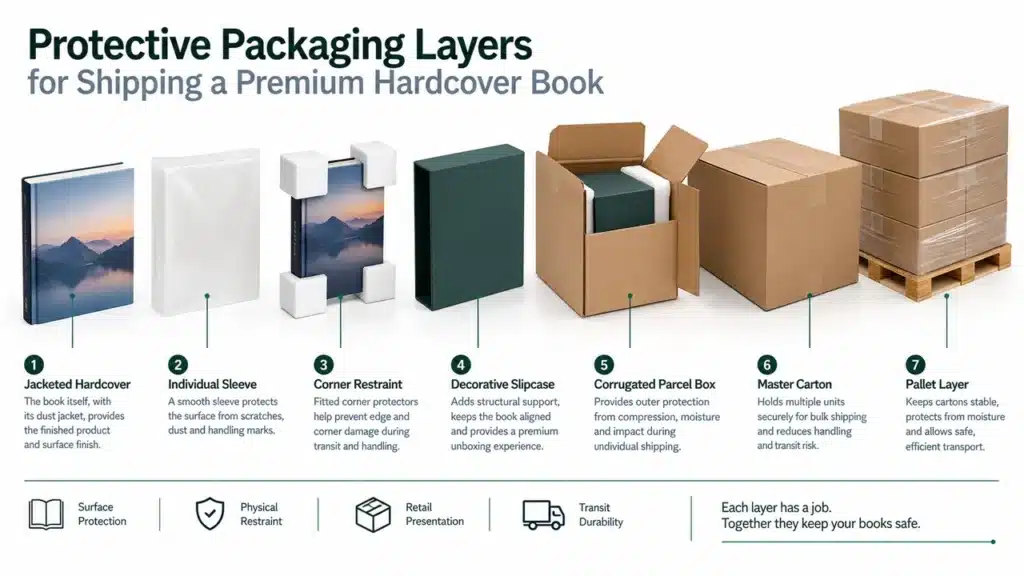
A premium edition moves through several protective layers:
- The book itself, including case, jacket, page edges and inserts.
- A non-abrasive surface barrier or individual bag.
- A component that limits movement and protects vulnerable edges or corners.
- Retail presentation packaging, such as a slipcase or rigid box.
- An inner or parcel carton.
- A master carton and, for bulk freight, a palletized load.
Each layer has a different job. Confusing those jobs creates expensive packaging that still fails.
A thin sleeve can keep dust away but absorb almost no impact. Bubble material can cushion a surface yet leave a heavy corner poorly supported. A fitted EVA insert can immobilize a collector set but add cost, mixed materials and shipping volume. A slipcase gives shelf protection and presentation, but its open side and wrapped edges are not designed to behave as an export carton.
This is why the book slipcase versus clamshell box guide states that a retail enclosure still requires transit packaging. For a hardcover book with a jacket and slipcase, protection must be checked twice: the book should not damage the slipcase from inside, and the shipping pack should not damage the slipcase from outside.
Five Failure Mechanisms to Control
1. Impact and corner crushing
Hardcover corners concentrate force. A thick book block also has enough mass to keep moving when the carton stops suddenly. If the book sits directly against the corrugated wall, a drop can transfer force through the carton into the board corner.
Corner protection therefore depends on more than adding loose filler. The pack should:
- keep the book away from likely impact faces;
- prevent the book from accelerating inside a void;
- distribute force without creating a hard pressure point;
- retain its geometry after repeated handling;
- remain practical for the packer to assemble consistently.
For a single book, a correctly sized corrugated mailer with engineered folds or fitted pads may outperform an oversized box filled inconsistently. For a heavy collector set, a fitted EPE or EVA component may be justified. The correct solution depends on mass, format, corner construction, retail value and distribution channel.
2. Abrasion and internal movement
Foil, dark uncoated wraps, soft-touch lamination, printed page edges and dust jackets show contact differently. A finish can pass visual inspection at the factory and arrive polished, scratched or offset because two surfaces moved against each other for days.
Surface protection should be selected against the actual finish. Ask whether the wrap material:
- is clean and non-abrasive;
- transfers color under pressure or humidity;
- blocks against soft-touch or gloss coatings;
- catches on foil relief, jacket folds or sprayed edges;
- allows the packer to see orientation and SKU labels;
- remains stable for the expected transit time.
Do not assume that tighter is safer. A book held under excessive film tension can develop bent jacket corners, compressed headcaps or pressure marks. The pack should immobilize the product through controlled geometry, not by squeezing its decorative surfaces.
3. Compression and stacking
Bulk books are dense. A master carton that is easy to lift at the factory may still spend weeks beneath other cartons, encounter high warehouse humidity or be stacked with part of its footprint outside the pallet.
Compression planning should include:
- units per carton and gross carton weight;
- corrugated construction and supplier performance data;
- carton orientation and stacking pattern;
- pallet footprint with no unsupported overhang;
- total stack height and storage duration;
- edge boards, stretch wrap and strapping where required;
- openings, hand holes or perforations that reduce panel strength;
- expected humidity, because corrugated performance falls when it absorbs moisture.
Do not specify an outer carton only by color or flute name. Two cartons described with the same flute can differ in liner and medium quality, dimensions, joints, printing coverage and compression performance. The purchase specification should identify the construction and measurable performance needed for the load.
4. Moisture, condensation and climate shock
Paper, greyboard, cloth and many adhesives respond to relative humidity. The Library of Congress notes that most books are best kept in a stable environment and warns that relative humidity above 60 percent can contribute to warping and mold, while very dry conditions and rapid changes can also cause distortion. Its book-preservation guidance is written for storage rather than commercial freight, but the material principle still applies: paper-based products react to moisture and to changes in moisture.
Long-distance shipping adds several variables:
- the books may be packed in one climate and opened in another;
- a container can pass through large day-night temperature changes;
- corrugated board and wooden pallets can carry moisture;
- cartons near doors, walls or floors may experience different conditions;
- sealed film can slow moisture exchange but cannot remove moisture already inside;
- desiccant capacity depends on enclosure volume, barrier performance, route and duration.
Desiccant is not a universal cure. It should be part of a defined system that includes conditioned product, suitably dry packaging materials, an effective moisture barrier where required, correct quantity and placement, and controlled sealing. Adding a small sachet to a permeable carton without calculation may provide reassurance rather than protection.
The related production issue is covered in PrintPack360’s guide to hardcover book cover warping. When boards are flat before packing but move after an international route, retained pre-shipment samples and carton-level patterns become especially important.
5. Fulfillment and repacking variation
A pallet can arrive at a warehouse in perfect condition and still produce customer complaints. Final-mile risk begins when the fulfillment center removes books from master cartons and places them into individual mailers.
The pack instruction should be treated as a controlled document. It should show:
- the correct mailer or box by SKU;
- book orientation;
- jacket and slipcase orientation;
- required wrap, pads and dividers;
- acceptable and unacceptable void space;
- placement of prints, cards and signed components;
- sealing method and label location;
- packed weight and a visual pass standard.
For subscription and crowdfunding editions, every version should have its own SKU and pack configuration. PrintPack360’s guides to subscription box book printing and Kickstarter special edition production explain why edition design, fulfillment weight and replacement stock must be planned together.
A Packaging Decision From a Real Quotation-Stage Project

The following example comes from an anonymized PrintPack360 quotation-stage packaging review. It is not presented as a completed shipment result, and historical prices have been omitted because they are not transferable to a new order.
The proposed product was a 6 x 9 inch collector hardcover of about 500 pages and roughly 1 kg. It included a reversible dust jacket, foil and UV decoration, colored endpapers and three-sided decorated page edges. The packaging discussion compared a basic corrugated solution, a bubble bag, a velvet-covered EPE insert and a printed anti-scuff corrugated structure with EPE or EVA.
The bubble bag was rejected as the only protection layer. It was inexpensive, but it did not reliably immobilize a heavy book or isolate the corners, jacket and decorated edges from impact. The working recommendation moved toward an extra-hard, approximately 3 mm B-flute corrugated structure, with fitted support selected according to the intended presentation level.
There was also a print-production constraint. High-quality foil could not be expected directly on a rough corrugated surface. The premium route required printing, laminating and foiling a coated paper first, then mounting it to the corrugated board. A simpler direct print or applied label was the economical branding route.
The useful lesson is not that every 1 kg hardcover needs the same flute or insert. It is that packaging decisions should begin with the vulnerable product features and packed mass, then separate three questions:
| Decision | What must be protected | Suitable direction to evaluate |
|---|---|---|
| Surface protection | Jacket, foil, lamination and page edges | Smooth individual barrier; no uncontrolled rubbing |
| Structural restraint | Heavy book block and case corners | Fitted geometry, corner clearance, EPE or EVA where justified |
| Branding | Exterior print and foil quality | Direct corrugated print for economy; mounted printed sheet for premium finish |
That sequence produces a defensible specification. Starting with a photograph of an attractive box often does not.
Choose the Pack for the Distribution Route
The same book may need more than one shipping configuration.
| Route | Dominant risks | Packaging priority | Validation approach |
|---|---|---|---|
| Factory to distributor by palletized sea freight | Compression, moisture, long storage, pallet handling | Master-carton strength, pallet geometry, moisture plan and load stability | Loaded-carton and pallet review; route-appropriate testing |
| Factory to launch event by air freight | Repeated handling, tight schedule, dimensional weight | Controlled carton weight, robust corners, clear labels and spare stock | Sample shipment or representative handling test |
| Fulfillment center to consumer by parcel | Drops, vibration, mixed orientation, conveyor handling | Individual immobilization, corner clearance and consistent mailer | Parcel distribution simulation and monitored trial shipments |
| Distributor to bookstore in case packs | Repacking, carton opening, repeated movement | Reclosable case pack, dividers, count accuracy and surface barrier | Warehouse pack trial and receiving inspection |
| Direct international parcel | Long route plus parcel impacts and climate changes | Parcel protection, barrier strategy, documentation and claims evidence | Representative international trial where commercially justified |
ISTA identifies Procedure 3A as a general simulation for individual packaged products weighing 70 kg or less moving through parcel delivery systems. Its test-procedure directory also distinguishes parcel, less-than-truckload, direct-import and retailer-fulfillment environments. That distinction is important: choosing a familiar test name is not the same as choosing the correct protocol for the shipment.
Carrier packaging rules still apply independently. ISTA’s own 3A overview states that the procedure does not necessarily satisfy carrier packaging regulations. The UPS packaging guide and FedEx customer packaging guidelines both emphasize strong corrugated containers, individual cushioning, restricted movement, proper sealing and double boxing for products that need additional protection.
What a Useful Transit Test Should Answer
A laboratory test should reproduce the product-package combination that will be shipped. Testing an empty box proves little. Testing a hardcover without its jacket, insert or final mailer may miss the exact surfaces that customers later reject.
Depending on the route and risk, the plan may include:
- atmospheric preconditioning;
- drop or rotational shock;
- vibration;
- compression or top load;
- post-test inspection against defined product criteria;
- opening, removal and repacking checks;
- comparison with actual field shipments.
ISTA recommends monitoring real shipments and retesting when the product, package or process changes. Its design and testing guidance specifically notes that changes to components, materials, interior packaging or closure methods can affect performance.
That means a passed pack should be reconsidered after a meaningful change, such as:
- a heavier paper or higher page count;
- a new dust-jacket stock;
- adding a slipcase;
- changing from EPE to folded board;
- reducing carton dimensions;
- changing the fulfillment center or parcel carrier;
- shipping several volumes together instead of one.
Use PrintPack360’s book sample strategy to separate color approval, structural approval and transport validation. A beautifully finished bound sample is necessary for production decisions, but it is not automatically a tested shipping pack.
Packing QC Before the Shipment Leaves
The shipping specification should be inspectable. Terms such as “export packing” or “strong carton” are too vague to audit.
Individual unit controls
- Correct SKU, edition and components
- Jacket positioned correctly with no bent folds
- Foil, coating and page edges protected from direct abrasion
- Book dry, clean and conditioned before sealing
- Sleeve or bag material and sealing method confirmed
- Insert fitted without excessive pressure
- No free movement when the retail pack is handled normally
Carton controls
- Approved internal and external dimensions
- Approved corrugated construction and performance specification
- Correct units per carton and divider pattern
- No damaging void and no forced overpacking
- Gross and net weight recorded
- Carton number, SKU, quantity and orientation marked
- Agreed tape and sealing pattern used consistently
- Random carton opening confirms the packing instruction was followed
Pallet controls
- Cartons remain within the pallet footprint
- Load pattern and height match the approved plan
- No crushed lower cartons before dispatch
- Edge protection, stretch wrap and strapping applied as specified
- Pallet and load are clean and suitably dry
- Shipping marks and labels remain visible
- Final photographs show every side and the container position where relevant
For a high-value order, retain one packed reference carton or a complete set of packaging components when practical. Retained evidence is far more useful than trying to reconstruct the packing method after a claim.
Receiving Inspection and Damage Evidence
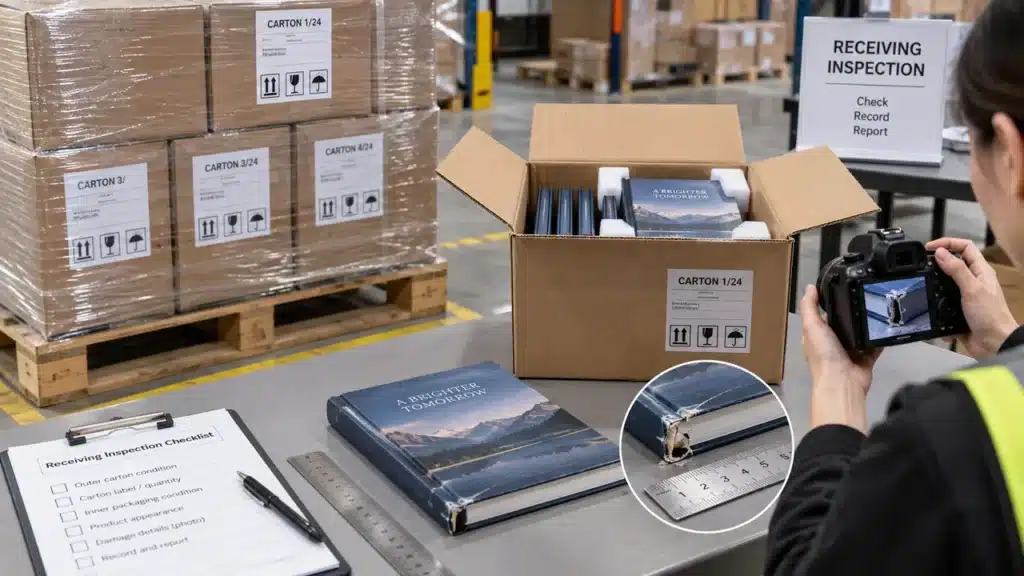
The receiving team should know what to photograph before it cuts the wrap or discards cartons.
- Photograph the pallet or parcel as received, including all sides and labels.
- Record visible water marks, punctures, crushing, leaning, broken straps or pallet overhang.
- Photograph the container number and relevant interior condition for containerized cargo.
- Open selected cartons in sequence and retain their carton IDs.
- Photograph the product in its original packing position before removal.
- Separate manufacturing defects from damage that aligns with the pack or carton.
- Count affected and unaffected units by carton, layer and pallet position.
- Retain representative damaged books and packaging until the claim is reviewed.
Maersk’s cargo claims guide asks claimants to photograph both exterior packaging and damaged goods and, where relevant, the container and container number. Carrier and insurer notice periods vary, so the buyer should check the applicable contract and claim procedure immediately rather than waiting for a full internal investigation to finish.
A useful damage report includes:
- purchase order and shipment reference;
- date, location and receiving conditions;
- total received quantity and inspected quantity;
- affected quantity by defect type;
- carton and pallet distribution;
- clear photographs with scale where helpful;
- retained samples and packaging;
- requested containment action;
- deadline for supplier response.
Put Packaging and Responsibility Into the Purchase Order
The trade term does not replace a packaging specification. ICC explains that Incoterms rules allocate tasks, costs and risk, but do not substitute for the sales contract. Its official Incoterms overview is useful when defining where delivery and risk transfer occur.
The purchase order or approved specification should separately state:
- individual packaging materials and construction;
- units per carton, carton dimensions and target gross weight;
- master-carton and pallet requirements;
- moisture-control plan where required;
- test protocol, sample quantity and acceptance criteria;
- pre-shipment inspection scope;
- photo and packing-data requirements;
- spare or replacement quantity;
- defect classification and remedy process;
- delivery place and named Incoterms rule;
- who files a carrier or insurance claim and what evidence is required.
This is commercial planning, not legal advice. For a material order or unusual allocation of risk, the parties should have the contract reviewed by an appropriate trade or legal professional.
Buyer Decision Table
| Product and route | Main vulnerability | Minimum planning direction | Upgrade when |
|---|---|---|---|
| Standard jacketed hardcover to retail warehouse | Jacket rubbing and carton compression | Smooth individual wrap, controlled case pack, specified master carton | Route is long, humid or repeatedly handled |
| Heavy art book by parcel | Corner impact and book-block mass | Fitted corrugated mailer with corner clearance and immobilization | Format is large, retail value is high or trial damage appears |
| Foil and soft-touch collector edition | Surface scratching and pressure marks | Non-abrasive barrier and no direct movement | Dark surfaces, broad foil areas or high rejection threshold |
| Decorated-edge novel | Edge scuffing and orientation errors | Sleeve plus insert that keeps edges away from contact | Several books share one mailer or inserts can migrate |
| Hardcover in a slipcase | Slipcase abrasion and book movement | Protect book-to-case and case-to-carton interfaces | Fit is loose, case wrap is delicate or parcel delivery is used |
| Multi-volume set | Accumulated mass and set movement | Fixed loading order, dividers and tested set restraint | Volumes vary in thickness or travel individually after import |
| Palletized sea shipment | Moisture, stacking and long dwell | Conditioned goods, specified cartons, stable pallet and documented moisture plan | Route crosses climates or storage conditions are uncertain |
What to Send for a Packaging Review
Useful packaging advice requires the finished product and route, not only a request for “stronger packing.”
Send:
- book trim size, page count, paper and estimated weight;
- binding style and board thickness;
- jacket, cloth, lamination, foil and page-edge details;
- slipcase, clamshell or rigid-box dimensions;
- quantity and editions or SKUs;
- units per parcel, carton and pallet;
- route from factory through fulfillment to final customer;
- parcel, air, sea, truck and warehouse stages;
- delivery country, deadline and named trade term;
- target damage threshold and replacement policy;
- any previous damage photographs or customer complaint patterns;
- required testing, inspection and receiving documentation.
For a premium art edition, the slipcased hardcover art book example shows why the enclosure, surface materials and book format should be quoted as a complete system. The retail package may be visually resolved, but the transit pack still needs its own engineering and approval.
FAQ
Do export master cartons replace individual e-commerce mailers?
No. A master carton is designed to move several units through bulk distribution. Once a fulfillment center opens it, each customer order needs a parcel pack designed for the final-mile route. Test the individual mailer with the finished book, all inserts and the shipping label configuration.
Should every hardcover book be individually wrapped?
Premium hardcovers usually benefit from an individual non-abrasive barrier, especially when they have dust jackets, foil, dark wraps, soft-touch lamination or decorated edges. The barrier must suit the surface and should not be treated as impact protection. It works with, not instead of, restraint and cushioning.
Can a slipcase be used as the shipping box?
No. A slipcase is presentation and shelf packaging. Its wrapped corners, open side and decorative surfaces remain vulnerable to parcel impacts, moisture and abrasion. Place the loaded slipcase in protective transit packaging with controlled clearance and movement.
How much replacement stock should a publisher hold?
There is no universal percentage. Set the quantity from the edition value, route, historical damage rate, replacement lead time, component complexity and sales promise. Hold complete finished units when a damaged finish or decorated edge cannot be replaced as a separate component.
Why can a hardcover arrive dented when the outer box looks undamaged?
An intact box can still transmit shock or allow a heavy book to move repeatedly inside it. Check internal clearance, voids, insert migration and whether dents repeat in the same position. Damage across several intact cartons may also indicate that books were marked before packing, so retained pre-shipment samples matter. Related public discussion: How FairyLoot packages its books.
Can shrink wrap damage a dust jacket?
Yes, if film tension pulls on jacket corners, groups several books too tightly or traps a fold in the wrong position. Shrink film may provide a surface or moisture barrier when properly specified, but it does not provide impact cushioning and should not be used to force an unstable pack into shape. Related public discussion: Damages and shipping discussion about shrink-wrapped jackets.
Why do replacement books sometimes arrive damaged too?
Replacing the product without correcting the pack repeats the same exposure. Before dispatching replacements, review the original damage pattern, use a defined mailer and insert, add a visual pack check and monitor the first replacement shipments. A replacement process should remove the cause, not only send another unit. Related public discussion: Readers reporting damaged replacement copies.
What photographs should be taken for a damaged-book claim?
Photograph the unopened parcel or pallet, every exterior side, labels, visible impact or water marks, the product in its original packing position and close views of each defect. Keep carton IDs visible, include a ruler when defect size matters and retain the packaging until the carrier, insurer and supplier have reviewed the claim. Related public discussion: Questions about supplying damaged-packaging photographs.
The Best Packaging Is a Controlled Specification
Hardcover book shipping damage is not reduced by adding material at random. It is reduced by identifying what can be damaged, how the route can damage it and which layer is responsible for stopping that mechanism.
Start with the finished book. Protect the critical surfaces, keep mass away from vulnerable corners, control movement, specify the carton and pallet, condition paper-based components, test the actual product-package system and preserve evidence at receiving.
PrintPack360 can review the book, premium finishes, retail enclosure and export pack as one production plan. Begin with the hardcover book printing category and include the delivery route, final customer channel and any previous damage pattern in the quotation request.