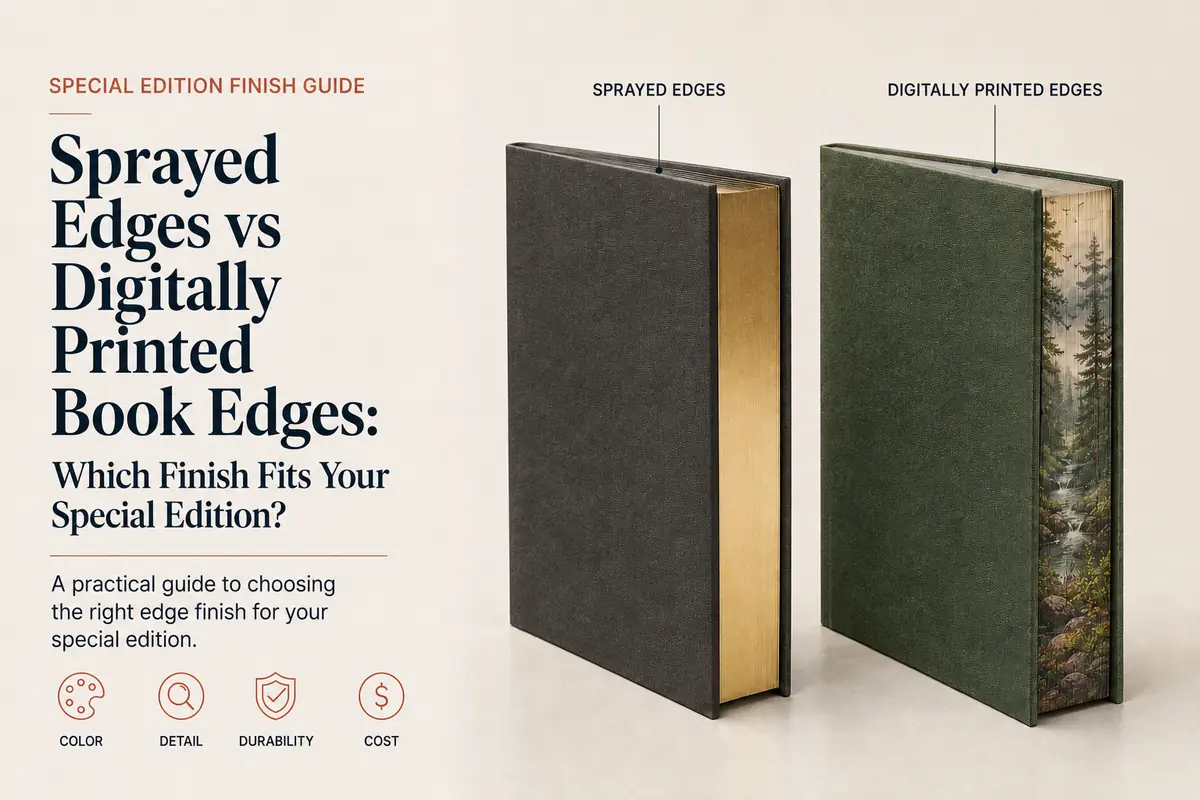
Decorated page edges have moved from niche collector editions into mainstream publishing. They are now visible across romance, fantasy, horror, literary fiction and children’s books. That growth has also created confusion: buyers use “sprayed edges,” “stenciled edges,” “printed edges” and “digital edges” as if they describe one process.
They do not.
A solid sprayed edge applies one field of color to the compressed book block. A stenciled edge uses one or more shapes or masks to create a repeated motif. A digitally printed edge places CMYK artwork, gradients or an image directly onto one or more trimmed edges. Some production systems spray ink through digital printheads, so a supplier may call full-color edge printing “digital spraying.” The visual requirement and approved sample are therefore more reliable than the name alone.
The correct choice depends on what the edge must do. Solid color can unify a series at relatively low visual complexity. A printed image can extend the narrative and make a collector edition immediately recognizable, but it demands more from the artwork, paper, trimming, registration and inspection.
Table of Contents
Sprayed Edges vs Printed Edges: Quick Comparison
| Edge treatment | Visual capability | Best suited to | Main production risk |
|---|---|---|---|
| Solid sprayed edge | One color or a simple tonal field | Series color coding, brand matching and restrained special editions | Uneven density, seepage, page blocking and color variation |
| Gradient sprayed edge | Controlled transition between colors | Romance, fantasy and design-led editions | Banding, inconsistent transition and orientation errors |
| Stenciled edge | One- or two-color motifs and repeated shapes | Symbols, florals, silhouettes and lower-detail patterns | Soft edges, stencil movement and inconsistent coverage |
| Digitally printed edge | CMYK illustration, pattern, texture or image | Collector editions, narrative designs and retailer exclusives | Registration movement, muted color, lost detail and artwork orientation |
| Gilded or metallic edge | Reflective metallic surface | Bibles, gift books, fine editions and ceremonial publications | Cracking, surface marks, adhesion and higher process complexity |
For a first decorated-edge project, solid color is usually the most controllable starting point. Choose digital edge printing when the artwork creates enough customer value to justify tighter file preparation, proofing and inspection.
What Each Book-Edge Term Should Mean in a Production Brief
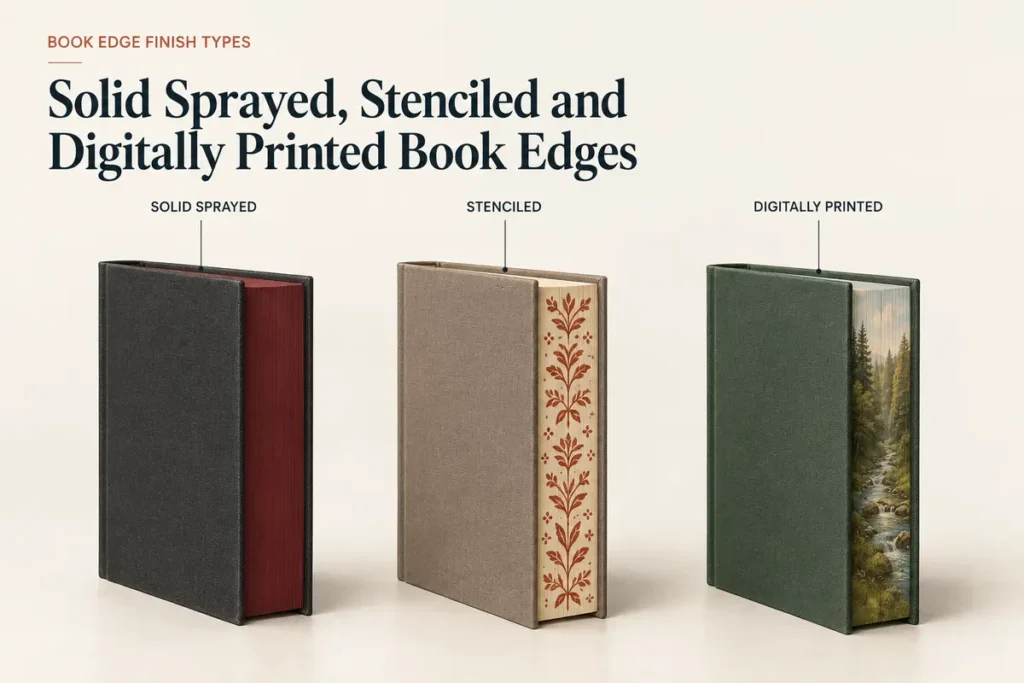
Solid sprayed edges
The trimmed book block is compressed or clamped and color is applied to the exposed head, foot or fore edge. The desired result is a visually even field rather than a recognizable image.
Solid edges work well when the objective is to:
- Match or contrast with the cover
- Identify one volume within a series
- Differentiate a first printing or retailer exclusive
- Add color without introducing another detailed artwork file
- Create a cleaner shelf profile for a special edition
The supplier still needs a color reference, paper specification, coverage requirement and physical approval standard. A Pantone number may communicate intent, but the final edge is not the same substrate or printing condition as a Pantone guide.
Stenciled edges
Stenciling uses a mask or controlled pattern to place one or more colors on the compressed page block. It sits between solid spraying and full digital printing in visual complexity.
Good stencil artwork uses bold forms that remain legible despite page texture and small registration shifts. Fine outlines, tiny stars and narrow reversed gaps may break up or fill in. Stenciling can be particularly effective when a repeated motif is more important than photographic detail.
Digitally printed book edges
Digital edge printing uses a production file for each decorated edge. It can reproduce gradients, landscapes, florals, symbols, typography-like forms and other CMYK artwork. The book block is the print surface, but it is not a smooth sheet: it is hundreds of trimmed page edges held together under pressure.
That distinction explains why screen artwork can look sharper and brighter than the physical result. Paper fibers, compression, trimming variation, page movement and ink absorption all influence the image.
Fore-edge painting is not the same process
Traditional fore-edge painting may be applied while pages are fanned so the image is revealed when the book is flexed. Modern commercial edge printing is typically visible while the book is closed. Do not use a historical fore-edge painting reference without explaining which viewing state is required.
The safest purchase-order language combines method and appearance, for example:
Three-edge CMYK digital edge print, visible when the book is closed, using approved head, foot and fore-edge PDFs and a signed production sample.
Why Decorated Edges Became a Publishing Decision, Not Just a Finish
Decorated edges are now part of format and merchandising strategy. In 2025, The Washington Post reported that Lakeside Book Company was producing millions of edge-decorated books annually and had quadrupled capacity after installing additional equipment. The same report cited Bloom Books’ powder-blue-edged Off-Campus collector set as an unusual bestseller for a bundled edition.
The market has continued to broaden. In August 2026, Publishers Weekly reported that patterned and sprayed edges were moving into middle-grade mysteries, fantasy and ghost stories. Some designs were being used as narrative devices: motifs on the edge referenced characters or clues inside the book. Scholastic also repeated the treatment on a second title after an earlier decorated-edge middle-grade release stood out on shelves and entered a bestseller list.
These cases suggest three commercially useful roles:
- Edition differentiation: the edge makes a hardcover visibly different from a standard release.
- Merchandising: the book attracts attention in stacks, face-out displays and social content.
- Narrative extension: the image or motif contributes to the story rather than decorating it at random.
The risk is equally clear. As more editions adopt decorated edges, the treatment alone no longer guarantees distinction. The Washington Post also documented reader complaints about chipping and odor, while publishers emphasized the difficulty of holding a viable consumer price.
The right question is not “Are sprayed edges trending?” It is:
Does this edge create a reason to choose this edition, and can the production specification deliver it consistently?
Eight Factors That Should Decide the Edge Process
1. What job must the edge perform?
Use a solid sprayed edge when color itself carries the idea. Use a stencil for bold motifs. Use digital edge printing when the edge must show a scene, layered pattern or recognizable narrative image.
Do not pay for image capability if the art is effectively one flat color. Conversely, do not force a detailed illustration into a stencil simply to reduce setup cost. The process should follow the minimum visual information the customer needs to perceive.
2. How close will customers inspect it?
A book edge is viewed at several distances:
- Across a bookstore table
- On a shelf beside other volumes
- In an online product photograph
- In a collector’s close-up video
- In the reader’s hand while the pages flex
Solid color can be powerful from a distance. Digital artwork earns its value in close views, but close views also reveal registration movement, grain, uneven trim and small white gaps. Design for the actual retail behavior, not only a flat mockup.
3. Does the genre support a premium edition?
Decorated edges are established in romance, fantasy and collector fiction, but the 2026 middle-grade examples show that genre boundaries are widening. They can also work for art books, commemorative titles, luxury brand books and museum publications when the edge connects to the subject.
For fiction programs, PrintPack360’s novel printing category is a useful starting point for trim size, binding and edition planning. For younger audiences, coordinate edge treatment with the safety, durability and handling requirements of children’s book printing.
4. How much visual variation is acceptable?
The edge is a fibrous, segmented surface. Some softness, paper texture and small positional movement should be expected. A digital edge is not a coated poster wrapped around the book block.
Avoid placing these elements near critical boundaries:
- Small readable text
- Thin borders that must remain centered
- Faces or eyes requiring exact alignment
- Fine horizontal lines crossing many pages
- Tiny symbols that become illegible with movement
- A three-edge image that must join perfectly at every corner
The digitally printed edge guidelines from Clays state that 1 mm of movement may occur and recommend keeping non-bleeding designs 1.5 mm from trim. Treat supplier tolerances as design inputs, not defects discovered after production.
5. Must the edge match the cover exactly?
Exact cross-material matching is difficult. The cover may be printed on coated paper, laminated, foil stamped or wrapped in cloth. The edge is printed across compressed page fibers.
Friesens notes that edge color is more similar to process printing on uncoated paper, can appear muted relative to coated stock and may not match a cover contract proof exactly. Use the cover color as a relationship, not an unconditional numerical promise.
A practical approval hierarchy is:
- Physical edge sample on the actual or representative paper
- Agreed acceptable color range under defined lighting
- CMYK values and physical cover reference
- Pantone or screen reference as design intent only
6. Will the interior bleed to the page edge?
Dark interior bleeds can interact visually with a light edge color. Inserts, coated plates, tabs or foldouts may absorb or reflect ink differently from the main text stock. Small variations in page size can create lines through the edge image.
Map every nonstandard component before approving the artwork:
- Full-bleed interior pages
- Color plate sections
- Gatefolds and foldouts
- Tabs or index cuts
- Different paper stocks
- Tip-ins or inserts
- Rounded corners
- Rough or deckled fore edges
If these features are essential, include them in the physical sample. Do not test a uniform dummy block and assume a mixed-stock production book will behave the same way.
7. Is one edge enough?
Fore-edge-only decoration can deliver most of the shelf and photography value while reducing artwork and registration complexity. Three-edge decoration creates a more complete object but requires orientation control and separate treatment of head, foot and fore edge.
Choose based on how the book will be displayed. A standing book often reveals the fore edge. A stacked book reveals the head or foot. A subscription unboxing may show all three.
8. Does the retail price support the risk?
Edge treatment adds prepress, machine setup, handling, drying or curing, inspection, spoilage and packing considerations. Digital imagery also adds design and proofing time.
Create an edition ladder rather than applying the most complex edge to every copy:
| Edition | Edge strategy | Commercial role |
|---|---|---|
| Standard | Plain trimmed edge | Price-accessible reading edition |
| Retail special | One solid sprayed edge | Visible upgrade with controlled complexity |
| Collector | Stenciled or digital fore edge | Exclusive visual identity |
| Numbered deluxe | Three-edge print plus upgraded case or slipcase | High-value direct or limited edition |
Paper, Book Thickness and Binding Change the Result
Paper color
White, cream and natural papers change the perceived edge color. A pale yellow paper warms blues and neutrals; a bright white stock may make the same file appear cleaner. The unprinted page surface also becomes visible when the book is opened, so the relationship should be intentional.
Coated versus uncoated paper
Many novels use uncoated woodfree paper. Its absorbency can produce a softer, more matte edge image. Coated inserts can create denser lines or respond differently during edge treatment. An image-heavy art book printing project should be tested on its actual mixed or coated stock rather than a standard novel dummy.
Paper caliper and page count
The artwork dimensions depend on the real book-block width, not the cover spine width. A paper substitution or page-count change alters the canvas. Even the same nominal paper can vary slightly in caliper with manufacture and conditioning.
Lock these before final edge files:
- Final page count
- Text paper and bulk/PPI
- Insert stocks and positions
- Binding method
- Trim size
- Book-block width
- Head, foot and fore-edge orientation
Sewn versus adhesive binding
Both sewn and adhesive-bound books may receive decorated edges, depending on the manufacturer’s process. The production sequence can differ. Friesens explains that sewn hardcover blocks may leave the casing line after trimming for edge treatment and then return for casing-in, while other structures may be treated at another stage.
That sequence matters because poor handling can mark the block, disturb the edge or add schedule pressure. Discuss edge finishing with the binder before finalizing the book rather than sending already-bound books to an unrelated finishing vendor without a test.
Rounded or ragged edges
Rounded corners reduce the usable image area and can distort details near the curve. Ragged fore edges create an intentionally uneven surface that may accept color but reduce image precision. Both require technical review and a sample.
PrintPack360’s hardcover book with sprayed edges and embossed spine provides the closest product route for coordinating paper, binding, edge color, cover finishing, proofing and export packing in one specification.
How to Prepare Artwork for Digitally Printed Book Edges
Always use the printer’s current template. Equipment and workflow requirements differ, so dimensions copied from another supplier’s guide may be wrong for your job.
Core file requirements
- Confirm final trim size and book-block width before artwork is built.
- Supply CMYK artwork unless the printer specifies another color workflow.
- Use 300 dpi images at final size for raster artwork.
- Embed fonts or convert them appropriately, although small edge text is best avoided.
- Add the printer’s required bleed on every side.
- Supply a separate PDF for each printed edge when requested.
- Clearly label
HEAD,FOOTandFORE EDGE. - Include a positional guide showing the front-cover direction and how the three files relate.
- Keep non-bleeding critical artwork inside the supplier’s movement allowance.
- Retain an approved composite preview, but do not use it instead of production files.
Friesens’ edge design template uses 0.125 inch bleed and defines file dimensions from trim size and book-block width. Clays requests 3 mm bleed, four-color PDFs and separate files for each edge. The similarity is useful, but the small differences are exactly why the selected manufacturer’s template must control the job.
Design for the edge, not for a flat rectangle
Strong edge artwork usually has:
- Broad shapes and controlled contrast
- A clear focal idea rather than dense detail everywhere
- Texture that tolerates small breaks and page movement
- Safe visual space around critical motifs
- Orientation that remains obvious after the book is turned
- A relationship to the cover without copying it mechanically
A three-edge composition should work both as separate surfaces and as one object. Avoid requiring corner joins to behave like a perfectly folded carton. Trimming and edge geometry make exact image continuation unreliable.
Prepare solid-color instructions properly
For a solid sprayed edge, provide:
- Target visual color
- CMYK or supplier-requested values
- Pantone or physical reference for communication
- Actual cover or material sample where coordination matters
- Which edges receive color
- Whether minor variation or exposed paper fibers are acceptable
- Approved physical edge sample
Do not specify only “dark green like the cover.” Cover lighting, lamination and cloth texture will change the comparison.
Proofing and Quality Control for Decorated Book Edges

Edge approval should separate color, position, book construction and bulk consistency.
1. Digital position proof
Check file dimensions, orientation, edge order, bleed and relationship to the front cover. This catches a reversed fore edge or upside-down foot before physical production. It does not approve color or edge texture.
2. Paper and color test
Print or spray on the intended stock where possible. If a standard dummy stock is used, approve only what that sample can prove. Clays explicitly notes that its standard dummy blocks may be used for color but not for exact artwork fit when the production paper and thickness differ.
3. Production-representative bound sample
Use the final or equivalent:
- Trim size
- Paper and page count
- Book-block thickness
- Binding
- Inserts
- Edge artwork
- Cover and packing method
Open and close the book repeatedly. Fan the pages. Rub the edge lightly with clean white material. Check page separation and inspect whether color has migrated onto page faces.
4. First-off check
Approve early production copies after the machine is set for the bulk run. Confirm direction, color, image position, corner behavior and relationship to the cover.
5. Batch inspection
Use observable criteria rather than “edges must be perfect”:
- Correct artwork and orientation on every specified edge
- No unacceptable ink migration into page margins
- Pages separate normally without blocking or tearing
- No wet ink, objectionable residue or transfer to adjacent books
- Image position remains within the agreed tolerance
- Solid color density is reasonably consistent with the signed sample
- No major white bands caused by incorrect trimming or clamping
- Inserts and mixed stocks do not create unapproved visual stripes
- Edge treatment does not contaminate the case, endpapers or page faces
- Packing prevents edge-to-edge abrasion and corner damage
Define acceptable variation before the run
Small differences can occur because paper is not an engineered plastic block. The approval sample and written tolerance should distinguish normal texture from functional failure.
Usually unacceptable:
- Upside-down or reversed artwork
- Missing treatment on a specified edge
- Pages stuck strongly enough to tear when opened
- Ink visibly invading text or illustration areas
- Severe chipping before normal use
- Large unprinted bands or major image displacement
- Color transfer onto covers, jackets or page faces
Potentially acceptable within an agreed range:
- Visible paper texture
- Slight softening of fine detail
- Minor density variation
- Small registration movement
- Slightly muted color versus a coated cover proof
Use PrintPack360’s sample strategy to decide whether your project needs a color test, dummy, finished sample or retained production reference.
What Drives Cost, Lead Time and Shipping Risk?
Main cost variables
- One edge versus three edges
- Solid, gradient, stencil or full-color image
- Book-block dimensions and thickness
- Binding and production sequence
- Quantity and machine setup
- Ink coverage and number of passes
- Special handling for inserts, tabs or rounded corners
- Physical proofing and sample blocks
- Inspection level and allowed variation
- Spoilage and replacement allowance
- Individual wrapping and carton design
Do not compare suppliers using “sprayed edge included” as if every offer were identical. Ask each quotation to state the visible effect, number of edges, color process, proof type and inspection basis.
The hardcover book printing cost guide explains how setup costs interact with quantity, materials, finishing and freight. For edge treatments, request a base hardcover price and separate increments for solid, stencil and digital options.
Schedule impact
Decorated edges add a finishing stage and may require drying, curing, fanning, extra handling or return to the binding line. Capacity also matters during peak special-edition seasons. Build time for file review, physical proofing and correction before the confirmed ship date.
Do not approve a finish sample before the book specifications are stable. A late paper or page-count change can invalidate both the artwork size and color expectation.
Shipping and fulfillment

Chipping and rubbing may occur after an acceptable production run if books move inside cartons. Dark edges make loose paper fibers and abrasion more visible. A slipcase can improve presentation but may also rub a decorated edge if clearance and insertion direction are wrong.
Protect the finished books with:
- Fully dried and conditioned edge treatment
- Suitable individual wrapping or interleaving
- Cartons sized to limit movement without crushing
- Dividers where surfaces can rub
- Controlled carton weight
- Moisture protection appropriate to the route
- Corner protection and palletization where required
- A parcel-fulfillment test for direct-to-consumer programs
Coordinate premium finishing with the full hardcover book finishing plan so foil, lamination, edges and packing are approved as one system.
Information to Send for an Accurate Quote
- Book genre, target customer and sales channel
- Standard, special, collector or numbered edition tier
- Finished trim size, page count and quantity breaks
- Paper name, GSM, color, bulk/PPI and coating
- Insert, plate, tab or foldout details
- Binding method and hardcover structure
- Final book-block width if already confirmed
- Edge type: solid, gradient, stencil, digital image or metallic
- Edges required: fore edge only, head and foot, or all three
- Target color or edge artwork
- Cover reference and desired visual relationship
- Proofing requirement
- Acceptable movement and variation expectations
- Cover finishes, endpapers, ribbon, jacket or slipcase
- Packing and fulfillment route
- Delivery city, country, postal code and deadline
- Required material or compliance documentation
When comparing alternatives, request three controlled versions:
| Version | Specification | What it reveals |
|---|---|---|
| A | Standard hardcover, plain edge | Base manufacturing and freight cost |
| B | Same book, solid fore edge | Cost of visible color differentiation |
| C | Same book, full digital edge artwork | Cost of narrative artwork, proofing and additional risk control |
Practical Recommendation
Choose solid sprayed edges when you need strong color, series coding and reliable shelf impact without asking the edge to reproduce detailed artwork. Choose stenciled edges when a bold motif carries the idea. Choose digitally printed edges when the edge is part of the narrative, collector value or exclusive-edition identity.
Whichever process you choose, lock paper and book-block dimensions before final files, simplify fragile detail, approve a physical sample and define acceptable variation in writing. The edge should raise perceived value without becoming the most common reason for customer complaints.
FAQ
What is the difference between sprayed and digitally printed book edges?
Solid sprayed edges create a field of color on the compressed book block. Digitally printed edges use CMYK artwork to reproduce gradients, patterns or images. Terminology varies by equipment, so specify the required visual result and approve a physical sample.
Are stenciled edges the same as printed edges?
No. Stenciling normally uses one or more masks to create bold motifs with applied color. Digital printing places artwork through a print file and can reproduce more complex tonal and image detail.
Can sprayed edges match a Pantone color exactly?
Pantone can communicate the target, but exact matching is difficult because the edge consists of exposed paper fibers rather than the Pantone guide substrate. Approve a physical sample and agreed color range.
Can all three edges of a hardcover book be printed?
Yes, when the book size, binding and equipment support it. Head, foot and fore edge usually require clearly labeled files and an orientation guide. Three-edge work adds handling and registration complexity.
Do digitally printed edges chip or rub off?
They can show abrasion if ink, drying, paper, handling or packing is unsuitable. Some normal wear may develop with use. Test the actual paper and inspect drying, page separation and transit protection before bulk shipment.
Will edge ink bleed inside the pages?
It should not intrude significantly into page content. Poor clamping, absorbent paper, excessive ink or unsuitable process settings can cause migration. A production-representative sample should be opened and checked before approval.
What paper works best for sprayed edges?
There is no single best paper. Uncoated novel paper often gives a matte, slightly softer result; coated or mixed stocks may behave differently. Color, absorbency, caliper, inserts and trim quality must be tested together.
Can small text be printed on a book edge?
It is technically possible in some workflows but usually risky. Page texture and positional movement reduce legibility. Use larger, bolder forms and keep critical details away from trim boundaries.
What files are needed for digital book-edge printing?
Requirements vary, but common needs include CMYK PDFs, 300 dpi images, bleed, correct book-block dimensions, separate files for each edge and a positional guide. Always use the selected printer’s current template.
Should every special edition have decorated edges?
No. The treatment should support the genre, audience, retail price and edition story. A stronger binding, better paper or better cover may create more customer value for some projects.