
The honest answer is that a hardcover book does not have a standard printing price.
A 6 x 9-inch black-and-white novel, an oversized photography book and a cloth-bound collector’s edition may all be described as hardcover books, but they are different manufacturing projects. Their paper consumption, press time, binding structure, handwork, proofing and shipping requirements are not comparable.
That is why a price such as “$8 per book” is almost meaningless without context. It may exclude a physical proof, foil tooling, protective packing, freight or import costs. It may apply to a different quantity, page count or paper. It may even describe an adhesive-bound book block when another supplier has quoted sewn sections.
To understand hardcover book printing cost, buyers need to compare the complete specification and the complete delivery scope. The lowest unit price is not always the lowest cost once samples, tooling, defects, freight and rework are included.
This guide explains the variables behind a professional custom hardcover book printing quotation and shows how publishers, authors, artists and brands can request prices that are genuinely comparable.Hardcover Cost GuideCost FormulaCost DriversDigital vs OffsetProject ComparisonsHidden CostsCompare QuotesQuote ChecklistFAQ
Table of Contents
The Cost Formula Buyers Should Use
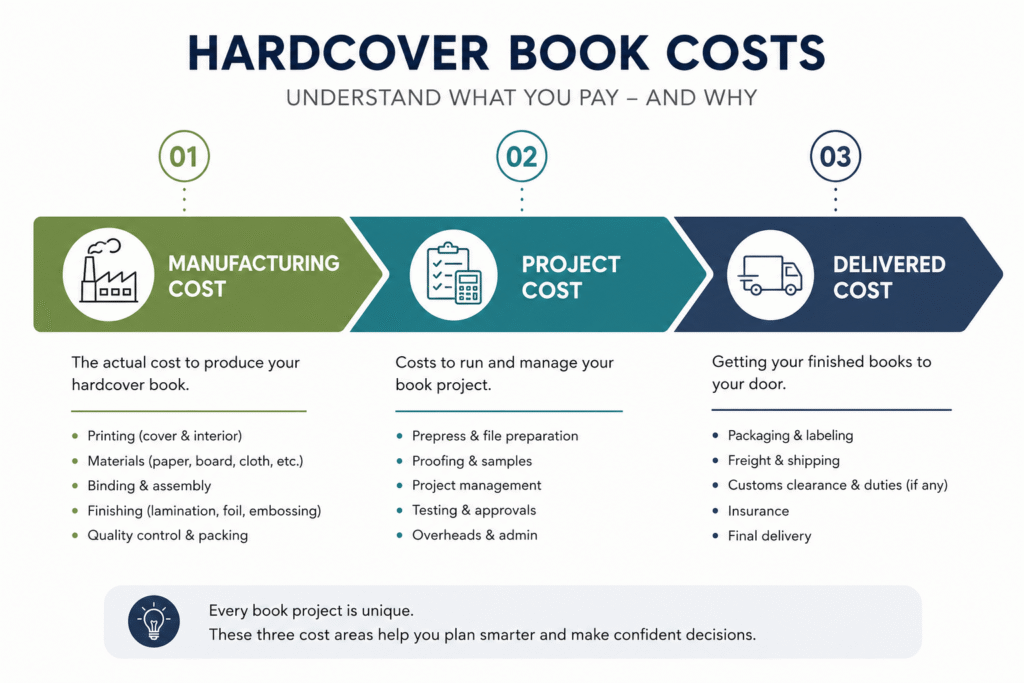
A useful hardcover book budget has three layers:
- Manufacturing cost: printing, paper, binding, cover materials and finishing.
- Project cost: file preparation, proofs, tooling, inspection and packing.
- Delivered cost: freight, insurance, destination charges, duties or taxes and final delivery.
The most useful number is often the landed cost per accepted copy:
Landed cost per accepted copy = total manufacturing, project and delivery cost divided by the number of usable books received
This is different from the printer’s factory unit price.
Suppose one quotation has a lower printing price but excludes the foil die, physical proof, reinforced cartons and destination delivery. A second quotation includes those items. Comparing only the first line of each quotation can lead to the wrong conclusion.
The Nine Main Hardcover Book Cost Drivers
1. Quantity
Quantity affects almost every part of the calculation.
Printing plates, press setup, binding setup, cutting dies, foil dies and production preparation are spread across the order. As quantity rises, these fixed costs are distributed over more copies. Paper purchasing, press efficiency and packing methods may also change at different volumes.
This does not mean a larger order is always the better business decision. Extra copies create inventory, storage and cash-flow costs. A publisher testing a new title may rationally accept a higher unit cost for a smaller initial run.
Ask for several quantity breaks using exactly the same specification, for example:
- 100 copies
- 300 copies
- 500 copies
- 1,000 copies
- 2,000 copies
The relevant question is not only “Which quantity has the lowest unit price?” It is “At what quantity does the total investment still match realistic demand?”
PrintPack360 supports hardcover projects from relatively small quantities on selected products. For premium launches and test runs, our guide to short-run book printing explains why inventory risk can matter more than the cheapest theoretical unit cost.
2. Finished size and page count
Book dimensions determine how efficiently pages fit on a press sheet. A small change in trim size can alter sheet utilization and paper waste. Two books with the same page count may therefore have different costs if one uses a production-efficient format and the other leaves significant unused sheet area.
Page count affects:
- Paper consumption
- Number of printed signatures
- Press and folding time
- Book block thickness
- Spine width
- Sewing or adhesive-binding work
- Carton weight and freight
For section-sewn books, page count must also work with the signature plan. A printer may need to combine full signatures with shorter sections or tipped pages. BindTech’s Smyth-sewn hardcover guidelines show how signature construction, paper grain, endpapers and book bulk affect manufacturing decisions.
Do not finalize a hardcover dieline or spine width from an estimated page count. Confirm the final interior paper and page extent first.
3. Black-and-white, CMYK or special-color printing
A text-only novel printed in black is fundamentally different from a full-color art book.
Black-and-white printing generally requires fewer color separations and less press control than four-color process printing. Full-color work adds plate or digital imaging requirements, color management, registration control and proofing.
Pantone or other spot colors can be useful for brand-sensitive pages, solid colors or special design effects, but they add a separate ink and production requirement. Metallic inks, fluorescent inks and other special systems require their own feasibility and proofing review.
Mixed-color books can sometimes be economical when color sections are grouped into planned signatures. Scattering a few color pages throughout a mostly black-and-white book may create a less efficient production plan.
4. Interior paper
Paper is often one of the largest components of a book quotation.
The right choice depends on content, opacity, image reproduction, reading comfort, thickness and shipping weight.
| Interior content | Common paper direction | Cost consideration |
|---|---|---|
| Text-heavy novel or memoir | Uncoated woodfree or offset paper | Efficient and readable; bulk and opacity must suit the page count |
| Illustrated children’s book | Coated or suitable uncoated paper | Color, durability and page stiffness become more important |
| Photography or art book | Matte, silk or gloss coated art paper | Higher GSM and tighter color expectations increase paper, proofing and freight cost |
| Premium literary edition | Natural, cream, book or specialty paper | Texture and bulk may matter more than maximum image sharpness |
| Sustainability-led project | FSC-certified or recycled options | Availability, certification scope, shade and print behavior should be confirmed |
A heavier paper does not automatically make a better book. It can create an overly thick spine, poor opening behavior and higher freight cost. A lighter sheet with appropriate opacity and bulk may produce a better result.
If an FSC claim is required, confirm the exact sourcing and documentation scope before artwork approval. The Forest Stewardship Council’s Chain of Custody guidance explains that certified material must be tracked through the relevant supply chain before an eligible finished product carries an FSC claim or label.
5. Book block binding
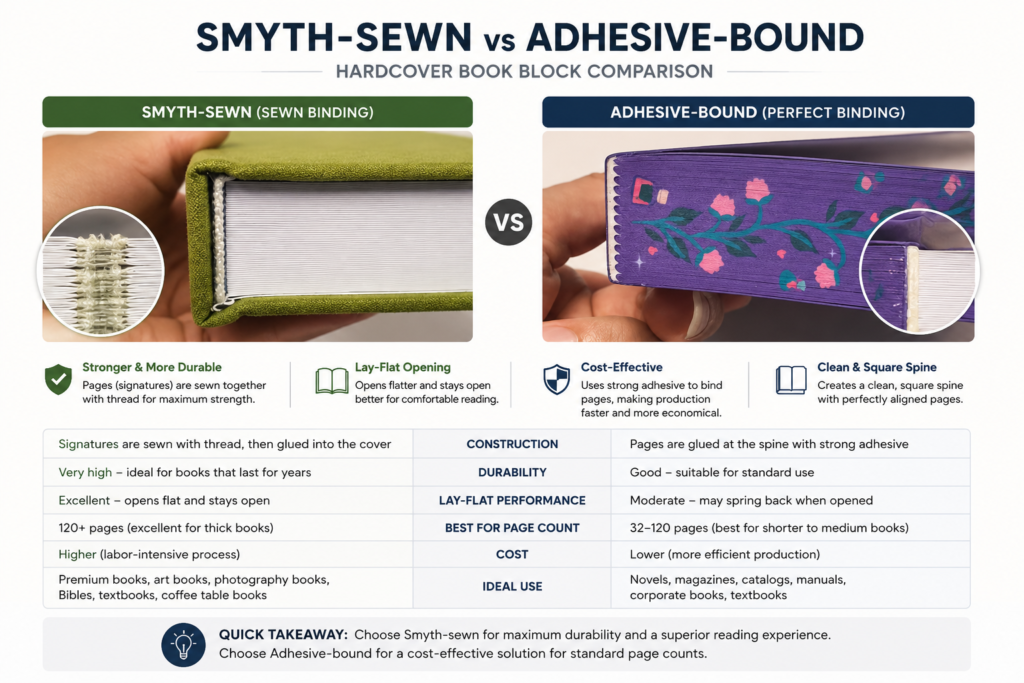
“Hardcover” describes the rigid case, not the complete internal binding method.
The book block may be:
- Adhesive bound and cased in
- Sewn in sections and cased in
- Sewn and additionally reinforced
- Produced with a specialized lay-flat structure
Smyth sewing adds folding, gathering and sewing operations, but it is often selected for premium books that need stronger page retention and more comfortable opening. Adhesive case binding may be appropriate for other page counts, papers, budgets and usage conditions.
The correct comparison is not “sewn is always good and glued is always bad.” It is whether the paper, page count, spine thickness, opening requirement, expected use and budget support the chosen structure.
For a tactile premium edition, PrintPack360’s cloth-bound Smyth-sewn hardcover books combine sewn sections with book cloth, foil or debossing, printed endpapers and optional belly bands.
6. Cover structure and materials
A standard printed paper-over-board case is usually more straightforward than a cover wrapped in imported cloth or specialty material.
Typical cover options include:
- Printed and laminated paper over greyboard
- Book cloth or linen
- Textured or dyed-through specialty paper
- PU or leather-look material
- Printed case plus dust jacket
- Quarter-bound or mixed-material case
The board thickness, joint width, spine shape, wrap material and case construction must work together. An oversized book may need a different board specification from a compact novel. Certain cover materials also require more handwork or special adhesives.
Cover material affects finishing. Fine foil may reproduce differently on coated paper, rough cloth and textured stock. Deep embossing may distort a thin material. Dark printed covers may need anti-scuff protection.
7. Premium finishing

Finishing is where a standard hardcover can become a special edition, but each process adds setup, tooling, material control or handwork.
Common options include:
- Gold, silver or colored foil stamping
- Embossing or debossing
- Spot UV
- Matte, gloss, soft-touch or anti-scratch lamination
- Printed or foil-stamped book cloth
- Ribbon markers and headbands
- Printed endpapers
- Dust jackets and belly bands
- Sprayed or gilded page edges
- Slipcases and rigid presentation boxes
Finishes should be priced as a coordinated specification. Foil, embossing and sprayed edges may all be technically possible, but using every available process can increase cost without improving the book.
For collector editions, custom hardcover books with sprayed edges can combine edge color, embossed spine details and foil stamping. If the project needs a fuller retail presentation, a custom book jacket and slipcase set adds protective rigid packaging and another group of material, tooling and fit requirements.
8. Proofing, samples and tooling
A PDF proof can confirm pagination, text, image placement and basic content. It cannot prove:
- Final paper shade and feel
- Book thickness
- Opening behavior
- Exact printed color
- Foil sharpness
- Embossing depth
- Sprayed edge appearance
- Slipcase fit
- Finished weight
Physical proofing adds cost because it may require dedicated output, hand binding, material sourcing or production tooling. For a simple novel, a digital proof and blank dummy may be sufficient. For an art book with demanding color or a collector edition with multiple finishes, a printed and bound sample can prevent much more expensive mistakes.
ISO 12647-7 specifies requirements for hard-copy digital proof systems intended to simulate a defined printing condition. The ISO overview of proofing processes helps explain why a controlled color proof is different from an office print or an uncalibrated screen.
Tooling may include:
- Foil die
- Embossing or debossing die
- Spot UV screen or plate
- Slipcase or packaging cutting die
- Special jigs or setup for edge decoration
Ask whether tooling is included, separately itemized or reusable for an exact repeat order.
9. Packing and international delivery
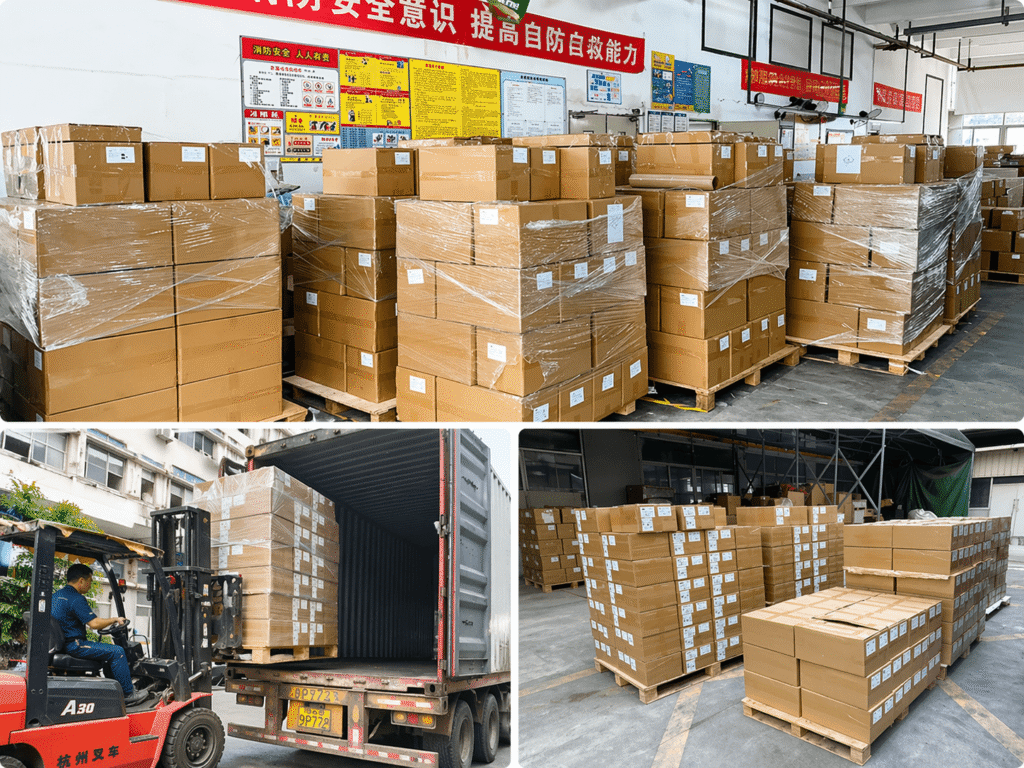
Hardcover books are dense. Freight can materially change the delivered cost, especially for oversized art books, heavy paper and rigid slipcases.
Packing also affects risk. Weak cartons or excessive carton weight can lead to damaged corners, split cartons and surface rubbing. Premium books may need individual wrapping, dividers, corner protection, moisture control, stronger export cartons or palletization.
Every international quotation should state:
- Shipping method
- Trade term
- Named place or port
- Whether export clearance is included
- Whether destination clearance, duties and taxes are included
- Whether delivery is port-to-port, airport-to-airport or door-to-door
- Estimated carton count, gross weight and volume
- Insurance scope
The International Chamber of Commerce explains that Incoterms rules clarify the tasks, costs and risks allocated between buyer and seller. EXW, FOB, CIF, DAP and DDP quotations cannot be compared as if they include the same delivery service.
Digital or Offset: Which Is Cheaper?
There is no universal crossover quantity.
Digital printing avoids some plate and press setup costs, which can make it useful for very small quantities, prototypes and fast market tests. Offset printing has higher setup requirements but can become more efficient as quantity rises. It also offers broad paper, format and finishing possibilities for commercial hardcover production.
The actual crossover depends on:
- Trim size
- Page count
- Color coverage
- Paper
- Quantity
- Binding
- Finishing
- Available equipment
- Quality expectations
Ask the supplier to quote the same specification at several quantities and recommend the production method. Do not assume that “digital” always means cheap or that “offset” always requires thousands of copies.
Three Project Types and Why Their Costs Differ
The following are illustrative specification profiles, not price quotations.
| Project | Example specification | Main cost drivers | Relative complexity |
|---|---|---|---|
| Text-led hardcover novel | 6 x 9 inches, black interior, uncoated paper, printed case, standard endpapers | Page count, quantity, binding and paper | Lower |
| Full-color photography book | Large landscape format, full CMYK, coated paper, sewn case binding, color proof | Paper, press sheets, color control, sewing, weight and freight | High |
| Collector’s edition set | Cloth cover, foil, printed endpapers, sprayed edges, ribbon and slipcase | Specialty materials, tooling, handwork, sampling, slipcase fit and packing | Very high |
The difference is not simply that one book “looks more premium.” Each additional requirement creates a manufacturing operation that must be set up, approved, produced and inspected.
The Hidden Costs Buyers Commonly Miss
Revisions after quotation
A quotation based on 160 pages is no longer valid if the final book has 224 pages. Changing the trim size, paper, cover material or quantity can also alter the production plan.
Incomplete files
Missing bleed, low-resolution images, unembedded fonts, incorrect spine width and improperly prepared foil layers cause delay and prepress work. PrintPack360’s article on why print-ready files still delay custom book quotations explains why a technically incomplete file prevents the supplier from confirming the real specification.
Color expectations without an agreed reference
“Match my screen” is not a measurable approval standard. A calibrated hard proof, approved production sample, Pantone reference or retained sample from a previous run provides a clearer target.
Packaging added too late
A slipcase, belly band, mailer or retail box changes dimensions, material requirements and freight. These components should be included in the initial brief.
Storage and unsold inventory
A lower unit cost can hide a higher total risk. Include warehouse charges, fulfillment fees and the possibility of unsold stock when choosing quantity.
Reprints caused by unclear approval
The most expensive book is the one that must be produced twice. Define what is being approved at each stage: content, color, structure, material, finishing and packing.
How to Compare Two Hardcover Book Quotations
Create a side-by-side comparison rather than reading each supplier’s quotation in isolation.
| Comparison item | Supplier A | Supplier B |
|---|---|---|
| Finished size and orientation | ||
| Page count | ||
| Interior printing | ||
| Interior paper and GSM | ||
| Endpapers | ||
| Book block binding | ||
| Cover board and wrap | ||
| Spine and case structure | ||
| Foil, embossing or other finishes | ||
| Digital proof | ||
| Blank dummy | ||
| Printed and bound sample | ||
| Tooling | ||
| Individual packing | ||
| Export cartons and pallet | ||
| Quantity and permitted variance | ||
| Production schedule | ||
| Shipping method and trade term | ||
| Freight and destination delivery | ||
| Total quoted cost |
If a line is blank, ask. Do not assume it is included.
What Information Produces an Accurate Quote?
Send the following in one brief:
- Book type and intended use
- Finished width and height
- Final page count
- Interior printing: black, CMYK or spot colors
- Interior paper type and GSM, if known
- Binding preference and opening requirement
- Cover material and board preference
- Endpaper printing
- Dust jacket, belly band or ribbon
- Foil, embossing, spot UV or sprayed edges
- Slipcase or presentation box
- Quantity and useful quantity breaks
- Proofing requirement
- Print-ready PDF status
- Delivery city, country and deadline
- Preferred shipping method or trade term
If paper and binding are undecided, provide the book’s content type, target retail price, expected use and reference samples. A professional supplier should be able to recommend practical alternatives rather than quote only the most expensive option.
How to Reduce Cost Without Making the Book Feel Cheap
Cost reduction works best when it removes low-value complexity.
Consider:
- Adjusting trim size for more efficient sheet use
- Selecting paper by opacity and bulk instead of GSM alone
- Using one strong finish rather than several competing effects
- Grouping color pages where the design allows it
- Replacing a large rigid box with a fitted slipcase
- Standardizing materials across a series
- Requesting quantity breaks before fixing the print run
- Completing content and prepress checks before sampling
- Designing export cartons around safe, manageable weight
Do not reduce cost by removing the proof that controls the project’s main risk. If color is commercially critical, keep the color proof. If the slipcase fit is critical, keep the structural sample. If the book will receive heavy use, evaluate the binding before downgrading it.
A Better Question Than “What Is Your Price Per Book?”
Ask:
“What specification gives this project the best balance of unit cost, quality, inventory risk and delivered cost?”
That question gives the printer room to identify an inefficient size, unnecessary finish, unsuitable paper or production quantity that may not be obvious from the artwork.
PrintPack360 coordinates prepress review, paper selection, offset printing, case binding, premium finishing, proofing, inspection and export packing for international hardcover projects. To request a comparable quotation, send the size, page count, quantity, paper direction, binding, finishing and delivery destination through the hardcover book printing service page.
Frequently Asked Questions
How much does it cost to print a hardcover book?
The price depends on quantity, finished size, page count, printing colors, paper, binding, cover material, finishing, proofing, packing and delivery scope. A unit price without these details cannot be compared reliably. Request several quantity breaks against one fixed specification.
What is the biggest factor in hardcover book printing cost?
There is no single factor for every project, but quantity, paper consumption, page count and book format usually have a major effect. For premium editions, sewing, specialty cover materials, foil, sprayed edges and slipcases can add significant setup and handwork.
Is Smyth-sewn binding more expensive than adhesive case binding?
Smyth sewing normally adds folding, gathering and sewing operations. Whether it is worth the additional cost depends on page count, paper, opening behavior, durability expectations and product position.
Is offset printing cheaper than digital printing?
Digital printing can be economical for very small runs because it avoids some setup costs. Offset printing can become more efficient as quantity increases. The crossover depends on the complete book specification, so compare both methods at realistic order quantities.
Why are hardcover book samples expensive?
A one-off sample may require material sourcing, dedicated printing, hand binding and separate finishing setup. Its cost is not simply the bulk unit price multiplied by one. The sample is intended to confirm risk before mass production.
Does a hardcover book quotation include shipping?
Only if the quotation says so. Check the shipping method, Incoterms rule, named destination, freight, insurance, customs clearance, duties, taxes and final delivery. EXW, FOB, CIF, DAP and DDP prices include different responsibilities.
Can changing the book size reduce cost?
Yes. A trim size that fits the available press sheet efficiently may reduce paper waste. However, the effect depends on page imposition, paper and equipment. Ask the printer to recommend nearby efficient sizes before finalizing the layout.
What files are needed for an accurate hardcover quotation?
At minimum, provide final size, page count, quantity, printing colors, paper direction, binding, cover structure, finishing and delivery destination. Print-ready PDFs help confirm page extent, color requirements and special-finish artwork, but a detailed specification can be quoted before final files are complete.